Tesla Concedes on Cybertruck Power System Defect, Extends Warranty to 8 Years and Pledges Full Reimbursements
Tesla has officially bowed to mounting consumer pressure and a wave of component failures, acknowledging a manufacturing defect in the Power Conversio...
Editorial Team
World Of EV
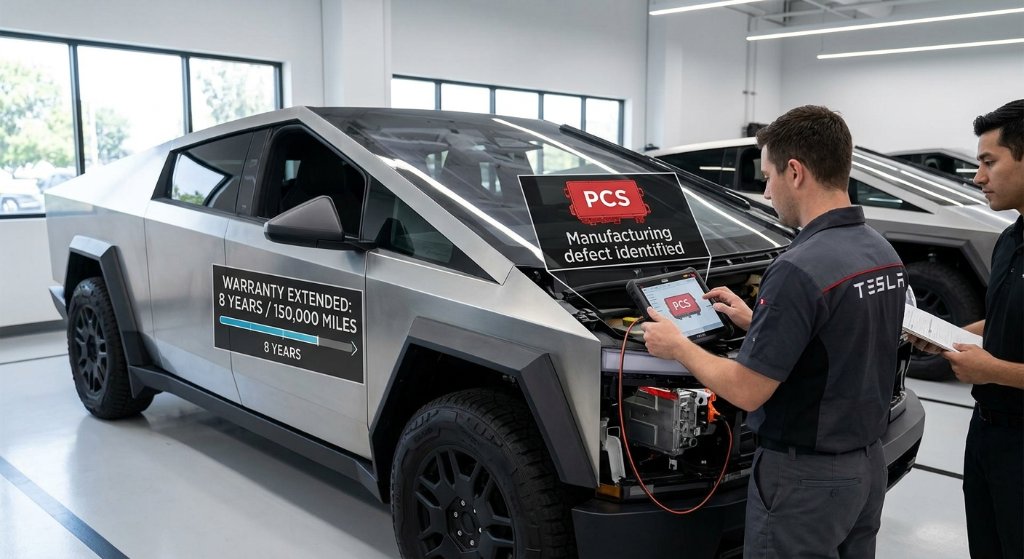
Tesla has officially bowed to mounting consumer pressure and a wave of component failures, acknowledging a manufacturing defect in the Power Conversion System (PCS) of pre-2026 Cybertrucks. For months, early adopters of Tesla’s highly anticipated electric pickup were left footing the bill—often reaching up to $7,200—to replace failed charging hardware that Tesla originally classified under its basic warranty. Now, in a major policy pivot, the automaker has extended PCS warranty coverage to 8 years or 150,000 miles and initiated a comprehensive reimbursement program.
This isn't Tesla's first rodeo with early-build hardware failures; veteran EV buyers will recall the drive-unit issues that plagued early Model S sedans, or more recently, the suspension failures dubbed "Whomp-it." However, when a vehicle marketed as an indestructible, apocalypse-proof machine struggles with the most basic function of EV ownership—charging at home—the brand's engineering reputation takes a direct hit. This warranty extension represents a significant course correction and a quiet admission that early Cybertruck buyers were, once again, acting as beta testers.
The Anatomy of the PCS Failure
At the heart of the issue is the Cybertruck's Power Conversion System (specifically the PCS2 unit in 2024 and 2025 models). This critical component is a combined module that acts as both the onboard charger (converting home AC power to battery-ready DC power) and the DC-DC converter. When this system fails, the consequences are immediate and severe:
- The Slow Death of Charging: The first warning sign is often a drop in Level 2 home charging speed, skyrocketing from 48 amps down to 24 amps before failing entirely.
- Dashboard Alerts: Affected owners are greeted by error messages like "AC Charging Unavailable" or the technical fault code
PCS2_a137_cycBmosfetHealthCheckFailed. - The Driveway Brick: Once the PCS completely dies, the truck is rendered incapable of home charging, leaving owners dependent on public fast-charging networks.
Tesla's Multi-Million Dollar Peace Offering
Tesla’s new directive fundamentally rewrites the rules for how early Cybertruck owners are treated. Rather than letting the defect slide past the standard 4-year/50,000-mile basic warranty, Tesla is aligning the PCS coverage with the vehicle's high-voltage battery and drive-unit warranty.
Here are the key takeaways of Tesla’s remediation plan:
- 8-Year / 150,000-Mile Warranty: Coverage for the PCS in 2024 and 2025 Cybertruck models (including the Foundation Series) is retroactively extended, matching the powertrain warranty.
- Retroactive Reimbursements: Owners who already paid up to $7,200 out-of-pocket for diagnostic fees and PCS replacements will receive full refunds in the coming weeks.
- Software-Enabled Supercharging: A new OTA software update ensures that a failed PCS no longer completely strands the vehicle. The truck can now bypass the failed AC charger to Supercharge (DC charging), and Tesla is temporarily covering Supercharging costs for affected owners while parts are on backorder.
- The 2026 Redesign: Newer 2026 models ship with a revised, redesigned PCS. Because of this hardware upgrade, 2026 models carry a standard 7-year/70,000-mile warranty on the part.
Why This Matters:
This warranty extension is a massive victory for early adopters, but it reveals a deeper, more systemic challenge for Tesla and the broader EV industry. By footing the bill for these repairs and reimbursing owners, Tesla is spending millions to contain a public relations nightmare. The move highlights the extreme difficulty of scaling radical, first-generation engineering. The Cybertruck's pioneering 48-volt architecture and ultra-compact power electronics were meant to showcase Tesla's engineering dominance, but instead, they have exposed a vulnerability to high-voltage component failure.
This situation closely mirrors Hyundai's recent struggles with its Integrated Charging Control Unit (ICCU) in its E-GMP platform vehicles (like the Ioniq 5 and Kia EV6). Both instances prove that consolidated power electronics are highly efficient but incredibly fragile. If one sub-component on the board fails, the entire multi-thousand-dollar module must be replaced.
For prospective buyers, this news is both a warning and a reassurance. It serves as a stark reminder of the financial risks of buying first-generation vehicles, but it also shows that Tesla will eventually stand behind its products when pushed. For the industry, it signals that as EV architectures become more integrated, legacy automakers and disruptors alike must place a higher premium on component-level durability testing before rushing products to market.
A Step Toward Rebuilding Trust
Tesla’s official acknowledgment of the PCS defect is a crucial step in repairing its relationship with its most loyal and high-spending customers. While early buyers should never have been forced to pay out-of-pocket for an obvious manufacturing defect, the retroactive reimbursement and extended 8-year warranty go a long way in making things right. As Tesla rolls out the redesigned hardware on 2026 models, the automaker must ensure its quality control matches its ambitious design language, proving that the Cybertruck is built for the long haul, not just the spotlight.