Tesla Confirms FSD Was Active in Fatal Left-Turn Crash: The Telemetry Leak That Demolishes the 'Full Self-Driving' Safety Narrative
In a major blow to Tesla’s narrative surrounding the safety of its controversial "Full Self-Driving" (FSD) system, a newly revealed investigation has ...
Editorial Team
World Of EV
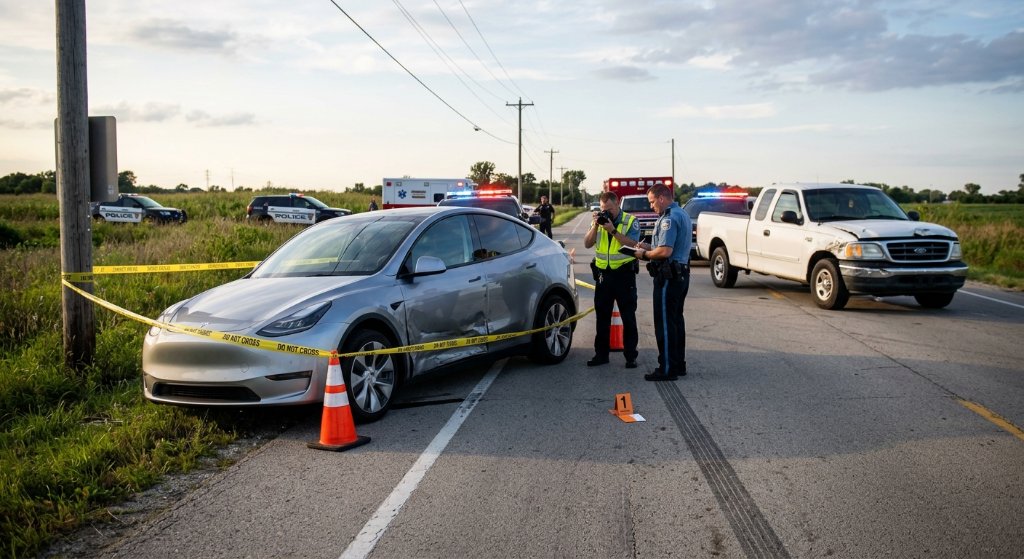
In a major blow to Tesla’s narrative surrounding the safety of its controversial "Full Self-Driving" (FSD) system, a newly revealed investigation has stripped away the automaker’s veil of corporate redaction. By cross-referencing local police records with Tesla's mandatory submissions to the National Highway Traffic Safety Administration (NHTSA), investigators have confirmed that FSD was "Verified Engaged" during a fatal March 25, 2026, collision in Batavia, Illinois. The crash took the life of 37-year-old front-seat passenger and mother of five, Maggie Espinosa, after a 2026 Tesla Model Y attempted an unprotected left turn—long known as one of FSD's most glaring software weaknesses—at 24 mph directly into the path of an oncoming pickup truck.
This revelation represents a critical inflection point for the EV giant. For years, Tesla has relied on heavily redacted NHTSA data dumps to shield itself from public scrutiny, hiding crash narratives, software versions, and system limitations behind the label of "confidential business information". However, this latest match of public police reports to Tesla’s telemetry data leaves no room for ambiguity: FSD initiated a high-risk maneuver that ended in tragedy, bringing the systemic dangers of camera-only Level 2 driver assistance under the harshest spotlight yet.
Inside the Batavia Left-Turn Disaster
According to Batavia police reports and Tesla's federal filings, the incident unfolded at the busy intersection of Randall Road and McKee Street. The Model Y, equipped with Tesla’s latest camera-reliant Vision system, attempted a southbound-to-eastbound left turn through oncoming traffic.
- The Collision: The Tesla initiated the unprotected turn at 24 mph, putting it directly in the path of a northbound Dodge pickup truck that had the right of way.
- The Impact: The truck struck the front-seat passenger side of the Model Y. Maggie Espinosa, a beloved local school teacher, sustained fatal injuries. Three other individuals, including the Tesla’s driver, were injured.
- Tesla's Telemetry: Tesla’s mandatory filing to the NHTSA under the Standing General Order—which requires automakers to report Level 2 crashes within 30 seconds of impact—specifically confirmed that FSD was "Verified Engaged".
Unprotected Left Turns: FSD's Achilles' Heel
The Batavia crash highlights an ongoing, systemic failure of Tesla's autonomous software: the unprotected left turn. While competitors like Waymo utilize costly but highly precise LiDAR sensors and geofenced mapping to safely navigate blind intersections, Tesla has famously doubled down on its pure-vision approach, relying solely on optical cameras and neural networks.
- Perception Gaps: Cameras often struggle with depth perception and speed estimation of oncoming traffic, particularly at complex intersections during high-traffic hours.
- Speed of Failure: Crossing a busy multi-lane road at 24 mph leaves virtually no margin for error or driver intervention when the system miscalculates.
- The Redaction Shelter: In its NHTSA report, Tesla heavily redacted the crash narrative, the specific FSD software version, and whether the road fell within its approved operating domain, demonstrating the automaker's intense efforts to control the public narrative surrounding its autonomous ambitions.
Why This Matters:
This is a watershed moment for the autonomous driving industry, signaling that the era of self-policing and narrative control for Level 2 systems is coming to a grinding halt.
- Who Loses? Tesla’s Autonomy Narrative: Elon Musk has consistently staked the future value of Tesla on FSD and the promise of an imminent "Robotaxi" network. But this verified FSD fatality destroys the narrative that its Level 2 system is already safer than a human driver. It exposes a chilling reality: FSD is piloting vehicles through high-risk urban maneuvers while keeping drivers in a false sense of security.
- Who Wins? LiDAR Proponents and Regulators: Waymo, Zoox, and traditional automakers like Mercedes-Benz—which is already deploying Level 3 systems in the US with strict liability acceptance—will point to this tragedy as proof that camera-only autonomy is fundamentally flawed. This also arms the NHTSA and State Attorneys with the smoking-gun evidence needed to force a recall or legally mandate driver-monitoring improvements.
- A Regulatory Reckoning: Tesla has long hid behind the legal defense that FSD is merely a "Level 2 driver-assist system" and that the human driver is ultimately responsible. However, as the Kane County State’s Attorney's Office reviews the Batavia crash data, the legal boundary of who is at fault when FSD initiates a fatal, 24 mph turn into oncoming traffic will be tested like never before.
Conclusion
The tragic loss of Maggie Espinosa is a stark reminder of the human cost of deploying "beta" autonomous software on public roads. As federal and state regulators look closer at the raw telemetry data Tesla has tried so hard to redact, the pressure on the automaker to fundamentally re-engineer or heavily restrict FSD will reach a boiling point. Tesla can no longer dismiss these incidents as isolated driver errors; the data has spoken, and the autonomous dream is facing its most severe reality check yet.