Tesla Cybercab Ready to Roll: Steering-Wheel-Free Robotaxi Slated for Austin Debut This Month
### The Austin Autonomous Shift Tesla is finally pushing its radically minimalist, purpose-built Cybercab onto public roads in Austin, Texas. Accordi...
Editorial Team
World Of EV
The Austin Autonomous Shift
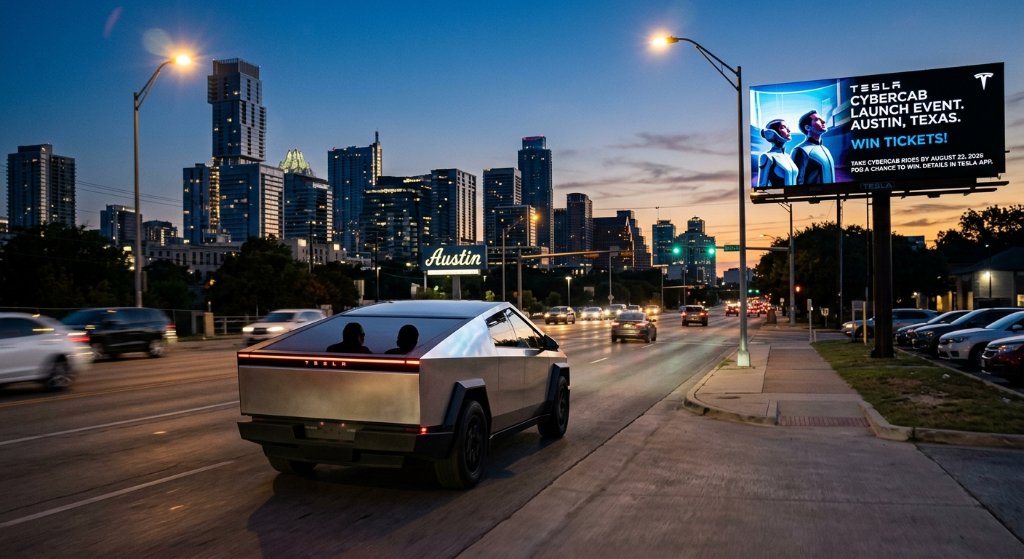
Tesla is finally pushing its radically minimalist, purpose-built Cybercab onto public roads in Austin, Texas. According to a newly launched in-app sweepstakes, current Tesla Robotaxi passengers—who currently ride in adapted Model Ys—can enter to win tickets to the upcoming Cybercab launch event by completing rides before August 23, 2026.
This move represents a watershed moment for the EV giant. Since CEO Elon Musk first unveiled the concept in October 2024, skeptics have debated whether a vehicle built entirely without a steering wheel or pedals could make the leap from the stage to the streets. While industry pioneers like Alphabet's Waymo have amassed hundreds of millions of commercial driverless miles, Tesla is taking a massive gamble by debuting its purpose-built autonomous hardware with a fraction of the unsupervised real-world testing.
Inside the Two-Phase Rollout Plan
To transition the Cybercab from pre-production testing into a revenue-generating commercial asset, Tesla is planning a rapid, highly controlled deployment in its home territory.
- Employee Tests First: Tesla plans to launch public-road testing using its own employees in Austin by late August 2026, allowing the company to gather initial baseline data under real-world conditions.
- Commercial Integration: Following the initial employee trial phase, the Cybercab will officially join the active, public-facing Tesla Robotaxi network in Austin, offering public rides.
- Local Preparation: The rollout is already physically underway; Tesla has completed specialized training with Austin first responders to instruct them on how to interact with and manually relocate the steering-wheel-free vehicles during emergencies.
A Radical Philosophy—And Its Hurdles
The Cybercab is unlike anything currently on public roads, rejecting legacy hardware in favor of total software reliance. Key characteristics of the new platform include:
- No Physical Backups: The vehicle is a two-seater with scissor doors, boasting no steering wheel, brake pedal, or throttle.
- Vision-Only Autonomy: Unlike Waymo or Zoox, which utilize expensive LiDAR arrays, the Cybercab relies solely on Tesla’s camera-based Full Self-Driving (FSD) system.
- Remote Operators: When the vision system encounters an unsolvable edge case, Tesla plans to use remote human monitors to guide the vehicle out of trouble.
- The Scale Dilemma: Tesla’s driverless pilot fleet has logged roughly 380,000 miles to date—a tiny fraction compared to Waymo’s established 220 million miles of commercial operation.
- Safety Under Scrutiny: The rapid rollout occurs on the heels of a public incident in Austin where an unsupervised Model Y robotaxi ran over a row of protective plastic bollards, raising questions about FSD's readiness for vehicles without manual controls.
Why This Matters:
This is a make-or-break pivot for Tesla. Over the last two years, Elon Musk has effectively bet Tesla's entire future valuation on autonomous ride-hailing and AI, deprioritizing the long-awaited, affordable mass-market passenger vehicle. If the Cybercab proves reliable, Tesla wins a monumental crown: the first to deploy a mass-produced, ultra-low-cost, purpose-built robotaxi that eliminates the massive overhead of human safety drivers. This would drastically undercut Waymo’s expensive hardware suite, securing Tesla's future as the undisputed leader in automated transit.
However, the downside risk is catastrophic. By launching a vehicle with absolutely no manual physical overrides, Tesla has eliminated the safety net. If a Cybercab suffers a major perception failure—similar to the recent bollard collision in Austin—and collides with a pedestrian or a concrete barrier, the regulatory backlash from the National Highway Traffic Safety Administration (NHTSA) will be swift. A forced shutdown of the driverless fleet could decimate Tesla's stock price, crash investor confidence, and stall the company's AI aspirations for a generation.
Looking to the Future
Tesla’s Austin sweepstakes is a clever marketing maneuver designed to stimulate order density and gather crucial fleet data ahead of the Cybercab’s official debut. But the real test begins when those scissor doors open to the public without a human in sight. Tesla is diving headfirst into the deep end of autonomous transport; whether it swims or sinks will define the next decade of the automotive industry.