Tesla Cybercab Specs Leaked: Why a 6.1-Mile-Per-kWh Fleet Weapon Changes Everything
Tesla’s long-promised autonomous future is finally transitioning from speculative PowerPoint slides into concrete engineering reality. Following recen...
Editorial Team
World Of EV
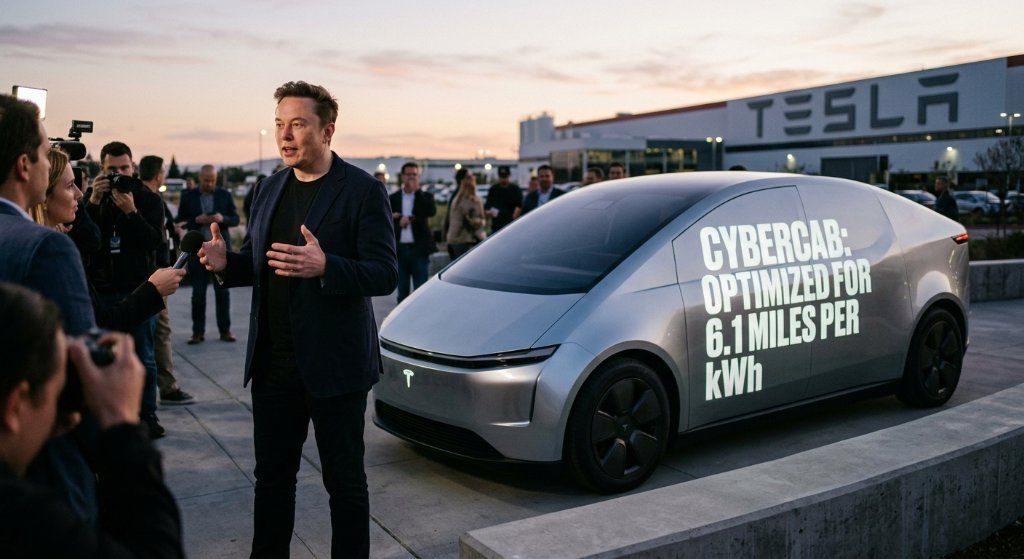
Tesla’s long-promised autonomous future is finally transitioning from speculative PowerPoint slides into concrete engineering reality. Following recent public rides in Austin, Texas, the automotive world has received its first concrete look at the underlying specifications of the two-seater Tesla Cybercab. What these numbers reveal is not just a driverless car, but a masterclass in ruthless, hyper-optimized fleet economics designed to upend the global transport landscape.
To put these figures in perspective, Tesla is pivoting hard from the high-margin, low-volume vanity projects of the past—such as the complex stainless-steel Cybertruck—back to its core strength: supreme electric efficiency. While legacy automakers scramble to build massive, heavy 100-kWh battery packs to solve range anxiety, Tesla’s Cybercab takes the opposite approach, squeezing maximum utility out of an incredibly lean hardware footprint.
A Masterclass in Raw Efficiency
The Cybercab’s leaked specifications confirm that CEO Elon Musk's focus on "cost-per-mile" optimization has dictated every single engineering decision. Rather than chasing raw performance or luxury-car swagger, the Cybercab is built to be a high-utilization utility asset.
The key specifications highlight this focus:
- Battery Pack: 47.6 kWh (exceptionally light, reducing overall vehicle mass and manufacturing cost)
- Unprecedented Efficiency: Over 6.1 miles per kWh
- Estimated Range: 293 miles on a single charge
- Powertrain: 219 horsepower, Front-Wheel Drive (FWD)
Achieving over 6.1 miles per kWh is a staggering feat of engineering. For context, industry benchmarks like the Lucid Air and the Hyundai Ioniq 6—which are widely praised for their aerodynamic efficiency—struggle to break 4.5 to 5.0 miles per kWh in real-world scenarios. By reaching over 6 miles per kWh, the Cybercab can achieve nearly 300 miles of range with a battery pack that is roughly half the size of a standard premium EV battery.
Ruthless Engineering for Maximum Margins
The choice of a 219-horsepower, front-wheel-drive (FWD) configuration is highly telling. While Tesla has historically favored rear-wheel or all-wheel-drive setups to emphasize performance, a FWD layout for the Cybercab is a deliberate cost-saving and packaging masterstroke. FWD powertrains are cheaper to manufacture, require fewer components, and allow for a flatter cabin floor to maximize passenger comfort in a compact two-seater footprint.
Furthermore, the small 47.6 kWh battery pack drastically reduces Tesla's exposure to battery raw material supply chains. It means Tesla can build twice as many Cybercabs with the same volume of lithium, nickel, and cobalt required for a single Model S or Cybertruck. This is not a vehicle designed to excite driving enthusiasts; it is a vehicle designed to print money for fleet operators.
Why This Matters:
The Cybercab’s specifications signal a paradigm shift in the electric vehicle industry. By delivering a 293-mile range from a tiny 47.6 kWh battery, Tesla has effectively cracked the code for affordable, scalable fleet electrification.
- Who Wins: Tesla and ride-hailing fleet operators. The operating costs of running a vehicle that gets 6.1 miles per kWh are virtually negligible. With standard electricity rates, running a Cybercab will cost fractions of a cent per mile, allowing operators to undercut traditional human-driven ride-hailing services by a massive margin.
- Who Loses: Legacy automakers and ride-hailing drivers. Companies like Uber and Lyft, which rely on human drivers owning and operating their own vehicles, will face existential pressure. Meanwhile, traditional automakers who are still struggling to build profitable EVs with massive, expensive battery packs will find themselves completely uncompetitive against Tesla's cost-per-mile economics.
- The Market Signal: The era of "range war by battery size" is officially over. The new battleground is efficiency. Tesla has proven that the key to mass EV adoption and profitable autonomy is not bigger batteries, but smarter, lighter, and more aerodynamically perfect engineering.
Ultimately, the Cybercab is the physical manifestation of Tesla's long-term master plan. By prioritizing extreme efficiency over brute-force battery capacity, Tesla is poised to dominate the next era of shared mobility. While the road to full regulatory approval for driverless vehicles remains complex, one thing is now undeniable: from a pure hardware and economic perspective, Tesla has built a machine that its rivals will struggle to match.