Tesla Deploys Legal Action and Rapid Hiring to Crush Rumors of a China FSD Retreat
Tesla is drawing a hard line in the sand to defend its self-driving ambitions in the world’s most competitive electric vehicle market. Following viral...
Editorial Team
World Of EV
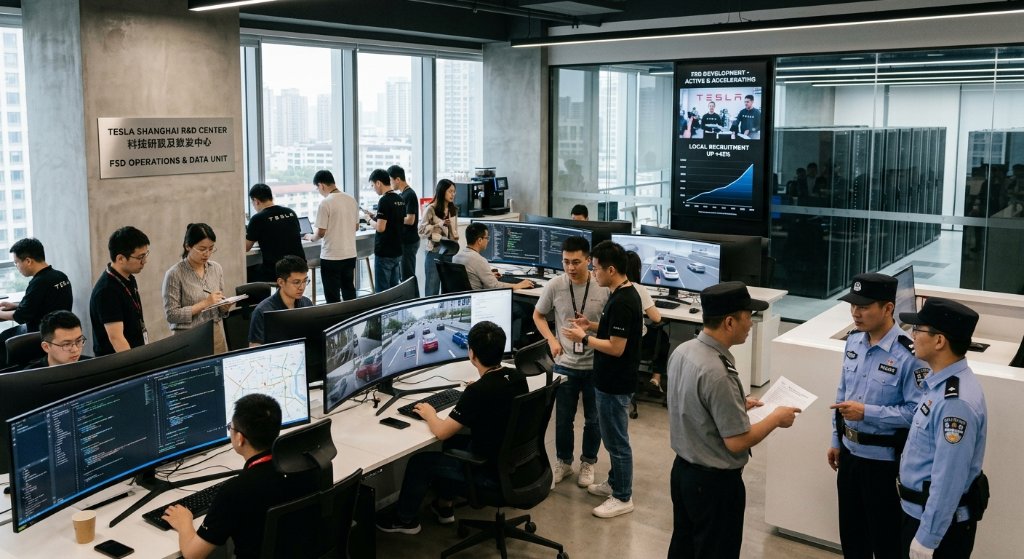
Tesla is drawing a hard line in the sand to defend its self-driving ambitions in the world’s most competitive electric vehicle market. Following viral online speculation claiming the American automaker had quietly vacated its Shanghai data center and abandoned plans to launch Full Self-Driving (FSD) in China, Tesla took the extraordinary and highly aggressive step of reporting the rumor-mongers to Chinese police. Far from packing its bags, Tesla insists its local operations are running normally and that it is actually accelerating recruitment for autonomous driving roles.
This dramatic confrontation underscores how high the stakes are for Tesla in China. After years of enjoying a dominant position, Elon Musk’s automaker faces an onslaught of local EV rivals who are already deploying highly capable, localized driver-assist systems. Stalling or retreating on FSD now would not just be a localized marketing setback; it would severely damage Tesla's competitive edge in its most critical global market outside the United States.
The Anatomy of a Rumor
The panic erupted when sharp-eyed observers noticed China was absent from a newly updated list of countries on Tesla’s North American website where "FSD Supervised" subscriptions are offered. This omission triggered a wave of viral posts on Chinese social media alleging that Tesla had completely shuttered its Shanghai data center, evacuated its FSD preparation teams, and quietly axed the project.
In reality, the website update simply reflects regional differences in how Tesla packages and sells the software:
- Subscription vs. One-Time Purchase: The updated online list strictly covers markets that have active, paid monthly subscriptions for FSD (such as the U.S., Canada, and South Korea).
- The Chinese Package: In mainland China, FSD is currently sold only as a one-time upfront purchase—rebranded locally as "Tesla Assisted Driving" (TAD)—priced at RMB 64,000 (roughly $9,500).
- Regulatory Limbo: While Tesla officially added China to its future FSD Supervised rollout map earlier this year, the company is still waiting on final approval from Beijing’s Ministry of Industry and Information Technology (MIIT) to deploy the software broadly to the public.
Why the Shanghai Data Center is Sacred Ground
To understand why Tesla reacted so aggressively, one has to look at the immense regulatory hurdles the automaker has spent years navigating. Beijing maintains incredibly strict, non-negotiable data-security laws that prohibit raw, high-resolution geographic and vehicle data collected in China from leaving the country.
To overcome this, Tesla established its dedicated Shanghai data center, followed by a localized AI training center. These facilities allow Tesla to:
- Store Locally, Train Locally: Keep all Chinese driving data strictly within sovereign borders to comply with national security laws.
- Train Neural Networks on Chaos: Adapt FSD’s vision-based AI to handle the chaotic, high-density traffic patterns unique to major Chinese metropolises like Guangzhou and Shanghai.
- Accelerate Hiring: Rather than scaling back, Tesla's current recruitment drive focuses on local AI scientists, data annotators, and autonomous driving test engineers to push the system past the regulatory finish line.
Why This Matters:
This is a high-stakes, do-or-die moment for Tesla. In China, autonomous driving is no longer a futuristic promise; it is an active sales battleground. Domestic champions like NIO, XPeng, Xiaomi, and Huawei-backed brands are already offering advanced, city-capable driver-assistance suites to their customers today.
Tesla's traditional playbook of relying on its hardware superiority is losing steam as EV market growth in China cools down. To maintain its premium status and justify its vehicle margins, Tesla desperately needs FSD to act as a primary software-driven demand generator. If Tesla fails to secure regulatory clearance or is perceived as scaling back, local competitors will happily devour its market share.
Furthermore, Tesla needs China's driving data to realize its global AI ambitions. Driving behaviors and street layouts in Chinese cities are highly complex. Training the FSD neural network on this localized data makes the global AI stack smarter, which is absolutely critical for Elon Musk's broader Robotaxi vision.
Conclusion
By bringing in local law enforcement to squash the exit rumors, Tesla has sent a clear message: it is fully committed to the Chinese market and will not let unverified speculation derail its momentum. However, the clock is ticking. With executive leadership previously hinting at a late-2026 target for broader regulatory approval, Tesla must convert its aggressive denials and hiring sprees into a fully approved, publicly available product. Until Chinese drivers can legally activate FSD on the streets of Shanghai, Tesla remains locked in a defensive posture against a highly aggressive local field.