Tesla Ditches Upfront FSD Sales: A Major Strategic Pivot Towards Subscription Dominance
Tesla is fundamentally recalibrating its Full Self-Driving (FSD) strategy, moving away from the long-standing model of outright purchase. Effective Fe...
Editorial Team
World Of EV
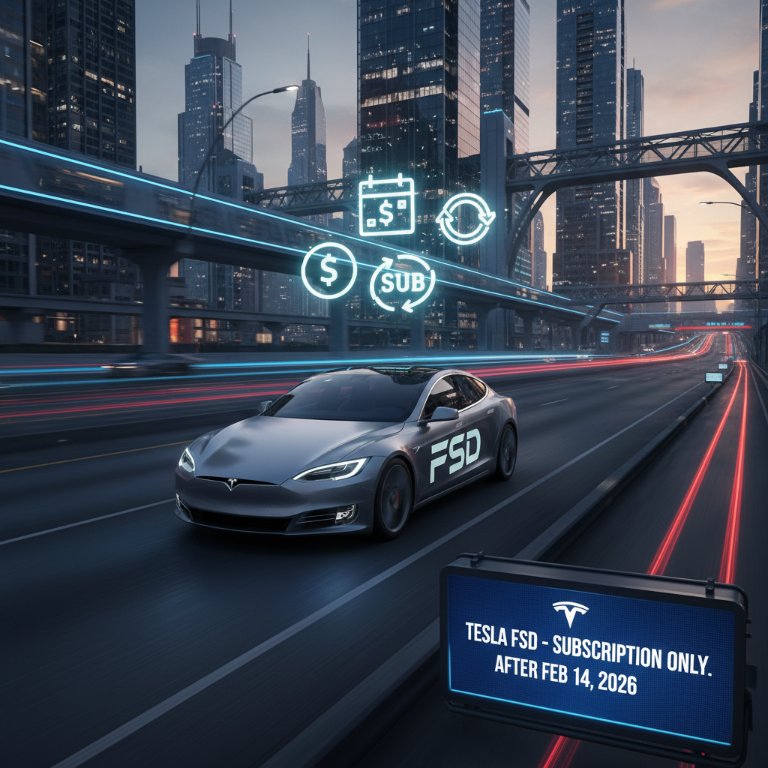
Tesla is fundamentally recalibrating its Full Self-Driving (FSD) strategy, moving away from the long-standing model of outright purchase. Effective February 14, 2026, the company will cease selling the FSD package as a one-time upfront payment, shifting instead to a subscription-only offering. This pivotal decision marks the definitive end of the 'appreciating asset' narrative that CEO Elon Musk famously championed for years.
For a decade, Tesla maintained that its vehicles, equipped with the necessary hardware, would eventually achieve full autonomy through software updates, rendering FSD an investment that would only grow in value. This philosophy underpinned FSD's substantial upfront cost, which historically ranged from an initial $5,000 to a peak of $15,000 in late 2022, before settling at $8,000 in April 2024. However, despite these bold claims, FSD has remained a Level 2 driver-assistance system, requiring active human supervision.
The End of Upfront Ownership
Starting mid-February, Tesla will transition FSD exclusively to a monthly subscription model. This eliminates the significant barrier to entry posed by the previous upfront cost, which currently stands at $8,000 in the U.S. The existing FSD subscription is priced at $99 per month in the U.S. This change streamlines how Tesla offers FSD, making it more accessible to a broader base of drivers who might be hesitant to commit to a large one-time payment for a system still under active development.
- Current Upfront Price (Until Feb 14, 2026): Approximately $8,000 USD
- Current Monthly Subscription Price: $99 USD (for Basic or Enhanced Autopilot upgrade)
- Effective Date for Subscription-Only: February 14, 2026
A Shift in Tesla's Software Strategy
This strategic pivot aligns Tesla more closely with the broader automotive industry's growing trend toward software-defined vehicles and recurring revenue streams. Many automakers are exploring subscription models for features ranging from heated seats to advanced driver-assistance systems. For Tesla, this move provides a more predictable and potentially scalable revenue stream, reducing reliance solely on vehicle sales.
Why This Matters:
- For Consumers: The 'appreciating asset' dream for FSD purchasers is unequivocally over. Those who paid upwards of $15,000 for FSD in the past now face the reality that their significant investment will not yield the promised long-term value appreciation. For new buyers, the lower monthly entry cost of $99 makes FSD more approachable, allowing them to experience the technology without a crippling upfront fee. However, long-term users will likely pay significantly more over the vehicle's lifespan compared to the previous upfront purchase, especially if they subscribe continuously for many years. This shifts the long-term financial risk from Tesla to the consumer.
- For Tesla: This move is a clear play for recurring revenue. In an automotive market transitioning to EVs with tighter margins, software subscriptions offer a lucrative, stable income stream. It also addresses the challenge of low FSD adoption rates; in October 2025, only 12% of Tesla customers had purchased FSD. A subscription model could significantly boost this 'take rate' by lowering the initial commitment. Critically, this change also ties into Elon Musk's ambitious 2025 CEO Performance Award, which includes a target of 10 million active FSD subscriptions. This metric is far more attainable through a widely adopted subscription service than through sporadic, high-cost upfront sales.
- For the Industry: Tesla's pivot further validates the subscription-based model for advanced automotive features. Other automakers, already exploring similar revenue streams (e.g., BMW with heated seats), will closely watch the success and consumer reception of this change. This could accelerate the trend towards a 'software-as-a-service' approach across the entire automotive landscape, fundamentally reshaping how consumers interact with their vehicles' capabilities.
Conclusion
Tesla's decision to make Full Self-Driving a subscription-only offering is a pragmatic, yet impactful, shift. It prioritizes recurring revenue and broader accessibility over a largely unfulfilled promise of asset appreciation. While it may sting early adopters who invested heavily, it signals Tesla's renewed focus on software monetization and sets a potential precedent for how advanced driver-assistance systems will be consumed across the entire EV industry in the years to come.