Tesla Fires Statistical Broadside at EU Regulators: Open-Sources FSD Safety Data to Force Continental Approval
In a high-stakes gamble to shatter Europe's notoriously rigid regulatory walls, Tesla has fired a statistical broadside directly at Brussels. Ahead of...
Editorial Team
World Of EV
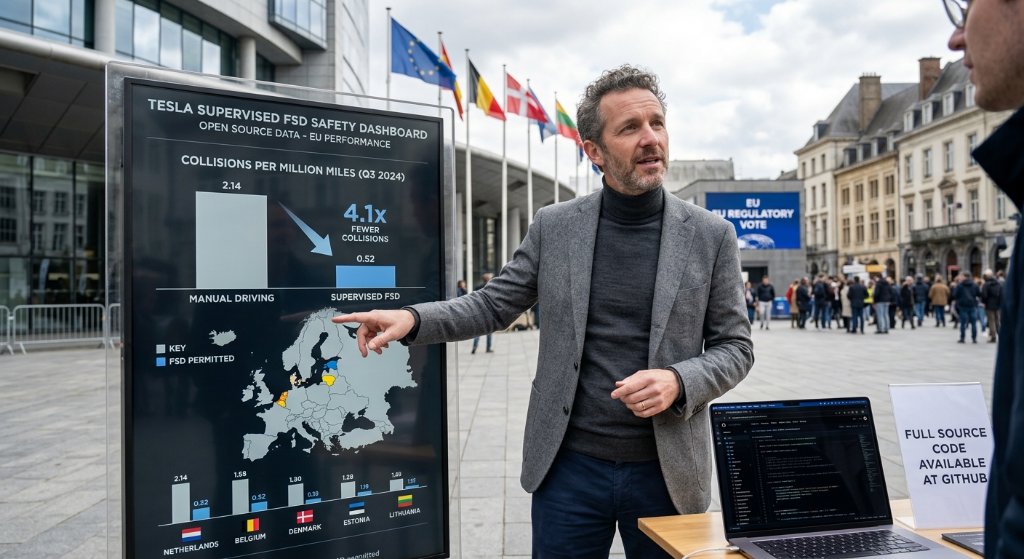
In a high-stakes gamble to shatter Europe's notoriously rigid regulatory walls, Tesla has fired a statistical broadside directly at Brussels. Ahead of a critical European Union vote next month, the American EV pioneer has open-sourced its previously confidential "Article 39 FSD Safety Evidence Dashboard". It is a calculated, hyper-aggressive lobbying move designed to force regulators to unlock its Full Self-Driving (Supervised) technology across the entire 27-member bloc.
This isn't just about sharing numbers; it's a direct challenge to the status quo. For years, European Tesla owners have watched their North American counterparts enjoy increasingly sophisticated Autopilot and FSD capabilities, while they remained hobbled by restrictive UNECE regulations that limited automatic lane changes and sharp steering. By publishing this data, Tesla is attempting to shift the narrative from bureaucratic compliance to raw safety outcomes, claiming FSD Supervised is currently 4.1 times safer than a human driver.
The Raw Data: FSD Supervised by the Numbers
The released dataset covers more than 100 million kilometers (62 million miles) of real-world driving logged by over 70,000 customers in the five European countries that provisionally permit the system (the Netherlands, Belgium, Denmark, Estonia, and Lithuania) between April and August 2026. The headline metrics are striking:
- Overall Crash Likelihood: FSD Supervised is 4.1x less likely to be involved in a crash than a manually driven Tesla.
- Highway Safety: Only 3 highway collisions occurred under FSD Supervised, compared to 137 under manual driving.
- Surface Street Safety: FSD logged just 9 non-highway collisions, compared to 490 for human-driven Teslas.
- Crash Reduction by Road Type: Major crashes plummeted by 45% on highways, 69% on arterial roads, and 50% in cities.
- Reduced Driver Stress: Tesla claims Automatic Emergency Braking (AEB) activations dropped by up to 84%, while telemetry indicates a 66% reduction in driver fatigue.
Demanding Exemptions to Beat EU Red Tape
Tesla's newly public dashboard, titled "Article 39 – FSD (Supervised) Dashboard," serves as the regulatory foundation for Tesla's request for five specific exemptions from UN Regulation 171 (UN-R-171 DCAS), which governs Driver Control Assistance Systems. To make FSD function in Europe as seamlessly as it does in North America, Tesla is lobbying for:
- System-Initiated Maneuvers: Allowing FSD to execute lane changes and turns on highways and local roads without requiring immediate hands-on-wheel confirmation.
- No Inhibition of Maneuvers: Preventing the car from blocking automated actions based purely on generalized driver-state detection.
- Lateral Acceleration Ceilings: Increasing lateral G-force limits so the car can negotiate tight European roundabouts and corners smoothly.
- Speed Matching: Granting permission to temporarily exceed posted speed limits when necessary to safely match the flow of surrounding traffic.
Critics and the "Selection Bias" Problem
However, Tesla's push is facing stiff resistance from safety experts and European rivals. Critics, including regulators in France and Sweden, point out that Tesla’s observational comparison has inherent limitations. In its own dashboard notes, Tesla concedes that the fleet data does not fully adjust for environmental variables:
- Traffic Density & Congestion: The data doesn't control for bumper-to-bumper traffic versus empty roads.
- Weather Conditions: Rain, snow, and low light conditions aren't dynamically isolated in the broad fleet statistics.
- Selection Bias: Drivers are naturally more likely to activate FSD in clear, easy highway conditions and disengage it (or never turn it on) during chaotic, high-risk urban driving, which potentially skews the manual driving crash statistics.
Why This Matters:
This is a pivotal moment for Tesla's global strategy. Up to this point, FSD has been a highly profitable but geofenced experiment, largely confined to North America. If Tesla can secure approval in the EU Technical Committee on Motor Vehicles (TCMV) vote scheduled for October 6, 2026, it will unlock a massive, premium market of 27 nations. To win, Tesla needs the backing of at least 15 member states representing 65% of the EU population.
Who Wins: Tesla and its European customer base are the obvious beneficiaries. Unlocking FSD on the continent would supercharge Tesla's high-margin software revenues at a time when vehicle sales growth has faced global headwinds. It would also justify the premium price tag many European buyers paid for FSD-ready hardware years ago.
Who Loses: Legacy European OEMs—specifically German giants like Volkswagen and Mercedes-Benz, alongside French manufacturers—have the most to lose. While Mercedes has pioneered Level 3 autonomy with its Drive Pilot, it remains highly restricted, expensive, and limited to low speeds on specific highways. If Tesla's Level 2 "Supervised" FSD is cleared to operate seamlessly across all road types EU-wide, it will instantly make European competitors' driver-assist offerings look obsolete.
Ultimately, this is a regulatory siege. If Tesla fails to win over skeptical regulators by October 6, its FSD expansion plans will remain locked behind European bureaucracy for years. By weaponizing its vast telemetry data, Tesla is hoping to make it politically impossible for regulators to vote against a system it claims is statistically saving lives.
Conclusion
By open-sourcing its FSD safety dashboard, Tesla is executing a classic Silicon Valley playbook: using radical transparency as a battering ram against traditional regulatory fortresses. While critics will continue to debate the mathematical purity of its safety comparisons, the real-world performance of 70,000 European drivers logging over 1 million kilometers daily is hard to ignore. Whether this public relations and statistical blitz will be enough to sway 15 EU member states on October 6 remains to be seen—but it has certainly put Europe's legacy automakers on notice.