Tesla FSD Cracks 100,000-Mile Near-Perfect Autonomy Milestone as Key HW3-Saving Update Rolls Out
For years, Tesla skeptics have argued that "supervised" autonomy is a dangerous half-measure, destined to remain a novelty rather than a true driverle...
Editorial Team
World Of EV
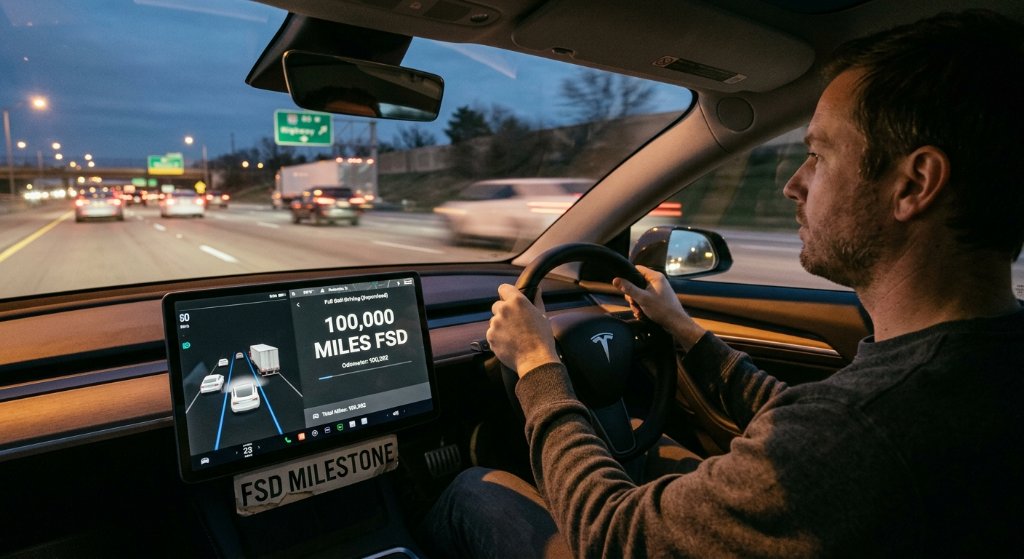
For years, Tesla skeptics have argued that "supervised" autonomy is a dangerous half-measure, destined to remain a novelty rather than a true driverless solution. But a jaw-dropping new milestone has just shattered that narrative. A prominent Tesla community member recently highlighted a Model 3 owner who clocked 100,000 miles driven almost entirely by Full Self-Driving (FSD), requiring a mere 382 miles of manual driving over the entire duration. At 99.6% autonomy, this real-world feat proves that Tesla's software-only, vision-based approach is edging closer to the holy grail of unsupervised, commercial-grade driving.
To back up this physical milestone, Tesla is aggressively pushing out its latest software update. Currently in its fifth wave of deployment, the rollout delivers FSD v14.3.7 to AI4-equipped vehicles and FSD v14.1 Lite to older HW3 cars. These parallel tracks represent a massive effort to bridge Tesla's widening hardware gap while fixing critical thermal and driving bugs.
Inside the 100,000-Mile Real-World Proof
The milestone logged by Tesla owner @TheWis65 represents one of the most statistically significant FSD endurance tests to date. Navigating through 100,000 miles of diverse weather, construction zones, and urban chaos with only 382 manual miles of intervention translates into a system that is already functioning far beyond the safety margins of an average human driver. For prospective buyers and industry professionals, this data point is the clearest sign yet that Tesla’s reliance on end-to-end neural network training is paying massive dividends in consistency and safety.
Bridging the Hardware Divide: v14.3.7 vs. v14.1 Lite
The rollout of the fifth wave of Tesla's v14 software highlights a major engineering challenge: keeping older vehicles relevant. When Tesla introduced Hardware 3 (HW3) in 2019, Elon Musk claimed it was all that was needed for full autonomy. However, the sheer computational demands of FSD v12 and v14 have pushed HW3 to its absolute limit, forcing Tesla to split its software development into two tracks: the uncompromised AI4 (Hardware 4) build and the optimized, pruned 'Lite' build for HW3.
The latest update introduces crucial adjustments for both platforms:
- ECU Overheating Solved on HW3: Previous v14 Lite builds triggered severe Autopilot ECU thermal issues (APP_w141_ECU_Thermal_Issue), threatening to hardware-limit older cars. FSD v14.1 Lite successfully resolves this thermal bottleneck.
- Jittery Braking Banished: Both builds finally address the aggressive 'brake pumping' and jittery deceleration that plagued the earlier v14.3.6 versions, delivering significantly smoother, human-like braking.
- Reversing and AutoPark on HW3: Despite the hardware limits, v14.1 Lite brings long-overdue reverse driving and automated parking capabilities to the legacy HW3 fleet.
- AI4 Speed and Precision: On the flagship AI4 platform, v14.3.7 utilizes a rewritten AI compiler that delivers 20% faster reaction times, bolstered by an upgraded reinforcement learning stage and superior 3D geometry recognition.
Why This Matters:
This software release and the 100,000-mile milestone mark a critical inflection point for both Tesla and the wider EV sector.
- The Ultimate Validation of Vision-Only: Critics who claimed Tesla could never achieve high-reliability autonomy without expensive LiDAR systems—like those used by Alphabet’s Waymo—now have 100,000 real-world reasons to reconsider. Tesla’s vision-only approach is proving it can sustain near-perfect autonomy at a fraction of the hardware cost.
- The Looming Legacy Problem: While FSD v14.1 Lite keeps older Teslas in the game, it also highlights a growing divide. By labeling the HW3 build as 'Lite,' Tesla is quietly signaling to the market that pre-2023 vehicles may never achieve true, unmonitored robotaxi status. For buyers looking at used Teslas, AI4-equipped models are now the only logical choice for future-proofing.
- The Robotaxi Launchpad: As Tesla prepares to deploy its highly anticipated Cybercab, these software refinements are not just minor bug fixes—they are the foundational building blocks of a commercial autonomous network. Achieving 99.6% autonomy over six figures of mileage is the exact safety data Tesla needs to present to regulatory bodies worldwide.
Ultimately, the v14 rollout proves that Tesla is no longer just an automaker struggling with production bottlenecks—it is a full-fledged robotics and AI powerhouse. By solving the critical thermal issues on legacy hardware and refining AI4’s decision-making speeds, Tesla is solidifying its lead in the race for true autonomous driving. The dream of a fully self-driving future is no longer on the horizon; for some owners, it has already covered 100,000 miles.