Tesla FSD Visuals Go Global: A Critical Step for European Trust and Expansion
Tesla has quietly but profoundly signaled its renewed commitment to Full Self-Driving (FSD)'s global expansion. The latest software update, 2026.14 – ...
Editorial Team
World Of EV
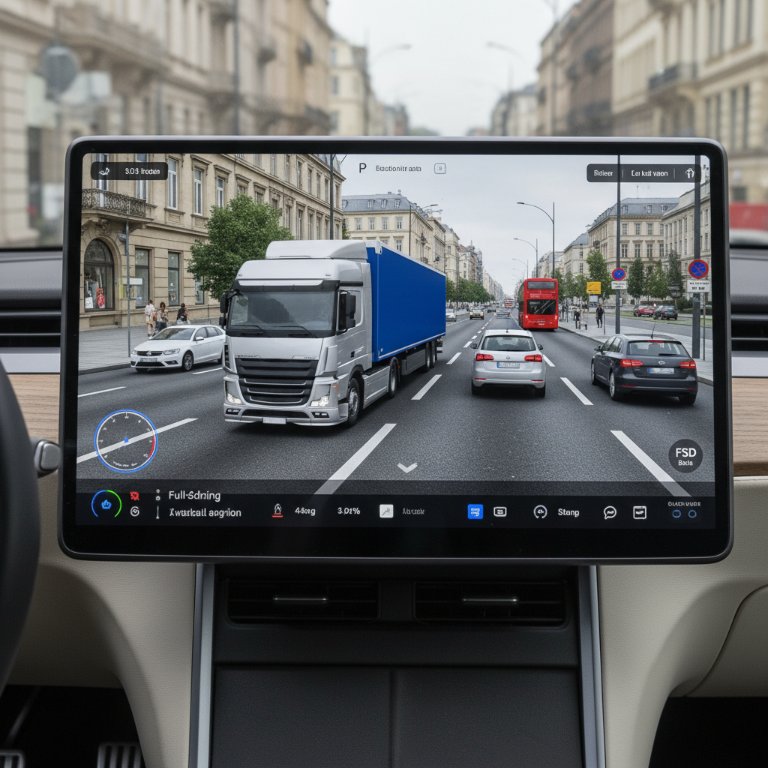
Tesla has quietly but profoundly signaled its renewed commitment to Full Self-Driving (FSD)'s global expansion. The latest software update, 2026.14 – part of the highly anticipated Spring Update – introduces region-specific vehicle designs into the FSD visualization system, a seemingly minor tweak with massive implications for European drivers and the future of autonomous technology. This isn't merely a cosmetic change; it's a foundational step towards building FSD readiness and, crucially, driver trust in diverse international markets.
For years, Tesla's FSD visualization, a key interface for drivers to understand what their vehicle 'sees,' has largely reflected North American road conditions and vehicle types. While functional, this often presented a somewhat generic, and at times inaccurate, representation of the complex European driving environment. The introduction of accurately rendered, flat-fronted, cab-over European-style semi-trucks on the center display marks a significant departure from this one-size-fits-all approach.
What's New in the Spring Update
Tesla’s 2026.14 software update brings a targeted enhancement that directly addresses the unique visual landscape of European roads. Key details of this deployment include:
- Accurate Truck Visualization: European Tesla owners now see precise renderings of local cab-over semi-trucks, moving beyond generic semi-truck designs previously displayed.
- Seamless Integration: This feature is part of the broader 'Spring Update' (software update 2026.14), ensuring a robust and integrated rollout.
- Universal Access: Crucially, this advanced visualization does not require an FSD subscription, making it accessible to all Tesla owners across Europe.
This update is far more than just better graphics. It reflects Tesla's significant investment in collecting, processing, and integrating region-specific data into its autonomous driving stack. The ability to distinguish between different truck types, for instance, can impact prediction models for braking, turning, and overall road behavior, leading to a more robust and safer driving experience. It also means Tesla is actively working to make its advanced driver-assistance systems (ADAS) truly globally aware, rather than retrofitting a North American-centric solution.
Why This Matters:
This seemingly small visual update is a giant leap for Tesla's global FSD ambitions and holds several profound implications for the market, consumers, and the company itself. For discerning EV enthusiasts and industry professionals, this signals a critical maturation of Tesla's autonomous strategy.
- Building Trust in Europe: European regulators and drivers are notoriously discerning about autonomous technology. An FSD system that visually misrepresents common vehicles erodes confidence. By accurately depicting local truck designs, Tesla directly addresses a critical psychological barrier, signaling that its system genuinely 'understands' the European road environment. This is paramount for FSD's eventual widespread adoption and regulatory approval across the continent. Who wins? European Tesla owners gain confidence; Tesla mitigates a potential trust deficit.
- Paving the Way for Global FSD Rollout: This isn't just about Europe. This move strongly suggests Tesla is systematically working through region-specific adaptations necessary for FSD's expansion beyond North America. Expect similar localization efforts for road signs, traffic lights, and driving behaviors in other key markets like China and Australia. This signals a concrete commitment to FSD's promised global reach, which is vital for Tesla to monetize its vast FSD development investment.
- Data-Driven Development: Accurate visualization doesn't happen in a vacuum. It stems from extensive data collection and annotation of European traffic scenarios. This indicates a robust pipeline for region-specific data ingestion, which will be critical for training FSD's neural networks for diverse global conditions. This is a quiet acknowledgment that global autonomy requires global data, not just North American data scaled up.
- Competitive Edge: While many OEMs offer advanced ADAS, few have demonstrated this level of granular, region-specific visual adaptation for their autonomous systems. Tesla's move positions it as a leader in tailoring its FSD visualization to local realities, potentially giving it an edge in markets where competitors still rely on more generic visual models.
This development underscores that for Tesla, true FSD is a global endeavor. It's a strategic move to address local nuances, build driver confidence, and lay the groundwork for a broader international rollout of its autonomous capabilities.
The integration of region-specific vehicle designs into Tesla's FSD visualization system is far more than a software amenity; it's a strategic declaration. It confirms Tesla's serious intent to adapt its autonomous technology for global markets, directly addressing the complexities of European roads. This foundational step in building driver trust and system accuracy points to an exciting future where FSD is truly a global, rather than merely North American, phenomenon.