Tesla FSD's European Breakthrough Hinges on Imminent Netherlands Approval
Elon Musk has once again set a definitive timeline for a critical Tesla milestone, announcing that the company anticipates regulatory approval for its...
Editorial Team
World Of EV
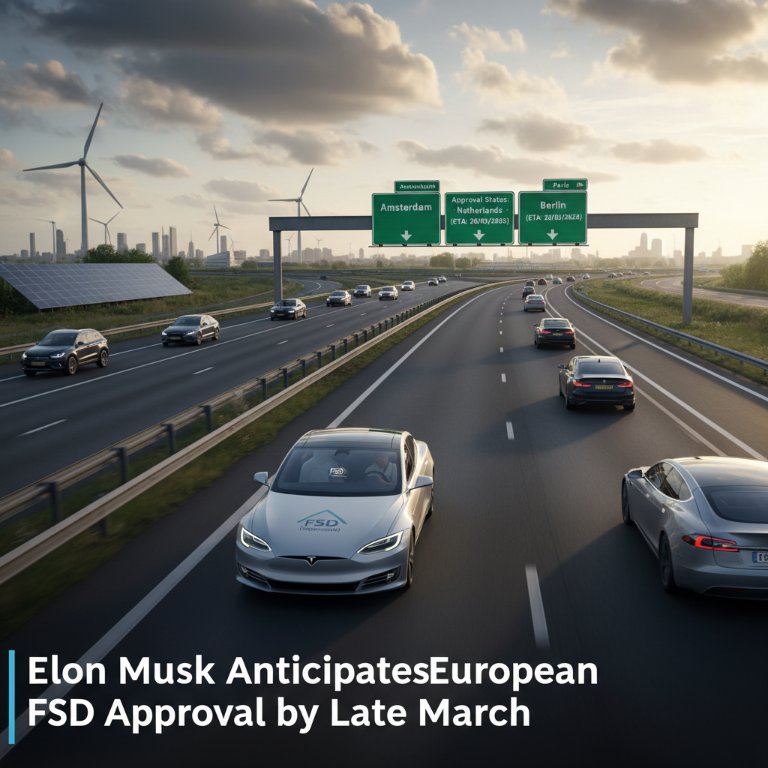
Elon Musk has once again set a definitive timeline for a critical Tesla milestone, announcing that the company anticipates regulatory approval for its Full Self-Driving (Supervised) system in the Netherlands by March 20, 2026. This expectation, shared during a recent interview at Giga Berlin, marks a potentially transformative moment for Tesla's advanced driver-assistance ambitions in a region historically slow to embrace such technology.
For years, European Tesla enthusiasts have watched from the sidelines as North American drivers gained access to FSD features, constrained by the continent's complex and often fragmented regulatory landscape. This anticipated approval in the Netherlands could serve as a crucial regulatory precedent, unlocking a pathway for a much broader rollout across the European Union, a market vital for Tesla's continued growth and the global legitimization of its AI-driven autonomy.
The Netherlands: A Critical Regulatory Gateway
Musk's confidence stems from discussions with Dutch authorities, suggesting a breakthrough in navigating the intricate web of European regulations. The Netherlands, often viewed as a progressive adopter of new technologies, could be the first major European market to greenlight Tesla's latest FSD (Supervised) software under updated regulatory frameworks. This move is particularly significant given past hurdles; the Dutch regulator (RDW) had previously denied a Tesla FSD approval claim in late 2025.
Understanding FSD (Supervised) in a European Context
It is imperative to clarify what “Full Self-Driving (Supervised)” entails. This is an advanced driver-assistance system (ADAS), classified as SAE Level 2 automation. It empowers the Tesla vehicle to navigate complex urban environments, execute lane changes, follow navigation routes, and even park automatically.
However, the 'Supervised' moniker is critical: it explicitly requires active driver supervision at all times. Drivers must remain attentive and prepared to take immediate control. Tesla maintains that FSD (Supervised) significantly enhances safety, reporting fewer collisions for vehicles operating with the system engaged compared to those driven manually.
- Navigation on Autopilot: Guiding the vehicle from highway on-ramps to off-ramps, including automated lane changes.
- Automatic Lane Changes: Facilitating overtaking and merging maneuvers.
- Traffic Light and Stop Sign Control: Recognizing and responding to traffic signals and stop signs.
- Autopark: Automatically maneuvering into parallel and perpendicular parking spaces.
- Smart Summon: Allowing the vehicle to navigate through parking lots to the driver.
Regulatory Hurdles and the Path Ahead
The European Union's regulatory environment has long presented a 'layer cake of bureaucracy,' as Musk himself described it, for advanced autonomous systems. Unlike the more fragmented approach in the U.S., Europe's multi-national structure demands policies that harmonize diverse national laws, traffic rules, and data privacy concerns. This includes differing speed limits, signage, and complex urban infrastructure like bus lanes and roundabouts.
While the EU has established a legal framework for the approval of highly automated vehicles (Level 3 and above) since 2022/2023, the practical implementation for widespread consumer use still hinges on individual member state approvals and ongoing technical assessments. The Netherlands' approval, if confirmed, would represent significant regulatory traction for Tesla's vision-based, end-to-end neural network approach, which contrasts with some rival systems relying heavily on HD maps or lidar.
Why This Matters:
This isn't merely another software update; it's a critical inflection point for Tesla's global strategy and the broader automotive industry. The imminent Netherlands approval carries profound implications:
- Tesla's European Ambition: For Tesla, Europe represents a massive, largely untapped market for FSD. Successful approval and rollout here are crucial for expanding its software revenue streams and monetizing its advanced AI capabilities. It signals that Tesla can indeed navigate the stringent European regulatory maze, something many doubted.
- Pressure on European OEMs: Traditional European automakers, while making strides in ADAS, largely lag behind Tesla in the deployment of a comprehensive, vision-only L2+ system like FSD (Supervised). This move will intensify pressure on them to accelerate their own software development and regulatory engagement, particularly as the EU's legal framework for autonomous driving evolves. Competitors focusing on Level 3 systems in limited operational domains might find themselves needing to match Tesla's broader, supervised functionality.
- Validation of Vision-Only AI: The Netherlands approval would lend significant credibility to Tesla's contentious vision-only approach, which eschews lidar and radar in favor of camera-based neural networks. This could influence future regulatory considerations and technological development across the industry.
- Consumer Impact: For European consumers, it means access to a highly anticipated and advanced driver-assistance system that promises enhanced convenience and, according to Tesla's data, improved safety. It finally brings a core Tesla promise to a market that has patiently waited.
- Regulatory Harmonization: A successful rollout in the Netherlands could create a domino effect, fostering greater regulatory harmonization and potentially accelerating FSD approvals in other European countries like Germany and France.
This approval is not a 'do-or-die' moment for Tesla in its entirety, but it is undeniably mission-critical for the company's autonomous driving division. Success in Europe validates years of R&D and significant investment, underpinning the future value proposition of every Tesla vehicle sold on the continent.
Conclusion
Elon Musk's prediction of FSD (Supervised) approval in the Netherlands by March 20, 2026, sets the stage for what could be the most significant expansion of Tesla's autonomous driving technology to date. This move, if realized, will not only bring advanced capabilities to European drivers but also profoundly reshape the competitive landscape and regulatory dialogue surrounding autonomous vehicles across the continent.