Tesla Ignites Autonomy Race: Controls-Free Cybercab Set for September 3 Launch in Austin
Tesla is finally pulling back the curtain on its long-awaited autonomous future, issuing exclusive invitations for a livestreamed Cybercab launch even...
Editorial Team
World Of EV
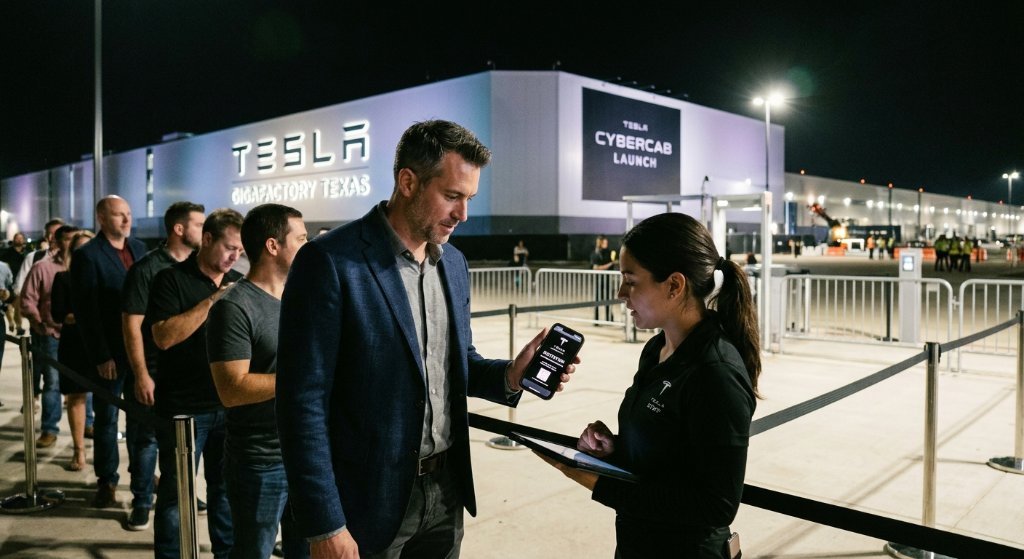
Tesla is finally pulling back the curtain on its long-awaited autonomous future, issuing exclusive invitations for a livestreamed Cybercab launch event on September 3, 2026, at Gigafactory Texas. Attendees will do more than just watch; they will experience public rides in a vehicle that features no steering wheel, no pedals, and no traditional charging ports. This event marks a critical turning point for CEO Elon Musk, who has spent nearly a decade promising a decentralized, high-margin robotaxi network to justify Tesla's massive market valuation.
The journey to this moment has been paved with intense skepticism and delays. Ever since Musk first predicted a million-robotaxi fleet by 2019, Tesla has battled critics over its "vision-only" Full Self-Driving (FSD) system. After a dazzling but highly controlled concept reveal at the "We, Robot" event in October 2024, the automaker transitioned the Cybercab into pilot production in early 2026. Now, by offering public rides in Austin, Tesla is aiming to prove that its radical, software-first approach to autonomy is ready for the real world.
A Masterclass in EV Efficiency
To make a driverless ride-hailing fleet financially viable, Tesla designed the Cybercab around extreme efficiency and lightweight engineering. Unlike its heavy, dual-motor siblings, the Cybercab is built on a stripped-down, highly specialized architecture.
Key specifications revealed ahead of the event include:
- Powertrain: A single 163 kW (219 hp) front-mounted electric motor, making this Tesla’s first-ever front-wheel-drive vehicle.
- Battery Pack: A compact ~48 kWh lithium-ion battery operating at 326 volts.
- Weight: A featherweight curb weight of just 3,113 lbs—making it the lightest production EV in Tesla's modern lineup.
- Efficiency and Range: Thanks to its slippery aerodynamics and low mass, the Cybercab boasts a jaw-dropping efficiency rating of roughly 5.5 miles/kWh, squeezing an estimated 418 miles of range out of its small battery pack.
The Death of the Charging Plug
The Cybercab also bids farewell to the physical charging cable. Instead of relying on a human to plug in a North American Charging Standard (NACS) connector, the vehicle relies entirely on high-efficiency inductive wireless charging.
This hands-free recharging cycle is made possible by a critical regulatory milestone achieved earlier this year. The Federal Communications Commission (FCC) granted Tesla a special waiver to utilize Ultra-Wideband (UWB) radio technology in the vehicle. While UWB does not transmit power, it allows the Cybercab to communicate with ground-based charging pads, guiding the autonomous car to park over the pad with millimeter precision. Once aligned, the vehicle charges wirelessly at over 90% efficiency, preparing itself for its next fare without any human intervention.
Why This Matters:
This September 3 launch is not just another vehicle rollout; it is a high-stakes, do-or-die moment for Tesla. By debuting a car completely devoid of physical controls, Tesla is effectively leaping off a regulatory cliff, betting everything on the absolute reliability of its vision-only FSD suite.
- The Market Signal: Tesla is telling the world that the age of human-driven rideshare is ending. By cutting out drivers, steering wheels, and expensive sensor suites like LiDAR, Tesla aims to slash ride costs down to a fraction of traditional rideshare. If the public rides at Giga Texas go flawlessly, it will trigger an immediate re-evaluation of Tesla's AI and robotics divisions. If there are any high-profile software glitches or hesitations on camera, TSLA stock will face immediate, severe downward pressure.
- The Winners and Losers: Traditional ride-hailing giants like Uber and Lyft are in the direct line of fire. While Uber has hedge-backed its bet with partnerships—such as the upcoming Lucid-Nuro-Uber autonomous program—a fully scaled Tesla Cybercab fleet could price them out of the market entirely. Meanwhile, Google’s Waymo and Amazon’s Zoox should be deeply concerned. Waymo’s current strategy relies on retrofitting expensive Jaguar I-Pace SUVs with bulky, costly LiDAR rigs. Tesla’s sleek, ultra-cheap Cybercab is built from the ground up for low-cost mass production, making it far easier to scale globally.
- The Scaling Bottleneck: The real challenge for Tesla won't be building the Cybercab, but legally running it. While Texas is an autonomy-friendly sandbox, operating a steering-wheel-free vehicle on public streets nationwide requires federal exemptions and state-level DMV approvals that remain incredibly difficult to secure. Furthermore, building out the physical infrastructure for inductive wireless charging hubs across major cities will require substantial capital and time.
Conclusion
The Cybercab represents the ultimate realization of Elon Musk’s long-term master plan: a vehicle that operates as an appreciating asset, earning revenue for its owner while they sleep. If the September 3 livestream at Gigafactory Texas demonstrates a seamless, confident passenger experience, Tesla will have successfully bridged the gap between science fiction and commercially viable autonomy. The race for the driverless future has officially entered its most aggressive phase, and Tesla is determined to write the rules.