Tesla Lands FSD V14.3.3 Down Under: Why This Software Leap Redefines the Local Autonomy Race
The wait is officially over for Tesla owners in the Southern Hemisphere. Tesla has launched Full Self-Driving (Supervised) V14.3.3 in Australia and Ne...
Editorial Team
World Of EV
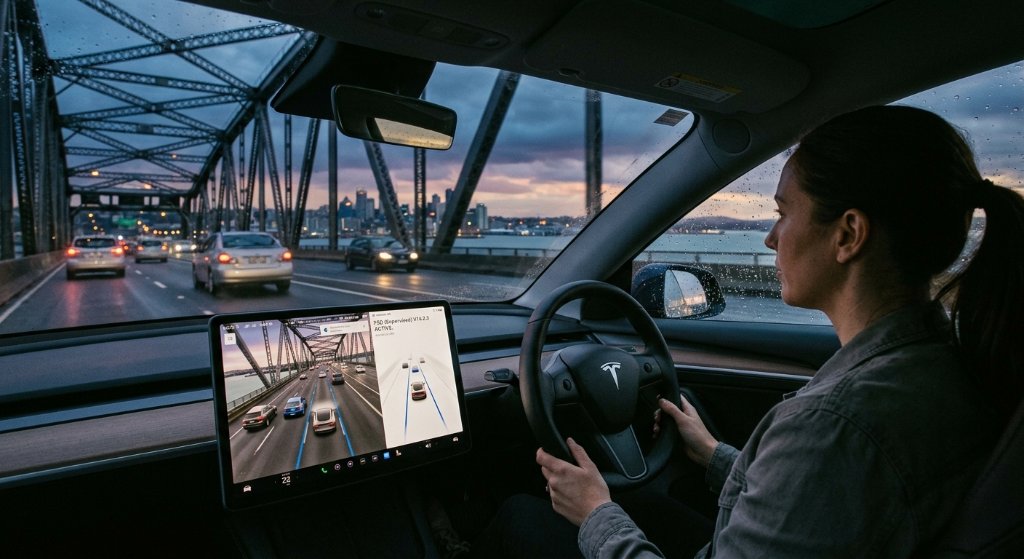
The wait is officially over for Tesla owners in the Southern Hemisphere. Tesla has launched Full Self-Driving (Supervised) V14.3.3 in Australia and New Zealand, marking the highly anticipated debut of the V14 neural network stack outside of North America. While North American drivers have long served as the primary playground for Tesla's autonomous ambitions, this regional expansion signals a major global milestone, bringing state-of-the-art vision-based driver assistance to right-hand drive markets.
Historically, Tesla’s international rollout of advanced autonomous features has been painfully sluggish, bogged down by strict regulations, localized road designs, and unique infrastructure. Australian and New Zealand owners have felt sidelined, stuck relying on the legacy V13.2.9 build since September 2025. With V14.3.3 officially hitting public roads, Tesla is fast-tracking its latest AI driving capabilities overseas—though it comes with a few regional caveats and an unexpected boots-on-the-ground validation campaign.
Under the Hood of V14.3.3: What's New Down Under
The jump to V14.3.3 is not an incremental bug patch; it represents a generational leap in how Tesla’s vehicles interpret and navigate the world. By running on end-to-end neural networks trained on millions of miles of driving data, V14.3.3 shifts driving logic from coded rules to pure AI-driven intuition.
Key details of this regional deployment include:
- Hardware 4 (HW4) Optimization: The rollout primarily targets newer HW4-equipped vehicles (Model 3 facelifts built since Sept 2023 and Model Ys built since Jan 2024), utilizing their higher-resolution cameras and upgraded processing power.
- No 'Mad Max' Profile: In a surprising regional modification, early reports confirm that Tesla’s aggressive 'Mad Max' driving profile has been excluded from this initial release, favoring a more conservative, regulatory-friendly driving posture.
- Smoother Road Negotiation: Local drivers are already reporting massive improvements in handling roundabout navigation—a notoriously tricky infrastructure element in both Australia and New Zealand.
- Real-World Database Activation: This is no mere test flight. The FSD Database has officially recorded its first real-world Australian miles, logged by local user @gbhall, validating the stack's immediate real-world performance.
Boots on the Ground: David Moss Reroutes to Australia
To ensure the transition to left-hand-side driving and foreign road geometry goes flawlessly, Tesla is not just relying on remote engineering. David Moss—the legendary Tesla driver who made headlines by completing a historic, zero-intervention, 12,000-mile cross-continental drive on FSD—has reportedly been rerouted from Mexico to Australia to provide hands-on support.
Moss’s sudden presence Down Under underscores the high stakes of this deployment. Adapting a vision-only system to operate seamlessly in a new continent requires immediate, real-world troubleshooting. Moss’s extensive experience with FSD’s edge cases will allow Tesla to gather critical local telemetry and refine the neural network specifically for Australian and New Zealand roads far quicker than standard telemetry uploads alone.
Why This Matters:
- Who Wins: Owners of HW4-equipped Teslas in Australia and New Zealand. For customers who spent $10,100 AUD outright or are paying the $149/month subscription fee, FSD finally delivers a cutting-edge experience that feels worth the premium price tag.
- Who Loses: Legacy HW3 (Hardware 3) owners. Once again, pre-2023 Tesla owners are left in the dust. While Tesla has promised a 'V14 Lite' version for older models, the widening capability gap between HW3 and HW4 raises tough questions about long-term upgradability and residual values.
- The Global Regulatory Play: Australia and New Zealand serve as the perfect testing grounds for Tesla's global ambitions. By deploying a highly supervised, conservative V14.3.3 stack (wisely omitting the aggressive 'Mad Max' profile), Tesla is actively building an undeniable safety record on right-hand drive roads. If they can prove that V14 drastically lowers collision rates in these highly regulated regions, it gives Tesla the ultimate regulatory leverage to break through European safety barriers next. This isn't just an update—it is an international proof of concept.
The Bottom Line
The arrival of FSD V14.3.3 in Australia and New Zealand proves that Tesla is finally ready to scale its autonomy engine globally. While HW3 owners face an agonizing wait and regional drivers will have to navigate without the aggressive 'Mad Max' profile, the physical support of veteran testers like David Moss proves Tesla is not taking this rollout lightly. This is a bold, calculated chess move to secure global self-driving dominance—one hemisphere at a time.