Tesla Launches Legal Battle Against Manitoba Over EV Rebate Suspension, Escalating Trade Tensions
Manitoba's electric vehicle (EV) market has been thrown into turmoil as Tesla Motors Canada announced its intent to pursue a judicial review against t...
Editorial Team
World Of EV
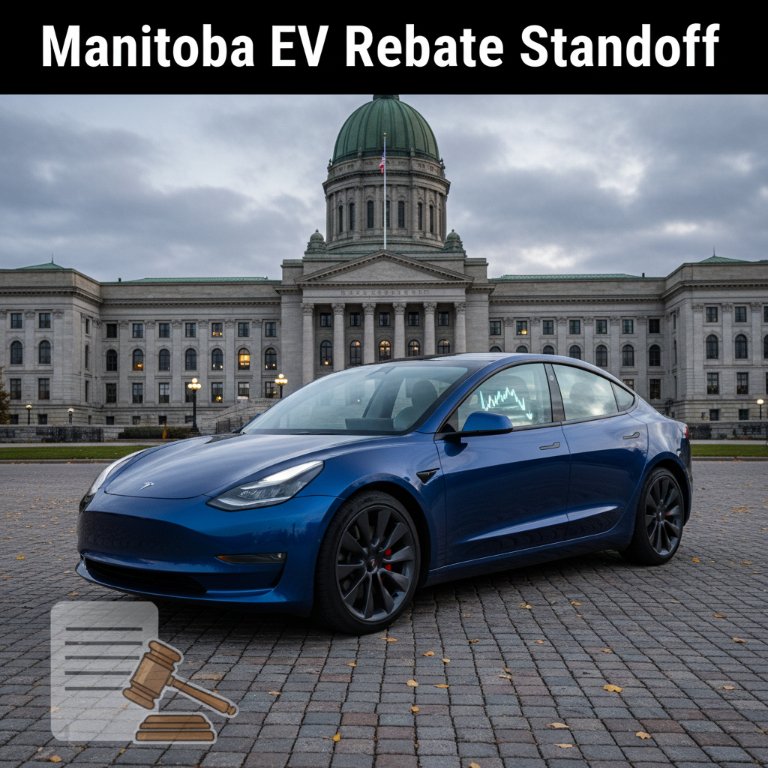
Manitoba's electric vehicle (EV) market has been thrown into turmoil as Tesla Motors Canada announced its intent to pursue a judicial review against the provincial government. The legal action stems from Manitoba's controversial decision to halt crucial rebates for Tesla and certain Chinese-made electric vehicles, a move that critics argue is less about environmental policy and more about international trade disputes. This development injects significant uncertainty into the province's EV adoption efforts and sets a worrying precedent for the broader North American market.
The Rebate Halt and Tesla's Legal Challenge
Last year, the New Democratic Party (NDP) government in Manitoba made a decisive — and many would say, abrupt — move to cease offering rebates of up to $4,000 for Tesla and Chinese-manufactured EVs. This policy shift directly impacts prospective buyers, effectively increasing the cost of these vehicles and potentially dampening consumer enthusiasm for electrification. Tesla's legal challenge alleges that the decision was procedurally unfair and enacted for an 'improper purpose,' suggesting a politically motivated agenda rather than a genuine reassessment of EV incentive programs.
Tariffs and Political Retaliation
Premier Wab Kinew has openly linked the rebate suspension to an ongoing trade dispute, stating that Manitoba would only reconsider its decision if the United States drops tariffs on Canadian goods. This revelation underscores a troubling trend where vital climate and consumer incentives are being leveraged as bargaining chips in international trade negotiations. For savvy EV enthusiasts and industry professionals, this isn't just a provincial policy change; it’s a clear escalation of economic nationalism bleeding into climate initiatives. The inclusion of 'Chinese-made electric vehicles' in the rebate ban further complicates matters, highlighting a broader geopolitical undercurrent affecting EV markets.
Why This Matters:
- Chilling Effect on EV Adoption: The immediate impact is a significant disincentive for Manitobans considering Tesla or other affected EVs. Without the $4,000 rebate, the total cost of ownership increases, making these vehicles less competitive against internal combustion engine (ICE) alternatives. This directly undermines the province's stated goals for emission reduction and EV uptake.
- Politicization of EV Incentives: This case sets a dangerous precedent, linking EV incentives – a cornerstone of climate policy – directly to unrelated international trade disputes. It signals to manufacturers and consumers that such policies can be arbitrarily withdrawn based on political whims rather than consistent environmental or economic strategies.
- Market Distortion and Consumer Choice: By specifically targeting Tesla and Chinese-made EVs, Manitoba is actively distorting its local market. This limits consumer choice and penalizes specific brands based on their country of origin or geopolitical factors, rather than their environmental merits or technological advancements. This could deter future EV investment and variety in the province.
- Legal Precedent and Industry Instability: Tesla’s judicial review could have far-reaching implications. A ruling in Tesla's favor could force Manitoba to reinstate the rebates and potentially influence how other jurisdictions approach similar incentive programs. Conversely, if Manitoba prevails, it could embolden other governments to use EV incentives as tools for broader political or economic leverage, introducing significant instability into the North American EV landscape.
- Who Wins? Who Loses?: In the short term, Manitoban consumers lose choice and financial incentives. Tesla loses sales and market share in the province. The province itself risks its environmental credibility and potential legal costs. Other EV manufacturers not subject to the ban might see a temporary benefit, but the overall market instability hurts everyone in the long run.
This legal standoff between Tesla and the Manitoba government is more than just a local dispute over rebates; it’s a a high-stakes battle that could redefine the role of EV incentives in an increasingly complex geopolitical and economic environment. The outcome will undoubtedly be watched closely by industry players, consumers, and policymakers across Canada and beyond.
Conclusion
Manitoba's decision to weaponize EV rebates against perceived trade grievances has ignited a legal battle with Tesla, exposing the fragile intersection of climate policy, consumer incentives, and international trade. The outcome of Tesla's judicial review will not only determine the future of EV adoption in Manitoba but could also establish a critical precedent for how governments balance economic nationalism with the urgent need for sustainable transportation. The road ahead for Manitoba's EV market appears anything but smooth.