Tesla Locks Down Massive 1 TWh Arizona Solar-Plus-Storage PPA to Feed Its Energy-Hungry Empire
Tesla is taking a massive leap to secure its energy future, proving once again that it is far more than just a car company. In a major move to lock do...
Editorial Team
World Of EV
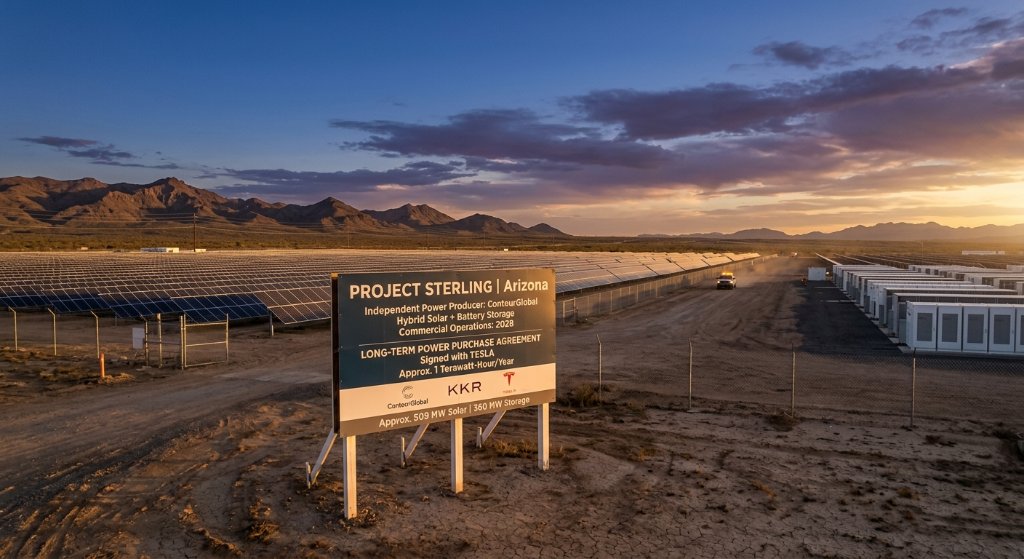
Tesla is taking a massive leap to secure its energy future, proving once again that it is far more than just a car company. In a major move to lock down green power, the company has signed a long-term power purchase agreement (PPA) with independent power producer ContourGlobal, backed by private equity giant KKR. Under the deal, Tesla will purchase 90% of the energy output—amounting to approximately 1 terawatt-hour (TWh) per year—from Project Sterling, a colossal hybrid solar and battery energy storage project in Mohave County, Arizona.
For years, critics viewed Tesla’s energy ambitions as a secondary play to its automotive division. However, as global EV markets face stiff competition and margins tighten, Tesla’s energy arm has emerged as an absolute powerhouse, deploying a record 46.7 GWh of storage in 2025 alone. This latest PPA is not just a carbon-offset public relations play; it is a calculated, strategic energy grab. By securing over 1 TWh of annual power, Tesla is positioning itself to fuel its rapidly expanding Supercharger network, satisfy the immense electricity demands of its AI supercomputers, and guarantee clean power for its regional manufacturing hubs.
Inside Project Sterling: Clean Power on a Colossal Scale
Project Sterling is designed as a highly flexible, utility-scale hybrid plant, maximizing both solar generation and battery storage to dispatch energy when the grid needs it most. By coupling clean generation with heavy storage, the project mitigates the "duck curve" issue that plagues western grids.
Here are the critical specs of the Arizona installation:
- Solar Capacity: 509 megawatts (MW) of peak solar generation (450 MWac).
- Battery Storage: 360 MW of battery capacity with a 1.4 gigawatt-hour (GWh) four-hour duration storage system.
- Annual Output: Expected to generate more than 1.1 TWh of electricity annually, with Tesla claiming 90% of that total.
- Grid Connection: Integrated directly into the Western Area Power Administration (WAPA) grid, carrying firm point-to-point transmission rights into California's CAISO market.
- Timeline: Groundbreaking is scheduled for the third quarter of 2026, with full commercial operations targeted for the first quarter of 2028.
Interestingly, this was not a standalone deal. On the exact same day, Tesla also quietly locked down a second PPA with Zelestra, securing 100% of the output from the 140 MWac Lumen Farm solar project in northeast Texas. Together, these two deals inject almost 650 MW of new contracted renewable capacity into Tesla's portfolio, solidifying its role as a premier energy orchestrator.
Why This Matters:
This is a chess move that signals a profound shift in how Tesla operates. Tesla is no longer just selling the hardware of the energy transition—such as its Megapacks and Powerwalls—it is actively monopolizing the supply of cheap, green electrons.
- The Big Winners: Tesla’s bottom line, first and foremost. Securing 1 TWh of predictable, long-term electricity protects Tesla from highly volatile wholesale market spikes. Furthermore, California's CAISO grid wins. Because Project Sterling features 1.4 GWh of battery storage, Tesla can hold solar power generated during the day and dispatch it into California during the high-demand evening peak, performing lucrative energy arbitrage.
- The AI and Charging Connection: The timing here is no coincidence. Tesla is aggressively building out energy-intensive AI training clusters, such as the xAI and Dojo supercomputers, while simultaneously scaling its global Supercharging network. These operations require astronomical amounts of power. By locking down dedicated renewable energy at wholesale PPA rates, Tesla bypasses the traditional utility middleman.
- The Competitive Moat: This highlights the chasm between Tesla and legacy automakers. While competitors struggle with battery chemistry and vehicle production margins, Tesla is thinking about the broader energy ecosystem. Tesla’s ability to act as a major power purchaser and grid player makes it highly resilient, driving down charging costs for EV owners while adding a highly profitable, high-margin software and energy-arbitrage layer to its corporate sheet.
Looking Forward
With groundbreaking set for late 2026, Project Sterling represents the physical manifestation of Tesla's Master Plan Part 3: a fully integrated, sustainably powered global economy. As we march toward 2028, expect Tesla to ink more of these mega-PPAs. By controlling both the vehicles that consume electricity and the infrastructure that generates and stores it, Tesla is steadily writing the playbook for the modern, decentralized utility company.