Tesla Model 3 Dominates 2026 Autotrader Poll, Crowned King of Long-Distance EV Travel
In a clear signal that tried-and-true performance still trumps novelty, Autotrader recently announced that the Tesla Model 3 has been voted the best e...
Editorial Team
World Of EV
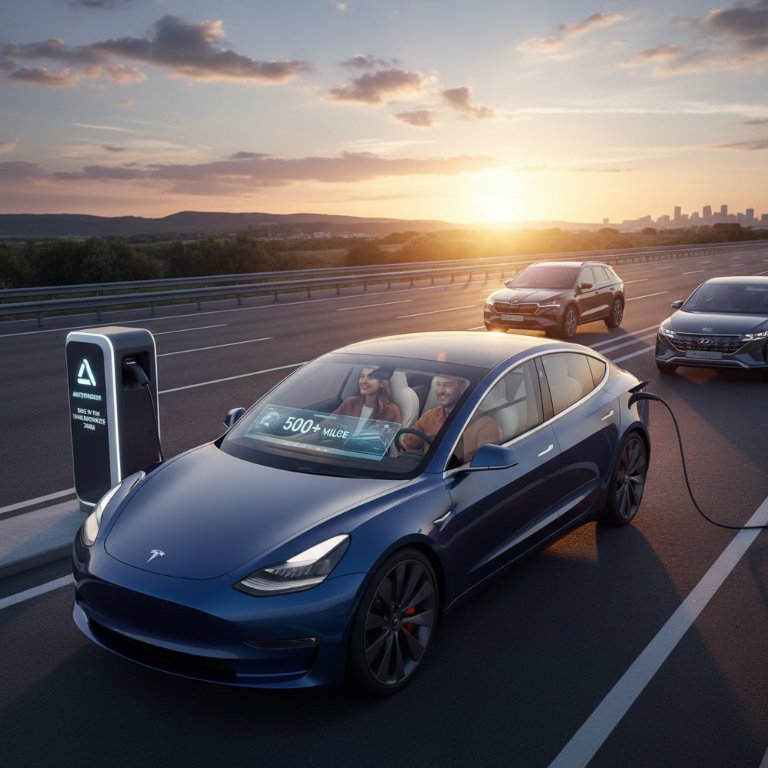
In a clear signal that tried-and-true performance still trumps novelty, Autotrader recently announced that the Tesla Model 3 has been voted the best electric car for long distances in 2026 by a discerning panel of EV drivers. This win isn't just a popularity contest; it's a testament to the Model 3's enduring appeal and Tesla's foundational strengths in the burgeoning electric vehicle market, despite a relentless wave of new contenders challenging its long-held dominance.
The Enduring Appeal of Tesla's Mid-Range Sedan
The Model 3, a vehicle that redefined the mainstream EV segment upon its launch, continues to impress owners with its comprehensive package for extended journeys. Drivers specifically lauded several critical attributes, cementing its status as a benchmark for highway cruising. Key factors in its victory include:
- Unrivaled Comfort and Space: Owners consistently praise the Model 3's interior for its ability to keep occupants relaxed over hundreds of miles, a crucial aspect often overlooked in the quest for headline range figures.
- Exceptional Efficiency: Tesla's expertise in powertrain optimization means the Model 3 consistently delivers impressive real-world range, translating to fewer charging stops and greater convenience on long trips.
- Advanced Safety Features: The vehicle's robust safety suite provides peace of mind, an essential consideration for families and individuals embarking on lengthy drives.
- Game-Changing Assistance Technology and Autopilot: The inclusion of Tesla's Autopilot system was repeatedly highlighted as a 'game changer' by drivers. This semi-autonomous driving capability significantly reduces driver fatigue on monotonous highway stretches, offering a level of sophistication and reliability that many competitors are still striving to match.
The Contenders: Skoda Elroq and Hyundai IONIQ 5 Nudge Closer
While the Model 3 firmly held its ground, the competition is clearly intensifying. The Skoda Elroq and the Hyundai IONIQ 5 were named as impressive runners-up in the Autotrader poll. The IONIQ 5, with its striking retro-futuristic design, 800V architecture enabling ultra-fast charging, and spacious V2L capabilities, represents a formidable challenge in terms of overall package and charging speed. However, Tesla's established Supercharger network and the maturity of its driver-assistance software likely provided the Model 3 with the decisive edge in the 'long-distance' category. The Skoda Elroq, as an upcoming entry into the booming electric SUV segment, signals a strong push from established European marques to capture market share, yet it still faces the uphill battle of matching Tesla's integrated ecosystem for sustained road trips.
Why This Matters:
This Autotrader award is more than just a nod to a popular car; it's a profound statement about the priorities of EV drivers and the strategic advantages that continue to define success in the long-distance EV segment. Tesla clearly wins here, not just for the Model 3, but for validating its long-term strategy centered on an integrated ecosystem of efficient vehicles, a robust charging network, and advanced software. This re-affirms Tesla's brand loyalty and its perception as the go-to choice for extended EV travel.
Competitors, particularly those without a mature, proprietary fast-charging network, face a significant hurdle. While vehicles like the IONIQ 5 offer blistering charging speeds, the availability and reliability of compatible third-party infrastructure for widespread long-distance travel remains a key differentiator for Tesla. This signals to the broader market that a holistic approach – encompassing vehicle efficiency, interior comfort, safety, sophisticated driver aids, and a dependable charging infrastructure – is paramount. Simply offering high range figures or fast charging capabilities isn't enough if the entire user experience isn't seamless from start to finish. For many manufacturers, the journey to a truly 'game-changing' long-distance EV experience is still in progress.
The Tesla Model 3's continued recognition as the top long-distance EV underscores a critical lesson for the industry: innovation in battery chemistry and charging speeds must be complemented by an equally strong focus on the entire journey experience. As the EV market matures, expect competitors to redouble their efforts in integrating comfort, advanced driver assistance, and comprehensive charging solutions to truly challenge Tesla's reign on the open road.