Tesla Model 3 RWD Obliterates EPA Estimates, Sets New Real-World Efficiency Benchmark
In a groundbreaking real-world test, the 2026 Tesla Model 3 Rear-Wheel Drive (RWD) has not only surpassed its official EPA range estimate but has also...
Editorial Team
World Of EV
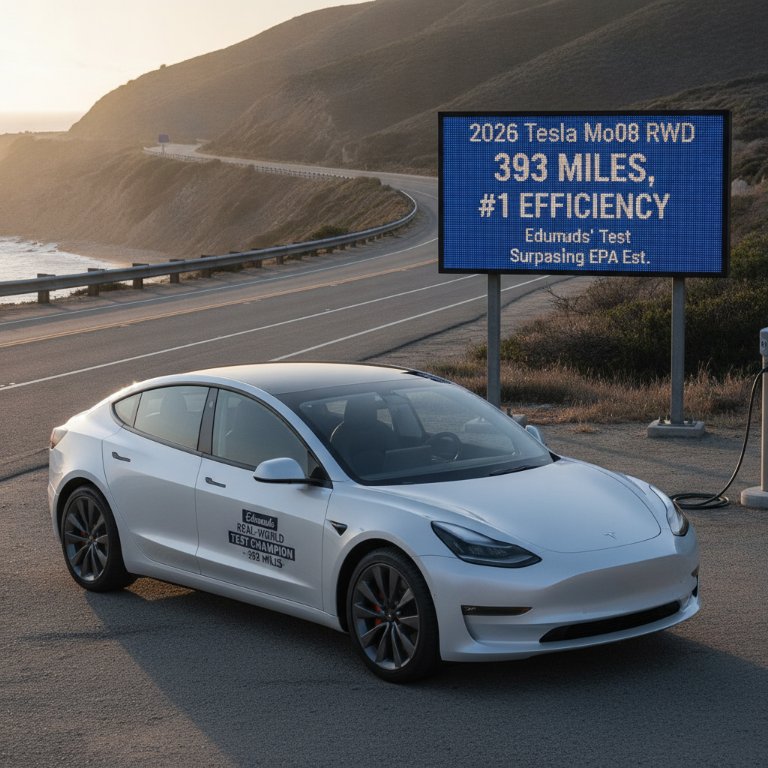
In a groundbreaking real-world test, the 2026 Tesla Model 3 Rear-Wheel Drive (RWD) has not only surpassed its official EPA range estimate but has also been crowned the most efficient electric vehicle (EV) currently in production by Edmunds. This exceptional performance redefines expectations for daily usability and efficiency in the burgeoning EV market.
Tesla’s smallest sedan achieved an astonishing 393 miles on a single charge during Edmunds’ rigorous evaluation, comfortably exceeding its 363-mile EPA rating by a significant 30 miles—an 8.3% improvement. For a segment often scrutinized for real-world range discrepancies, this overperformance by the Model 3 RWD stands as a powerful testament to Tesla's persistent engineering focus on efficiency. While some EVs struggle to match their EPA figures in real-world scenarios, with many falling short in highway tests, Tesla has consistently aimed to meet or exceed these benchmarks.
The Unprecedented Performance
Edmunds' testing methodology, designed to mirror everyday driving conditions with a mix of city and highway routes and climate control active, provides a pragmatic view of an EV's capabilities. The 2026 Model 3 RWD's 393-mile result not only places it near the top of the range charts but, more importantly, its energy consumption figure truly sets it apart. The EPA rates the Model 3 RWD at 25 kWh per 100 miles (4 miles/kWh), but Edmunds recorded an even more impressive 21.7 kWh per 100 miles (4.61 mi/kWh)—making it 13.2% more efficient than its official estimate.
Key takeaways from the Edmunds test include:
- Real-World Range: 393 miles, a full 30 miles (8.3%) over its 363-mile EPA estimate.
- Class-Leading Efficiency: 21.7 kWh per 100 miles (4.61 mi/kWh), making it the most efficient EV Edmunds has tested in production.
- Solid Charging: The Model 3 RWD achieved a peak charging rate of 246 kW, closely matching Tesla's 250 kW claim, adding approximately 100 miles of range in just over 12 minutes.
Tesla's Enduring Efficiency Edge
Tesla's consistent ability to deliver and often exceed expected range figures stems from a multi-faceted approach to engineering. Unlike many traditional automakers adapting internal combustion engine platforms, Tesla designs its vehicles from the ground up as EVs, allowing for optimal integration of powertrain components, battery technology, and aerodynamic design. Their vertical integration, including in-house motor and inverter development, grants them unparalleled control over efficiency. The constant refinement of software through over-the-air updates further optimizes energy management and performance, distinguishing Tesla from many competitors.
Why This Matters:
- Boost for Consumer Confidence: Range anxiety remains a significant barrier for many prospective EV buyers. The Model 3 RWD's nearly 400 miles of real-world range, verified by an independent third party, directly addresses this concern, demonstrating that practical, long-distance EV travel is not only achievable but readily available in a mainstream offering. For daily drivers, this means fewer charging stops and greater peace of mind, enhancing the Model 3's already strong daily usability.
- Intensified Competitive Pressure: This result sets a formidable benchmark for other automakers. In an increasingly competitive EV landscape, rivals must now strive not just to meet EPA estimates but to genuinely exceed them in real-world driving. This puts pressure on manufacturers to prioritize holistic vehicle efficiency over simply installing larger, heavier battery packs. The Model 3 RWD, with its focus on doing more with less energy, challenges competitors like the Mercedes-Benz CLA 350 and Audi A6 Sportback E-tron, which, while offering respectable range, were edged out in Edmunds' testing.
- Validation of Tesla's Strategy: For years, Tesla has championed efficiency and continuous improvement. This test validates that strategy, proving that meticulous engineering across battery chemistry, motor design, software optimization, and aerodynamics yields tangible benefits. It underscores that true EV prowess lies not just in battery size, but in how efficiently that energy is utilized.
Conclusion
The 2026 Tesla Model 3 RWD's exceptional performance in Edmunds' real-world range test cements its position as a segment leader and a beacon of efficiency in the EV world. By delivering nearly 400 miles of practical driving range and setting a new efficiency record, Tesla continues to push the boundaries of what's possible, providing a compelling and practical choice for consumers and raising the bar for the entire electric vehicle industry.