Tesla Parades Cybercab in China: A Brilliant Marketing Tease That Highlights Severe Hurdles Ahead
Tesla is bringing its radical, steering-wheel-free Cybercab to Beijing and Shanghai for a high-profile public tour starting September 17. While this r...
Editorial Team
World Of EV
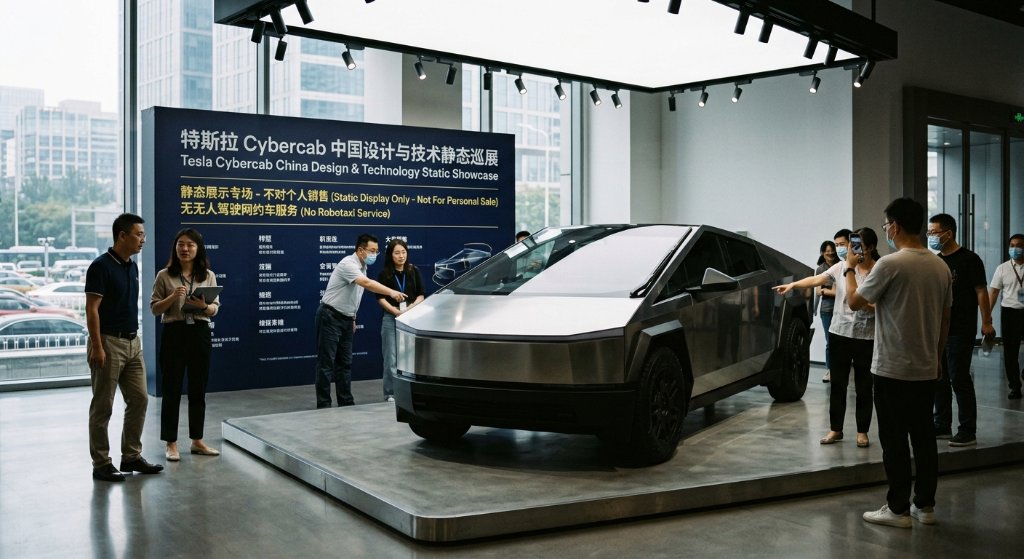
Tesla is bringing its radical, steering-wheel-free Cybercab to Beijing and Shanghai for a high-profile public tour starting September 17. While this represents a major milestone in Tesla’s Asian charm offensive, it comes with a sobering reality check. Tesla China has issued an unusually blunt disclaimer: the tour is strictly a design and tech showcase. The company has explicitly ruled out selling the Cybercab to Chinese consumers or launching its driverless ride-hailing service in the country anytime soon.
Since Tesla first unveiled the Cybercab as a concept at its 'We, Robot' event in October 2024, the vehicle has transitioned from a design exercise into a low-volume reality. Gigafactory Texas kicked off production in early 2026 and recently deployed a small fleet for employee testing in Austin. But bringing a driverless, pedal-free vehicle to public roads in China is an entirely different beast. By launching a 'look, but don't touch' campaign, Tesla is trying to reignite consumer enthusiasm in a critical market where local champions are rapidly eating its market share.
The Mainland Tour: Where, When, and What to Expect
Tesla designed its dual-city showcase to maximize media buzz across China's two most influential metropolises. Eager fans can catch the Cybercab in person at the following venues:
- Beijing (September 17–27): The vehicle will occupy a central spot at the Huamao Tesla experience store, giving the capital's tech crowd a 10-day viewing window.
- Shanghai (September 17–21): The display will run for five days in the north hall on level LG1 of HKRI Taikoo Hui.
- The Format: This is a strictly static display. Visitors can examine the sleek, two-seat aesthetic and the radical control-free cabin, but test rides are entirely off the table.
The Reality of China’s Regulatory and Competitive Maze
Tesla's strict disclaimer is more than just standard legal boilerplate—it is a direct concession to a harsh regulatory environment. Because the Cybercab completely eliminates conventional driver controls like steering wheels and pedals, it cannot legally be registered or sold to private buyers under current Chinese automotive regulations.
Furthermore, Tesla's software is still playing catch-up in the region. While the American automaker is currently pushing to expand its Full Self-Driving (FSD) beta to international markets, it has not yet secured the necessary regulatory green light to operate unsupervised driverless systems in China. Meanwhile, homegrown autonomous driving titans are not waiting around. Companies like Baidu’s Apollo Go, Pony.ai, and WeRide are already operating fully driverless, commercial robotaxi services at scale in major Chinese cities, generating paid revenue and building a massive data moat.
Why This Matters:
- The Brand Halo Effect vs. Slowing Sales: Tesla’s retail sales in China are facing sustained downward pressure from domestic giants like BYD. The Cybercab tour is a calculated play to reinforce Tesla’s image as a futuristic technology leader, diverting attention away from its aging consumer lineup (the Model 3 and Model Y) and preserving brand prestige.
- The Ultimate Geopolitical Catch-22: To run an active driverless network in China, Tesla must navigate incredibly strict national security laws regarding mapping data, data residency, and algorithmic control. By showcasing the Cybercab while explicitly ruling out a commercial launch, Tesla is signaling to Beijing that it wants to play ball, but recognizes it is still a long way from receiving the keys to the kingdom.
- Winners and Losers: The immediate winners are China's domestic robotaxi operators. Baidu and Pony.ai retain their massive first-mover advantage on public roads, completely unchallenged by Tesla's physically present but functionally parked vehicle. The loser is the Chinese consumer hoping for immediate disruption, but the broader industry benefits as the showcase forces local regulators and competitors to keep their feet firmly on the accelerator.
Conclusion
The Cybercab's arrival in Beijing and Shanghai is a masterclass in modern marketing, offering a thrilling glimpse of an autonomous tomorrow. However, it also serves as a stark reminder of the massive gulf between building a futuristic prototype and deploying a viable commercial service. For now, Tesla's driverless revolution in China remains parked behind a velvet rope.