Tesla Pivots From Open Supercharging to Build Walled-Garden 'Robotaxi Hubs'
Just a few years after winning the global plug wars by opening its gold-standard Supercharger network to rival automakers, Tesla is quietly reversing ...
Editorial Team
World Of EV
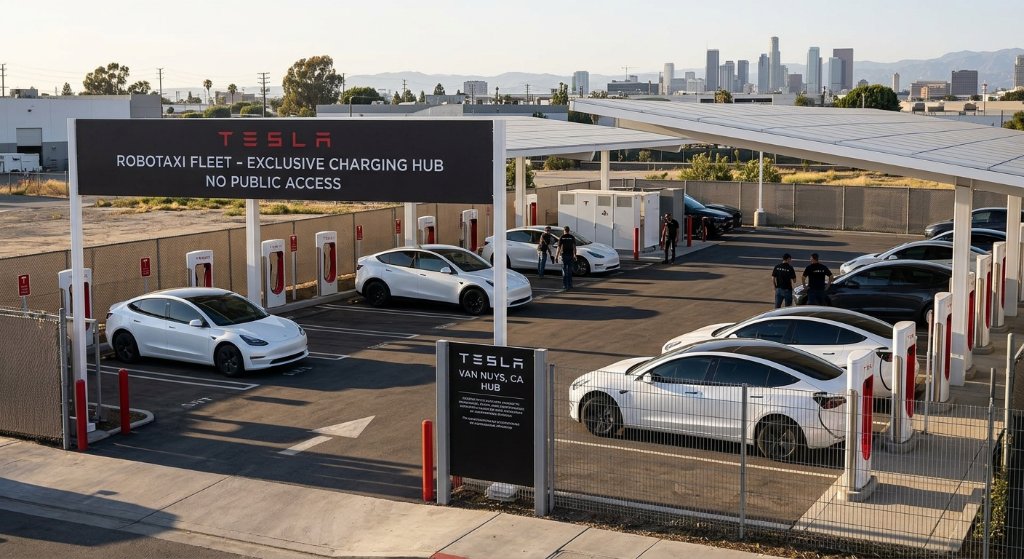
Just a few years after winning the global plug wars by opening its gold-standard Supercharger network to rival automakers, Tesla is quietly reversing its open-network philosophy. The Texas-based EV giant is officially laying the groundwork for a private, restricted network of automated charging hubs dedicated exclusively to its upcoming autonomous robotaxi fleet.
According to Max de Zegher, Tesla’s Director of North American Charging—who was famously rehired after Elon Musk's abrupt gutting of the charging division in early 2024—the company is moving away from the public eye to fuel its self-driving future. While Tesla's current test fleet of driverless Model Ys relies on human operators to manually plug them in at public Superchargers overnight, the automaker is rapidly transitioning to closed-door, highly optimized charging depots built specifically for driverless cars.
Automated Depots: Ditching the Human and the Cable
Tesla’s path to an autonomous ride-hailing network hinges entirely on removing human intervention from the equation. Because the steering-wheel-less Cybercab—unveiled in late 2024 with a production rollout slated for late 2026 or 2027—was engineered entirely without a physical charging port, automated charging is not a luxury; it is an absolute necessity.
To solve this, Tesla is developing specialized hubs designed for rapid, automated vehicle turnaround on low-cost land situated near high-demand urban areas. Recent permit filings and statements from de Zegher reveal a calculated approach to scaling this hidden infrastructure:
- The Austin 'St. Elmo' Wireless Depot: Tesla is converting a logistics staging lot in Austin, Texas, into a massive automated hub featuring 80 dedicated wireless inductive charging pads.
- The Austin-Ridgepoint Manual Hub: A secondary, 24-plug dedicated site is also in development, acting as an interim facility utilizing manual plugs to maintain fleet uptime.
- The Cybercab Spec Match: Documents filed with the EPA reveal the Cybercab sports a modest 48-kWh battery pack designed to charge wirelessly at up to 25 kW. At this rate, a driverless cab can fully replenish its battery in just two hours on an inductive pad.
- Cost Center Strategy: De Zegher confirmed that Tesla is treating fleet charging as a strict cost center. By building on cheap, off-grid or fringe real estate, Tesla can secure lower utility rates and maximize site utilization with continuous, back-to-back charging sessions.
The European Regulatory Roadblock
While a private, closed-loop charging network makes perfect financial sense for Tesla's U.S. operations, the strategy is headed for a massive collision with regulators in Europe. This is the very continent where Tesla first pioneered its open-network program in 2021, and European lawmakers have since codified that open-access philosophy into law.
Under the EU’s Alternative Fuels Infrastructure Regulation (AFIR), charging stations must be "publicly accessible" and feature transparent, ad-hoc payment methods (such as direct card payments for stations above 50 kW) to count toward national infrastructure quotas or receive lucrative state subsidies. A walled-garden hub restricted solely to Tesla-owned robotaxis will receive zero regulatory incentives. It could even face severe zoning and licensing pushback from European cities aiming to prevent private monopolies from clogging local grids.
Why This Matters:
This shifting of gears is a highly calculated gamble that reveals the true trajectory of Tesla’s business model.
- Who Wins: Tesla’s autonomous fleet economics. By bypassing the public Supercharger network, Tesla ensures its passenger-carrying robotaxis are never stuck waiting in line behind a consumer-driven Model 3. It also allows Tesla to run a highly optimized, low-cost utility system that drives down the cost-per-mile of its ride-hailing service, squeezing competitors like Waymo and Zoox.
- Who Loses: The unified EV charging dream. Tesla's decision to build private, restricted infrastructure marks a return to the "walled-garden" ecosystem. Non-Tesla EV drivers who hoped the adoption of the North American Charging Standard (NACS) would lead to a completely frictionless, single-network future will now have to watch prime real estate get locked behind Tesla-only gates.
- A Do-or-Die Bet: This is the ultimate proof that Elon Musk is willing to sacrifice Tesla’s status as a public utility provider to win the autonomous transport wars. The Cybercab simply cannot exist without automated charging infrastructure. If Tesla cannot scale these private, wireless hubs—especially in highly regulated markets like Europe—its dreams of a global autonomous ride-hailing monopoly will stall at the curb.
Conclusion
Ultimately, Tesla’s transition to private, automated Supercharger hubs marks a definitive pivot from an automaker supporting an open EV transition to a vertically integrated tech company defending its autonomous territory. As we march toward the late-2026 rollout of the Cybercab, these silent, wireless depots will represent the physical foundation of Elon Musk’s self-driving empire—provided regulators don't block the gates first.