Tesla Recalls 14,575 Model Ys Over Missing Crucial Safety Labels, Raising Fresh Quality Concerns
Tesla is recalling 14,575 Model Y SUVs from its Fremont, California, factory, impacting both the 2025 and 2026 model years. The issue, a seemingly min...
Editorial Team
World Of EV
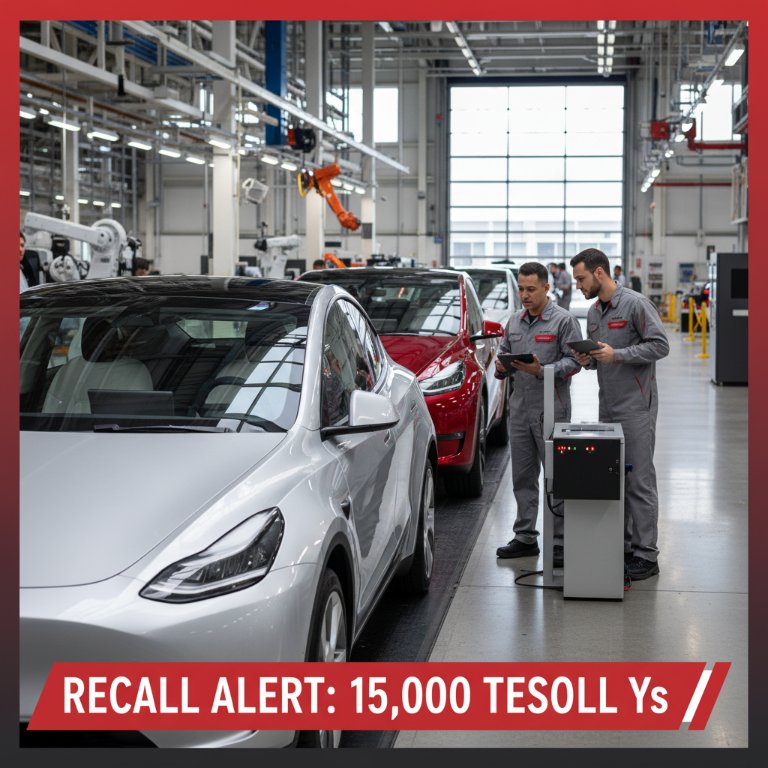
Tesla is recalling 14,575 Model Y SUVs from its Fremont, California, factory, impacting both the 2025 and 2026 model years. The issue, a seemingly minor yet critical omission, stems from an automated scanning tool's failure to verify the application of a federally required certification label to the driver-side door pillar. This isn't merely an administrative oversight; the missing label contains vital information such as maximum loaded weight and tire specifications, directly impacting vehicle safety and regulatory compliance.
This latest recall places a spotlight once again on Tesla's manufacturing quality control, particularly at its longstanding Fremont facility. While recalls are a fact of life in the automotive industry, the nature of this particular issue – the absence of a fundamental safety label due to an automated system malfunction – prompts scrutiny of Tesla’s robust, high-tech production claims.
The Missing Link: A Critical Oversight
The core of the problem lies with an automated scanning tool designed to confirm the presence of the critical certification label. This label is non-negotiable, serving as the primary source for owners to understand their vehicle's safe operating parameters, including:
- Maximum loaded weight (GVWR)
- Recommended tire pressures
- Original tire sizes
- Vehicle identification number (VIN)
Without this label, owners could inadvertently exceed safe load capacities or operate with incorrect tire pressures, significantly increasing the risk of a crash. The failure of an automated system, often touted by Tesla as a cornerstone of its manufacturing efficiency and quality, to detect such a basic compliance requirement is particularly noteworthy.
Beyond Software: A Hands-On Fix
Unlike many issues Tesla addresses with over-the-air (OTA) software updates, this problem demands a physical remedy. Owners of the affected 2025 and 2026 Model Ys must bring their vehicles to a service center for inspection and, if necessary, the application of the missing label. This necessitates an inconvenient trip for thousands of owners, adding to Tesla's service center workload. Notification letters to affected owners will begin distribution on July 17.
Why This Matters:
- Manufacturing Quality Under the Microscope: For a company that prides itself on innovative manufacturing and automation, the failure of a basic automated QC check on a federally mandated label is a stumble. It feeds into a persistent narrative among critics and even some investors that Tesla's rapid scaling sometimes outpaces meticulous attention to fundamental quality and regulatory adherence, especially on components not directly controlled by software.
- Erosion of Trust: While the fix is straightforward, the sheer number of vehicles affected (nearly 15,000) and the foundational nature of the missing information chip away at consumer confidence. Owners expect a premium product to meet all basic compliance standards straight from the factory.
- Operational Inefficiency: Physical recalls are costly, both in terms of direct expenses for parts and labor, and the indirect costs of logistical planning and service center capacity. This diverts resources and attention from other critical areas, such as new vehicle deliveries and advanced feature development.
- Regulatory Scrutiny: Agencies like NHTSA (National Highway Traffic Safety Administration) observe these trends closely. Repeated issues, even seemingly minor ones, can lead to increased oversight and more stringent requirements for future vehicle introductions.
This latest recall serves as a pointed reminder that even the most technologically advanced automakers must master the fundamentals of manufacturing quality and regulatory compliance. For Tesla, consistently battling perceptions around build quality, ensuring that every vehicle leaves Fremont with its essential, legally required credentials intact is non-negotiable in maintaining its leadership position in the fiercely competitive EV market. The focus now shifts to how swiftly and seamlessly Tesla can execute this physical recall and whether this incident prompts a deeper review of their automated quality assurance protocols at Fremont.