Tesla Rescues Hardware 3 Fleet with FSD v14.2 Lite: The Magic of "Model Distillation" Explained
For years, millions of Tesla owners who bought into the promise of Full Self-Driving (FSD) have harbored a quiet, lingering anxiety. When Tesla introd...
Editorial Team
World Of EV
For years, millions of Tesla owners who bought into the promise of Full Self-Driving (FSD) have harbored a quiet, lingering anxiety. When Tesla introduced Hardware 4 (HW4)—boasting vastly superior cameras and computing power—it seemed like only a matter of time before older Hardware 3 (HW3) vehicles were left in the software dust. The computing gap between the two platforms was simply too wide for the same heavy, end-to-end neural networks to run natively.
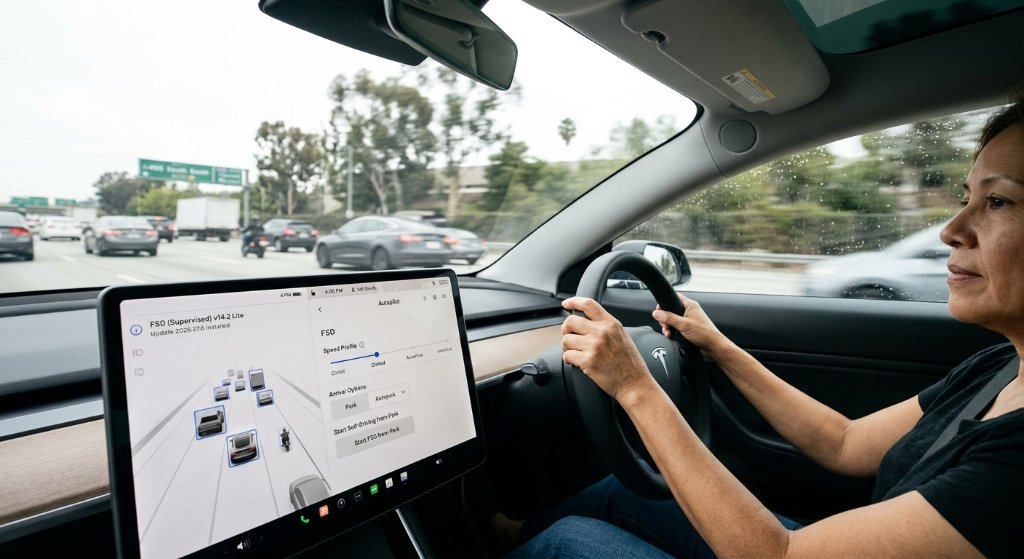
But Tesla isn't throwing in the towel on its legacy fleet just yet. With the release of software update 2026.27.6, the company has officially commenced the rollout of FSD (Supervised) v14.2 Lite to HW3 vehicles. Rather than a lazy software port, this milestone release represents a massive architectural triumph. It relies on a sophisticated machine learning technique called "model distillation" to compress the massive, HW4-optimized FSD v14 neural network so it can run efficiently on older, less-capable hardware.
Bridging the Computing Gap via Model Distillation
Model distillation is essentially the process of transferring knowledge from a massive, resource-heavy AI model (the "teacher") to a smaller, more streamlined model (the "student"). In this case, Tesla's AI team trained a distilled version of the v14 network to mimic the decision-making patterns of the full-scale HW4 model. This allows the HW3 computer to achieve a highly comparable level of intelligence and driving smoothness without choking on the massive computational overhead.
Historically, Tesla has struggled to maintain feature parity across its hardware generations. Whenever a major architectural shift happens in AI—such as the transition to end-to-end neural networks—older silicon suffers. By leveraging model distillation, Tesla has managed to extract maximum utility out of HW3, delaying what many feared would be an inevitable, multi-billion-dollar hardware retrofit crisis for the automaker.
Key Features Arriving with v14.2 Lite
While the underlying architecture is a mathematical masterpiece, the real-world impact for drivers comes down to tangible features. HW3 owners receiving update 2026.27.6 can expect several major quality-of-life additions that bring their vehicles up to modern FSD standards:
- Speed Profiles: Dynamically adjusts the vehicle's speed relative to flow-of-traffic and road conditions, moving away from rigid, speed-limit-based driving to a more natural, human-like flow.
- Arrival Options: Offers more refined end-of-trip behaviors, allowing the vehicle to handle the transition to its final destination with far greater smoothness and accuracy.
- Start Self-Driving from Park: Eliminates the awkward gap between starting a trip and engaging FSD. The vehicle can now initiate autonomous driving directly from a parked state.
Why This Matters:
This release is an absolute masterclass in software engineering, but it also signals a critical turning point for Tesla’s autonomous driving strategy.
The Big Win: First and foremost, legacy owners win. Millions of Model 3, Model Y, S, and X drivers who purchased FSD years ago are getting access to Tesla’s most modern v14 driving intelligence. It also represents a massive sigh of relief for Tesla's legal and financial departments. Upgrading millions of HW3 vehicles to HW4 or the upcoming HW5 (AI5) via physical retrofits would have been logistically impossible and financially devastating. Distillation successfully kicks that can down the road.
The Hard Truth: However, the "Lite" moniker is a massive tell. It is an implicit admission from Tesla that HW3 has hit a physical hardware ceiling. While model distillation can replicate the logic of the larger network, a compressed model will inevitably have lower resolution processing, slightly slower reaction times, or less redundancy than its full-fat counterpart.
The Market Signal: Ultimately, this signals to the market that Tesla remains years ahead of legacy automakers in software lifecycle management. While other OEMs struggle to push basic infotainment OTA updates, Tesla is performing complex neural network compression over-the-air to legacy vehicle fleets. However, it also clarifies the segmentation of Tesla's future: true, unsupervised Robotaxi operations will almost certainly require HW4/HW5, while HW3 will likely remain capped at a highly polished, distilled "Supervised" state.
In the grand scheme of the EV transition, FSD v14.2 Lite is proof that Tesla's software-first approach can breathe new life into older cars. But as the gap between HW3 and HW5 inevitably widens, the clock is ticking on how much longer distillation can keep legacy hardware in the game.