Tesla Rescues Landmark US Graphite Deal to Break China’s Battery Stranglehold
For years, Western automakers have talked a big game about decoupling from China’s overwhelming monopoly on battery materials, yet actually doing so h...
Editorial Team
World Of EV
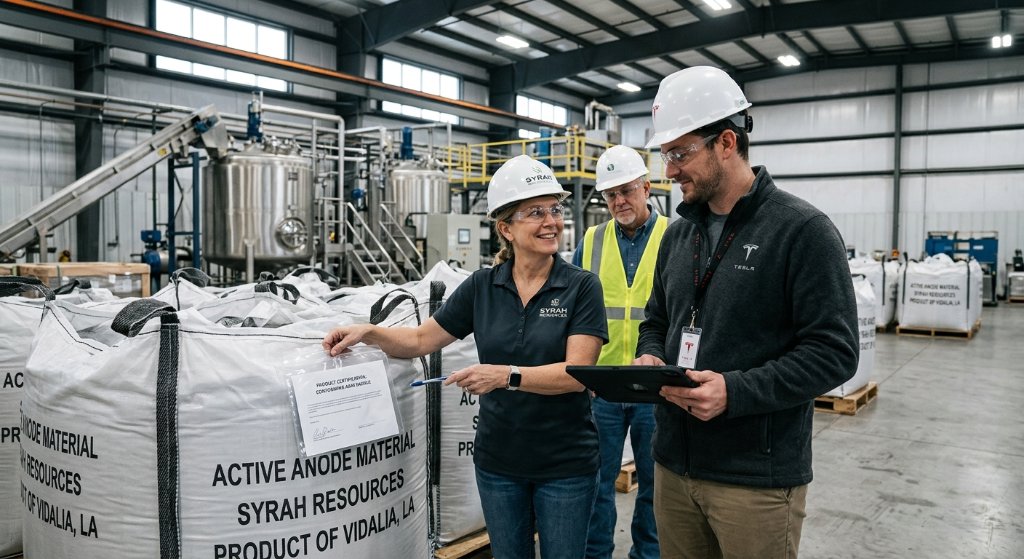
For years, Western automakers have talked a big game about decoupling from China’s overwhelming monopoly on battery materials, yet actually doing so has proven to be an agonizingly slow and fragile process. Tesla’s high-stakes supply relationship with Australia’s Syrah Resources represents the ultimate test of this transition. In a major relief for the domestic EV supply chain, Tesla has officially withdrawn its notice of intent to terminate its natural graphite agreement with Syrah, securing a critical link for American-made EV batteries.
The decision resolves a high-friction dispute that began in July 2025, when Tesla issued a default notice alleging that Syrah’s Vidalia processing facility in Louisiana had failed to deliver conforming active anode material (AAM) samples. After granting four deadline extensions, Tesla has finally acknowledged that Syrah has demonstrated the production of compliant, battery-grade graphite samples. The original 2021 agreement—which locks in 8,000 metric tons of AAM annually—remains intact, breathing new life into the United States' bid for critical mineral independence.
The High-Stakes Battle Over Battery Anodes
Graphite is the unsung workhorse of the electric vehicle revolution. It makes up nearly all of the anode material in a standard lithium-ion battery, yet Western automakers are almost entirely dependent on foreign sources. Currently, China controls approximately 70% of natural graphite mining and over 90% of global anode manufacturing capacity. In December 2024, Beijing tightened its grip further by introducing strict graphite export controls targeting the U.S., leaving American manufacturers with zero time to stockpile.
Syrah’s Vidalia facility in Louisiana is the Western hemisphere’s primary hope to counter this dominance. By importing raw graphite mined at its Balama operation in Mozambique and refining it on U.S. soil, Syrah offers the only large-scale, vertically integrated anode supply chain outside of China.
What’s Locked in the Restored Agreement
The revival of this contract represents a vital lifeline for both parties. Here are the key specifications of the restored supply deal:
- Annual Volume: Syrah will supply Tesla with 8,000 metric tons of active anode material (AAM) per year.
- Contract Duration: An initial four-year term, which was originally inked in December 2021.
- Total Capacity: The Vidalia plant operates with an overall capacity of 11,250 metric tons of AAM per annum, meaning Tesla has secured the lion's share of its output.
- Final Approval Clause: While the termination notice is withdrawn, Tesla retains the right to walk away if Syrah fails to achieve final, commercial-scale qualification approval.
Why This Matters:
The resolution of this standoff is a massive win for the U.S. EV industry, but it also underscores the extreme difficulty of building a non-Chinese battery supply chain from scratch.
- Who Wins:
- Syrah Resources: This is a literal "do-or-die" victory. Syrah has a $98 million loan from the U.S. Department of Energy (DOE) secured by the Louisiana facility, which is currently under a strict forbearance agreement. Losing Tesla as a primary buyer could have triggered a financial collapse for the miner.
- Tesla & US EV Buyers: To qualify for the lucrative $7,500 federal EV tax credit under the Inflation Reduction Act (IRA), vehicles cannot contain battery minerals processed by "Foreign Entities of Concern" (FEOC) like China. Securing Vidalia’s graphite keeps Tesla's domestic vehicle lineup eligible for these tax credits, directly keeping costs lower for consumers.
- Who Loses:
- Chinese Suppliers: While China still holds a near-monopoly on the global market, this successful U.S.-based processing setup proves that localized, vertically integrated supply chains are viable. It breaks a precedent of absolute dependency.
- The Bigger Picture:
What makes this deal truly fascinating is that natural graphite prices have plunged by roughly one-third since 2021. In a purely short-term financial environment, Tesla might have been tempted to let the contract die and buy cheaper Chinese material. However, the regulatory stick of the IRA and the carrot of tax-credit compliance have forced Tesla to prioritize supply-chain resilience over bottom-line cost-cutting. This signals to the wider market that Western automakers are willing to pay a premium for localized, compliant minerals to insulate themselves from geopolitical trade wars.
While Syrah is not completely out of the woods—it must still clear the final hurdles of commercial qualification testing—this breakthrough proves that high-quality, Western-refined anode material is no longer just a theoretical concept. As the transition to electric vehicles shifts from a sprint to a marathon, domestic supply chains like the Syrah-Tesla partnership will be the bedrock upon which the next decade of American EV manufacturing is built.