Tesla Secures Colossal $30 Billion Credit Package to Fund AI and SpaceX Expansion
After years of relying on automotive margins to self-fund its ambitious roadmap, Tesla is finally calling in the heavy financial cavalry. In a massive...
Editorial Team
World Of EV
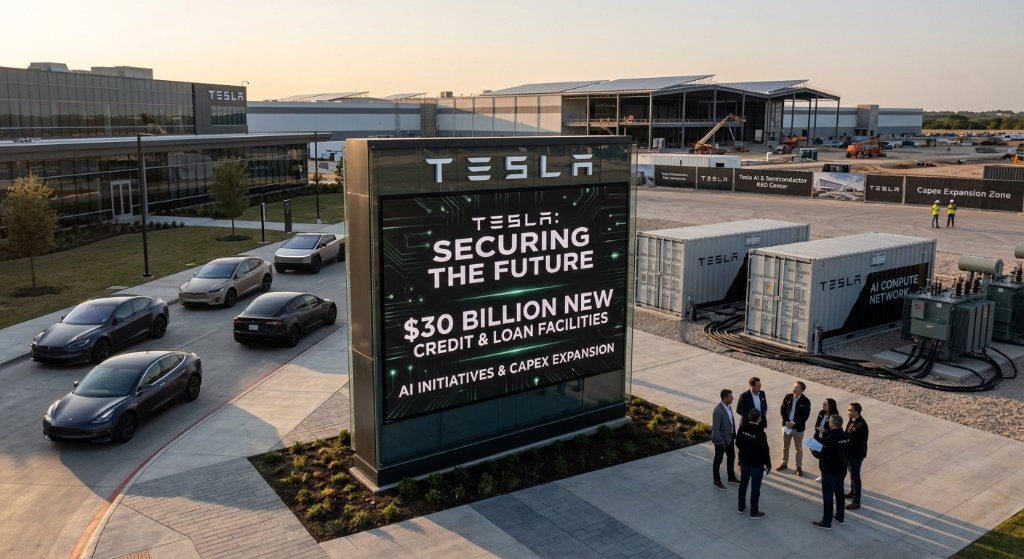
After years of relying on automotive margins to self-fund its ambitious roadmap, Tesla is finally calling in the heavy financial cavalry. In a massive regulatory filing, the EV titan has secured a whopping $30 billion in new credit facilities, replacing its prior, relatively modest $5 billion revolving credit line. This is not just a financial restructuring; it is a dramatic declaration of intent. As Tesla pivots aggressively from building electric cars to mastering artificial intelligence and deep tech, the company is ensuring it has the ultimate safety net to fund its high-risk, high-reward future.
The timing is crucial. While the brand has historically boasted a debt-free, cash-generative balance sheet, its core automotive business is currently facing significant margin compression amid global competition. To maintain its blistering pace of innovation, Tesla is projecting a record capital expenditure (CapEx) of over $25 billion this year—a massive leap from the $8.53 billion spent in 2025. With analysts forecasting a negative free cash flow of nearly $9.8 billion for the year, this $30 billion war chest acts as a critical buffer, guaranteeing that Tesla's most ambitious tech projects remain completely funded.
Anatomy of the $30 Billion War Chest
The newly structured credit package is divided into three highly flexible, unsecured tranches designed to provide maximum liquidity without diluting shareholders. Notably, Tesla ended its previous agreement with no outstanding balances or penalties, and currently has no plans to draw on this new $30 billion pool of "dry powder" immediately, keeping it in reserve.
The credit line breaks down as follows:
- $20 Billion Delayed-Draw Term Loan: Led by Citibank, this senior unsecured three-year facility matures on September 29, 2029. Staged to match major capital milestones, Tesla can draw from it up to ten times over an 18-month window.
- $8 Billion Five-Year Revolving Credit: Led by Wells Fargo, this multi-currency (USD, GBP, EUR) facility includes up to $500 million in letters of credit and matures in September 2031, with options for extensions.
- $2 Billion 364-Day Revolving Credit: Also led by Wells Fargo, this short-term facility provides an instant liquidity buffer and terminates on September 28, 2027.
- Built-In Expansion: Tesla holds the option to increase commitments across the two revolvers by up to $4 billion, potentially pushing total revolving capacity even higher.
Funding the Next Era of Deep Tech
This massive influx of capital is not aimed at ramping up traditional vehicle assembly lines. Instead, Tesla’s filing points directly to the bleeding-edge initiatives championed by Elon Musk. The financing is earmarked for three primary domains:
- AI Compute Infrastructure: Purchasing the massive computational clusters required to train Full Self-Driving (FSD) neural networks and power the brain of the Optimus humanoid robot.
- In-House Semiconductor Fabrication: Financing custom chip design and fabrication projects to secure Tesla's silicon supply chain and optimize processing power at the hardware level.
- SpaceX Solar Partnerships: Backing joint solar cell-manufacturing capacity with SpaceX, targeting a colossal joint goal of 200 gigawatts of annual production.
By securing these credit facilities, Tesla guarantees it can maintain its blistering pace of deep-tech development even if the broader automotive market faces temporary headwinds.
Why This Matters:
This is a do-or-die era for Tesla, and this $30 billion credit package is the ultimate shield. By establishing this colossal liquidity backup, Tesla is fundamentally changing the rules of the automotive and tech sectors.
- The AI Arms Race is Funded: Tesla is no longer just competing with Ford or BYD; it is in a direct computing battle with Nvidia, Meta, and Google. With a negative free cash flow of $9.78 billion projected for 2026 due to aggressive CapEx, this deal ensures that Tesla's data centers keep expanding without threatening the company's solvency.
- No Dilution, Pure Execution: Many market observers feared that Tesla would have to issue new stock to cover its massive $25 billion CapEx demands, which would dilute existing shareholders. Instead, by leveraging its excellent credit standing with giants like Citibank and Wells Fargo, Tesla has secured non-dilutive, flexible financing.
- The Tesla-SpaceX Ecosystem Deepens: Earmarking funds for a semiconductor and solar partnership with SpaceX demonstrates that Elon Musk’s empire is becoming increasingly interconnected. This synergy utilizes SpaceX’s industrial scale to rapidly advance Tesla’s energy and hardware ambitions, even if it draws occasional corporate governance questions.
- Wall Street's Stamp of Approval: Underwriting $30 billion in unsecured debt is a monumental show of faith by traditional banks. It proves that Wall Street views Tesla not as a struggling car company experiencing margin squeeze, but as a premium AI and infrastructure bet with a highly viable long-term runway.
Conclusion
Tesla’s $30 billion credit coup is the financial bedrock of its next decade. By transforming its balance sheet to match its gargantuan AI and energy ambitions, Tesla has insulated itself from the cyclical volatility of the auto market. The message to competitors is clear: Tesla is playing a completely different game, and it has the financial firepower to play it to the end.