Tesla Semi Invades Europe: Demonstration Runs Slated for H1 2027 as Giga Nevada Prepares for Global Export
At the IAA Transportation 2026 keynote in Hannover, Germany, Dan Priestley—head of Tesla’s Semi program—dropped a bombshell that will shake the Europe...
Editorial Team
World Of EV
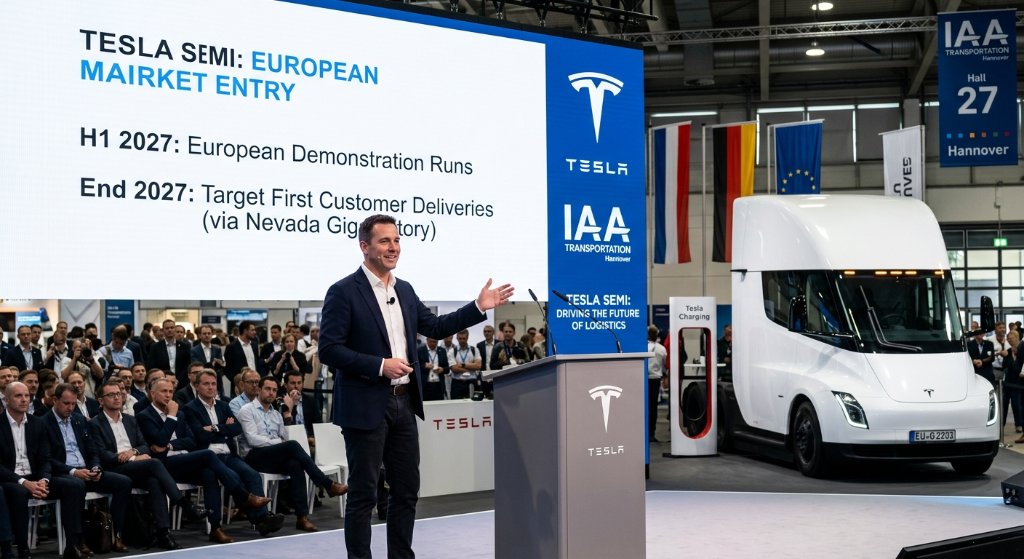
At the IAA Transportation 2026 keynote in Hannover, Germany, Dan Priestley—head of Tesla’s Semi program—dropped a bombshell that will shake the European logistics industry to its core: the Tesla Semi is officially heading across the Atlantic. Tesla will kick off European demonstration runs of the heavy-duty electric hauler in the first half of 2027, targeting the first official customer deliveries by the end of that year.
This is a massive pivot for a program that skeptics once wrote off as "vaporware." First unveiled in 2017 with a promised 2019 launch, the Semi suffered years of production delays before a tiny, hand-built pilot fleet finally reached PepsiCo in late 2022. By shifting focus to Europe, Tesla is signaling that its production bottlenecks are finally in the rearview mirror, and it is ready to challenge established European trucking giants on their home turf.
Built in Nevada, Tailored for Europe
Instead of waiting to build a local European manufacturing line, Tesla will supply early European units directly from its newly opened, 1.7-million-square-foot high-volume facility adjacent to Gigafactory Nevada in Sparks. This massive $3.6 billion plant features vertical integration with Tesla's own 4680 battery cell production, laying the groundwork for an eventual capacity of 50,000 trucks per year.
To satisfy the unique regulatory and operational demands of the European market, Tesla has specifically tailored the Semi’s specifications:
- Optimized European Specs: The European-bound Semi corresponds to the U.S. Standard Range model, offering an estimated 550 km (342 miles) of range while hauling a full 40-metric-ton gross combination weight.
- Massive Weight Reduction: Tesla managed to slash the truck's curb weight to approximately 9,100 kg (20,000 lbs), preventing the heavy battery pack from eating into the valuable cargo capacity that fleet operators rely on for profitability.
- Aerodynamic Camera Mirrors: Ditching traditional bulky glass mirrors, the European spec features sleek camera-based side mirrors that improve aerodynamics and completely eliminate blind spots.
- Mega-Charging Capability: Operating on an 800-volt architecture, the Semi supports Megawatt Charging System (MCS) speeds of up to 800 kW, recovering 60% of its range in just 30 minutes—perfectly matching the mandatory rest breaks for European drivers.
- Auxiliary Power (ePTO): The truck includes an integrated 25 kW electric power take-off (ePTO) system designed to power auxiliary trailer systems like refrigeration units.
Why This Matters:
The European launch of the Tesla Semi represents a seismic event for the logistics and commercial vehicle markets.
The Big Winners: Fleet Operators. With European diesel prices sitting historically high, the total cost of ownership (TCO) calculation heavily favors electrification. Tesla's highly efficient 1.0 kWh/km energy consumption means freight companies could see their operational costs slashed compared to fossil fuels. The 550 km range also aligns perfectly with strict European driver rest-mandates (which require a break every 4.5 hours), meaning the truck can recharge its battery during standard operator downtime without losing a single minute of productivity.
The Big Losers: Legacy European Truck Makers. Traditional heavyweights like Volvo, Mercedes-Benz (Daimler), Scania, and MAN have enjoyed a comfortable head start in the European electric truck sector. However, they lack Tesla’s level of vertical integration, proprietary charging network ecosystem, and software-defined vehicle architecture. Furthermore, with estimated pricing starting under $300,000, Tesla can severely undercut local European offerings that often carry much higher price premiums.
The Strategic Signal: By utilizing its expanded Nevada Gigafactory to supply the European market, Tesla is leveraging its manufacturing scale to outpace local competitors before committing to costly domestic expansion in Europe (such as at Gigafactory Berlin). It shows that Tesla’s commercial arm is no longer a side project; it is a primary driver of the company’s next phase of global growth.
Conclusion
Tesla's aggressive 2027 timeline for the European Semi proves that the automaker is finally serious about conquering global freight. While legacy manufacturers in Europe have spent years running small-scale electric truck trials, Tesla's massive production capacity in Nevada allows it to leapfrog the competition with a highly optimized, cost-effective product from day one. When demonstration runs begin in early 2027, the quiet hum of the Tesla Semi will likely sound like a warning bell for the rest of the commercial trucking industry.