Tesla Semi Slated for Autonomous Flight: Musk Targets FSD Launch by Early 2027 to Tackle Driver Shortages
Tesla is finally preparing to unleash its heavy-duty weapon. During the company’s Q2 2026 earnings call, CEO Elon Musk laid down a concrete timeline f...
Editorial Team
World Of EV
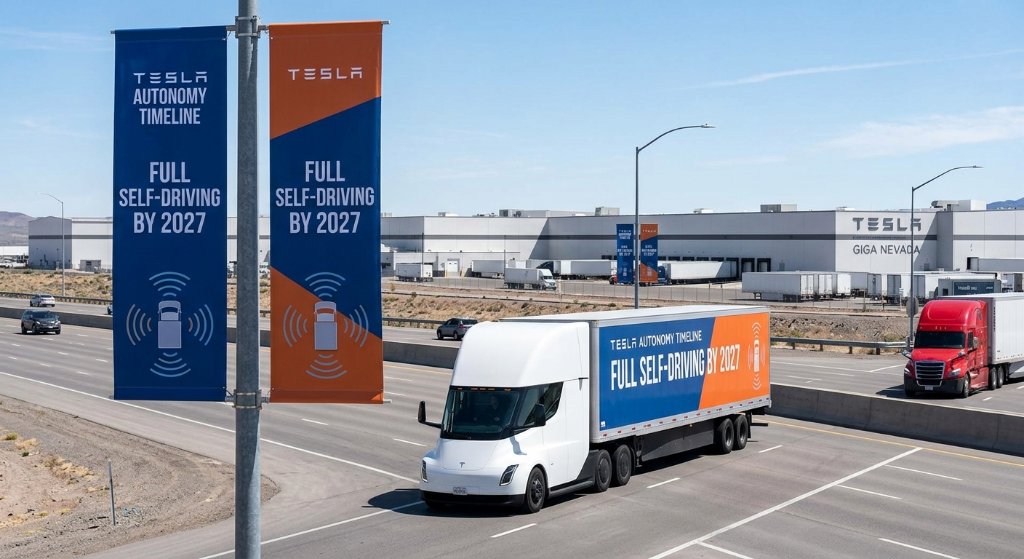
Tesla is finally preparing to unleash its heavy-duty weapon. During the company’s Q2 2026 earnings call, CEO Elon Musk laid down a concrete timeline for Full Self-Driving (FSD) on the Tesla Semi, indicating the system should start functioning by the end of this year or early 2027. It’s a major pivot for the long-delayed Class 8 electric hauler, which has spent years playing second fiddle to Tesla’s passenger vehicle fleet.
This development marks a critical shift. When Musk first unveiled the Tesla Semi in November 2017, the logistics industry was promised a rapid rollout by 2019. Instead, what followed was a grueling saga of delayed production timelines, battery supply bottlenecks, and only a trickle of hand-built deliveries to early partners like PepsiCo in late 2022. Now, with Tesla’s massive 1.7-million-square-foot Nevada expansion finally running a high-volume assembly line, the hardware is in place. Autonomy is the next logical—and highly lucrative—step.
The Focus: Solving the Passenger Car 'March of Nines' First
Why has FSD for the Semi taken so long to arrive? Musk didn't mince words on the earnings call, framing the delay as a strategic allocation of limited engineering bandwidth. The autonomy team’s focus has been strictly locked onto the mass market—specifically perfecting FSD on the Model 3, Model Y, and the newly launched Cybercab at Gigafactory Texas.
Musk explained that diluting the software team’s attention to adapt FSD to an 80,000-pound rig would have compromised what he calls the 'march of nines'—the agonizingly difficult push to transition FSD from a 99.9% reliable supervised system to a completely generalized, unsupervised autonomous network. With passenger vehicles making up the overwhelming majority of Tesla's fleet, those vehicles took priority. However, with unsupervised FSD on cars nearing maturity, Tesla is ready to direct its real-world AI powerhouse to commercial shipping.
Bridging the Gap in Nevada
The timeline for the Semi's FSD release is engineered to align perfectly with the manufacturing ramp-up in Sparks, Nevada. After years of relying on a slow pilot line, Tesla officially kicked off series production at its new dedicated facility in April 2026. Crucially, the plant is nestled right next to Gigafactory Nevada. This vertical integration allows the Semi to directly source its locally produced 4680 battery cells, stripping away the massive logistics bottlenecks that plagued the truck's early years.
While validation rigs and sensor arrays have already been spotted testing on California highways, the production Semis rolling off the assembly line are fully equipped for the autonomous future. Key specifications of this production-ready freight disrupter include:
- Two Formidable Trims: A Standard Range model boasting a 548 kWh battery (offering 325 miles of range) and a Long Range model equipped with an 822 kWh battery (stretching up to 500 miles on a single charge) at a full 82,000-lb gross combination weight.
- Competitively Priced: The Standard Range version starts at approximately $260,000, while the 500-mile Long Range variant is priced near $290,000, making them some of the most aggressive Class 8 electric options on the market.
- Integrated Autonomy Hardware: Production Semis are now rolling off the line equipped with a native array of ten AI4-based cameras, completely built into the cab rather than retrofitted.
Why This Matters:
This is more than a software update; it is an existential threat to traditional freight and a massive shot in the arm for Tesla's long-term margins.
The logistics industry is currently being choked by a massive, structural trucker shortage. Finding drivers willing to spend weeks away from home on grueling long-haul routes is becoming harder and more expensive by the day. By delivering an autonomous Semi, Tesla is offering fleet operators a silver bullet: a truck that doesn't need sleep, doesn't draw a salary, and operates at an energy cost of less than two kilowatt-hours per mile.
Furthermore, this is a clear warning shot to autonomous trucking startups like Aurora Innovation, Kodiak, and Gatik. Unlike those companies, which must painstakingly negotiate and integrate their autonomous stacks with third-party truck OEMs (like Peterbilt or Volvo), Tesla builds the hardware, the software, and the battery cells in-house. This complete vertical integration eliminates structural integration risks and allows Tesla to scale at a speed that pure-play software competitors simply cannot match. If Tesla achieves unsupervised FSD on the Semi by 2027, they won’t just capture the electric truck market—they will command the entire commercial shipping economy.
Looking to the Future
As Tesla’s capital expenditure spikes to build out its AI, robotaxi, and manufacturing infrastructure, the company is making it clear that near-term margin protection is secondary to total technological dominance. Perfecting autonomous freight could be the ultimate validator of this high-risk strategy. If the Semi can successfully shoulder the burden of heavy-haul shipping without a driver by early 2027, Tesla will have solved one of the most stubborn links in the global supply chain, turning a long-delayed project into an unassailable commercial empire.