Tesla Semi Targets Europe: Hanover Debut Triggers Electric Freight War with Volvo and Mercedes
### The European Offensive Begins in Hanover Tesla is officially taking its heavy-duty disruptor across the Atlantic. The electric vehicle pioneer ha...
Editorial Team
World Of EV
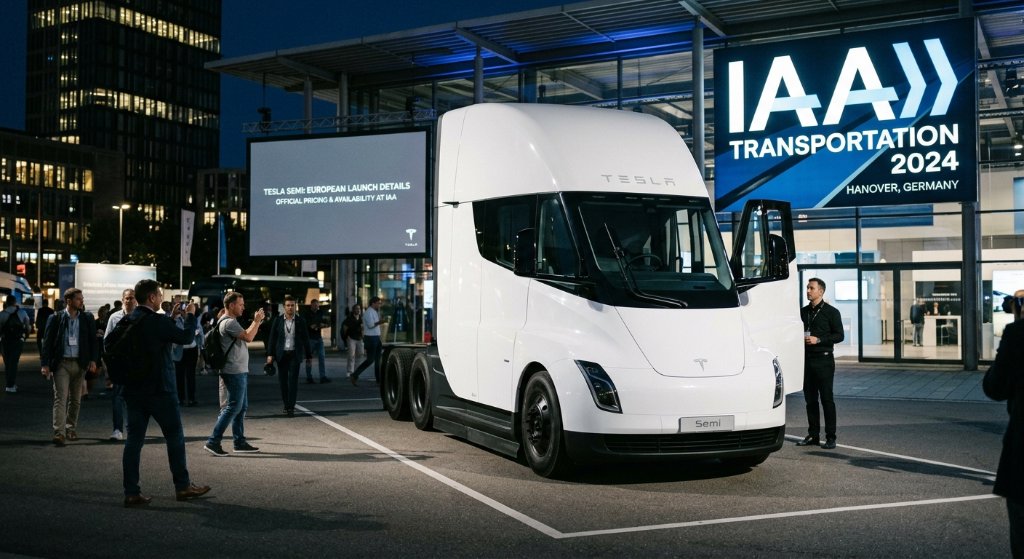
The European Offensive Begins in Hanover
Tesla is officially taking its heavy-duty disruptor across the Atlantic. The electric vehicle pioneer has confirmed it will reveal the highly anticipated European launch details—including pricing, delivery timelines, and market-specific regional configurations—for the Tesla Semi at the IAA Transportation trade show in Hanover, Germany, this September.
For years, Tesla kept the Semi confined to North American pilot programs, primarily hauling chips for Frito-Lay and sodas for PepsiCo. Meanwhile, European legacy giants like Volvo, Scania, and Mercedes-Benz (Daimler) capitalized on Tesla's slow ramp, locking down the continent's early electric truck market with platforms like the Mercedes eActros 600. Now, Tesla is ready to disrupt their home turf, signaling a high-stakes showdown for the future of European commercial freight.
Inside the Battle Plan: Hanover, Einride, and EMEA Hires
Tesla's European launch is not a speculative trial balloon—it is a coordinated commercial invasion. The company is actively laying the groundwork to ensure the Semi hits the ground running:
- The Beachhead Order: On August 18, Swedish freight technology pioneer Einride AB placed a major order for 50 Tesla Semis. Einride plans to integrate these trucks directly into its proprietary Saga AI fleet-management platform, immediately establishing a high-profile, software-optimized footprint on European soil.
- Building the Sales Army: Behind the scenes, Tesla is aggressively recruiting Business Development Managers across the EMEA (Europe, Middle East, and Africa) region. This targeted hiring spree focuses on executives who can navigate complex enterprise fleet sales and local regulatory frameworks.
- The Charging Play: Success in Europe hinges on infrastructure. Tesla will detail its plans to expand its proprietary Megawatt Charging System (MCS) across Europe, capitalizing on the continent's rapidly developing high-power charging corridors.
Heavyweight Showdown: Tesla Semi vs. Legacy Giants
To win over conservative European fleet managers, Tesla must prove the Semi can outperform established local rivals. The competition is formidable, but the Semi's paper specs present a compelling threat:
- Tesla Semi: Features a tri-motor propulsion system delivering over 1,000 horsepower. Its long-range variant boasts an advertised range of 500 miles (approximately 800 km) and can recoup 70% of its battery in just 30 minutes via megawatt-class fast chargers.
- Mercedes-Benz eActros 600: The current German benchmark features a 621 kWh Lithium Iron Phosphate (LFP) battery, delivering a highly respectable real-world range of 500 km (310 miles) and an ultra-durable e-axle designed to last 1.2 million kilometers.
- Volvo FH Electric: The reigning sales leader in European heavy-duty EVs offers world-class build quality and ergonomics but is primarily restricted to regional distribution rather than ultra-long-haul corridors.
Why This Matters:
This is a defining crossroads for the commercial transport industry. Tesla is no longer just a passenger car company trying to sell a cool lifestyle; it is positioning itself as the backbone of global logistics.
The Winners: Logistics operators and environmental regulators. As Tesla enters the fray, price wars are inevitable. Fleet operators looking to slash operating costs and meet strict European Union carbon-reduction mandates will suddenly have immense leverage. Third-party charging developers like Milence will also win as the demand for standardized Megawatt Charging Systems skyrockets.
The Losers: European legacy truck manufacturers. Companies like Volvo and Daimler have enjoyed a comfortable, slow-paced transition to electric, relying on existing dealership networks and customer loyalty. Tesla’s vertical integration, superior software ecosystem, and unmatched battery efficiency threaten to render traditional commercial sales models obsolete.
The Do-or-Die Factor: This is Tesla's most critical market expansion to date. If the Semi fails to gain traction in Europe—where diesel fuel is highly taxed and environmental mandates are aggressive—it will prove that Tesla's commercial ambitions are limited. But if the Semi succeeds, it will cement Tesla's dominance over the lucrative global freight market, leaving legacy manufacturers to scramble for survival.
A New Era for European Freight
Tesla’s arrival in Hanover this September marks the end of the experimental phase for electric trucking in Europe. With major enterprise backing from Einride and a dedicated commercial team scaling up across EMEA, the Tesla Semi is poised to turn the theoretical transition to zero-emission shipping into a brutal, highly competitive market reality. Legacy truckmakers have been warned: the honeymoon is officially over.