Tesla Shakes Up US Solar Market with Massive $10 Billion 'Project Crystal Sun' Texas Mega-Factory Proposal
For years, Tesla’s energy division—specifically its solar arm—has lived in the shadow of its high-profile electric vehicle business. Ever since Tesla ...
Editorial Team
World Of EV
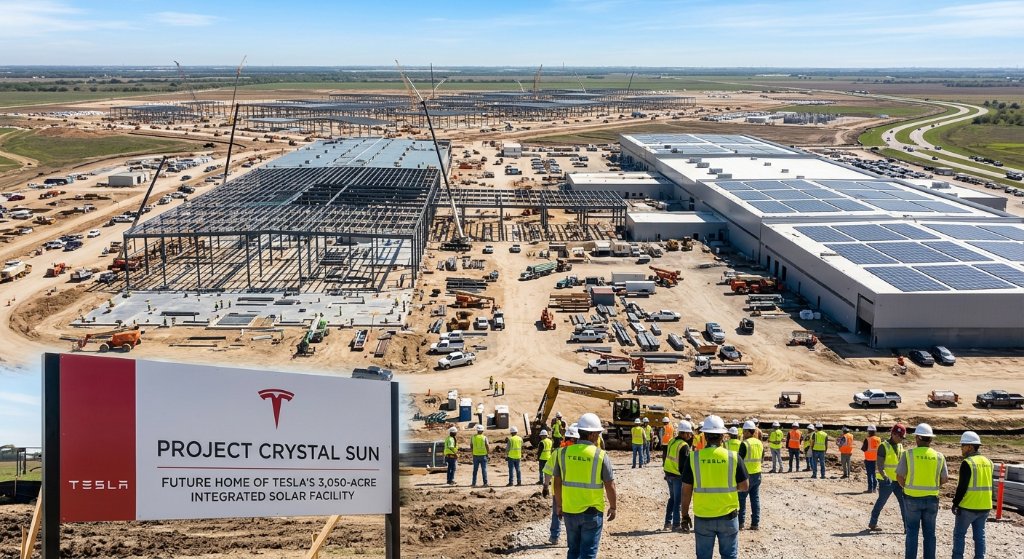
For years, Tesla’s energy division—specifically its solar arm—has lived in the shadow of its high-profile electric vehicle business. Ever since Tesla acquired SolarCity in 2016 for $2.6 billion, the company has struggled to match its automotive dominance in the solar space. Its Gigafactory 2 in Buffalo, New York, originally slated to be a solar manufacturing powerhouse, ultimately pivoted toward battery assembly and Autopilot data labeling after Panasonic pulled out of cell production in 2020. But Tesla is finally ready to stop relying on external suppliers and build an energy empire on its own terms.
The company has officially filed a tax-incentive application under Texas’s Jobs, Energy, Technology and Innovation (JETI) Act for "Project Crystal Sun," a proposed $10.1 billion, 3,050-acre vertically integrated solar cell factory in Fort Bend County, Texas. This is not just another assembly line; it is a ground-up attempt to bring China-style, full-stack solar manufacturing directly to American soil.
Replicating China's Vertical Integration Model
Project Crystal Sun represents the largest single manufacturing investment Tesla has ever proposed on paper. Located just 40 minutes southwest of Houston near Richmond, the massive campus is designed to bypass the highly fragmented traditional solar supply chain. While most domestic solar companies simply import photovoltaic cells from Southeast Asia to assemble and frame them locally, Tesla plans to execute the entire process under one roof.
Key specifications and details of the proposed megaproject include:
- Capital Investment: A staggering $10.116 billion, allocating approximately $1.5 billion to real property and $8.6 billion to advanced manufacturing equipment.
- The Footprint: Over 3,050 acres of greenfield land in Lamar Consolidated ISD, Fort Bend County.
- True In-House Manufacturing: End-to-end production covering ingot manufacturing, wafer fabrication, coating, metallization, cell testing, and final module assembly.
- Job Creation: 9,712 permanent, full-time jobs once fully operational, in addition to 1,147 peak construction roles.
- Timeline: Construction is scheduled to run from 2026 to 2028, with commercial operations targeted to begin in Q1 2029.
Leveraging the JETI Act and Tariffs
To make the astronomical numbers work, Tesla is seeking a 10-year property-tax limitation under the newly established JETI Act. In its filing, Tesla has been candid: Texas is not a guaranteed home for the project yet. The automaker is actively evaluating at least one competing out-of-state location, using the tax incentive as a critical tool to offset Texas's higher recurring property taxes.
This massive push is a direct response to shifting geopolitical sands. With ongoing tariff wars targeting foreign clean energy components, relying on imported solar cells has become a high-risk liability. By processing raw polysilicon into finished modules in Texas, Tesla secures its supply chain against global shocks, sidesteps trade penalties, and maximizes domestic manufacturing tax credits under the federal Inflation Reduction Act (IRA).
Why This Matters:
This is a defining, high-stakes moment for Tesla’s clean energy business. For nearly a decade, critics dismissed Tesla Solar as a sideshow to the Model 3 and Model Y. Project Crystal Sun changes everything, signaling that CEO Elon Musk is finally getting serious about his ambitious goal to manufacture 100 gigawatts (GW) of solar power annually in the United States.
- Who Wins: Texas and the domestic clean energy industry. If approved, this plant will instantly turn Fort Bend County into the epicenter of American solar manufacturing. Rather than playing defense against cheap imports, the US will host a gigafactory capable of producing solar cells from raw materials at an unprecedented scale. This also creates a massive synergy with Tesla's booming Megapack energy storage business, allowing the company to offer fully integrated, US-made utility energy packages.
- Who Loses: Traditional US solar assemblers and foreign cell manufacturers. Companies that rely on importing cheap Asian photovoltaic cells to assemble modules in the US will find it increasingly difficult to compete with Tesla’s vertically integrated margins. Geopolitically, it represents a direct challenge to China’s near-monopoly on the early stages of the solar supply chain (ingots and wafers).
- The Market Signal: This project proves that Tesla is no longer content being just an EV company. By heavily investing in the upstream energy supply chain, Tesla is positioning itself as a vertically integrated grid-scale utility player. This is a massive, high-stakes bet that the future of energy is just as profitable as the future of transport.
Tesla’s Project Crystal Sun is a bold, $10 billion declaration that the future of clean energy must be built from the ground up, right here in America. If Tesla secures the JETI tax incentives and breaks ground in 2026, the Fort Bend facility will not only revive Tesla’s solar ambitions but could single-handedly reshape the global renewable energy landscape by 2029.