Tesla, Sunrun, and Renew Home Team Up on Massive 16 GW Virtual Power Plant to Fuel AI's Energy Surge
On June 24, 2026, three of the largest players in clean energy and home automation shook up the utility landscape by announcing a gargantuan partnersh...
Editorial Team
World Of EV
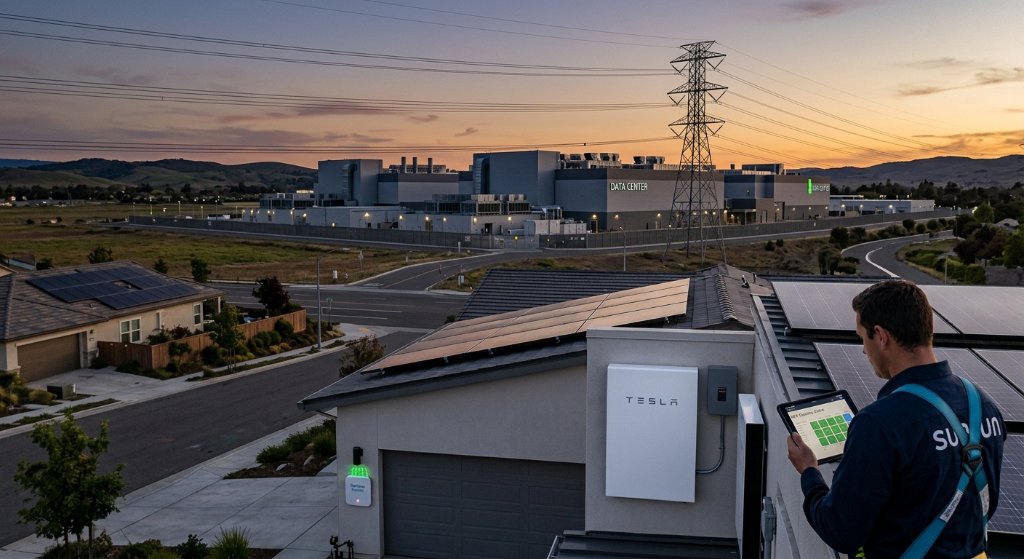
On June 24, 2026, three of the largest players in clean energy and home automation shook up the utility landscape by announcing a gargantuan partnership to aggregate more than 16 gigawatts (GW) of flexible energy capacity. Tesla, Sunrun, and Renew Home are uniting to form the nation's largest virtual power plant (VPP), targeting the tech hyperscalers and utilities currently struggling to power the global artificial intelligence boom.
For years, the rapid growth of electric vehicles and home electrification has put pressure on aging grids, but the sudden explosion of power-hungry AI data centers has pushed infrastructure to the breaking point. Traditional utility expansion—building new transmission lines, substations, and gas peaker plants—takes anywhere from five to ten years to permit and build. This massive new VPP sidesteps that bureaucracy entirely, delivering dispatchable, decentralized power to the grid in months, rather than years, by leveraging assets that are already sitting in consumers' homes.
The 'Capacity-as-a-Solution' Blueprint
Under a novel "capacity-as-a-solution" framework, the three companies are pooling together their massive residential networks. Instead of asking data centers to throttle down operations or relying on fossil-fuel plants during high-stress hours, utilities can tap this distributed ecosystem to immediately balance the grid.
Key details of how this 16.8 GW monster VPP will operate include:
- A Massive Combined Fleet: The alliance aggregates hundreds of thousands of residential solar-plus-battery systems (driven by Tesla's Powerwall fleet and Sunrun's subscription services) with over 8 million smart thermostats and devices managed by Renew Home (a leading energy platform backed by Google Nest services).
- Fast and Footprint-Free Deployment: The solution requires zero additional hardware, permitting, water, land usage, or complex grid interconnection procedures because the devices are already installed in homes.
- The 'Data Center Alley' Proof of Concept: The partnership is deploying 300 megawatts (MW) of capacity immediately in Virginia—the heart of the world's largest concentration of data centers—with plans to scale that to 500 MW by 2030.
Bridging the Divide Between Homeowners and Big Tech
Historically, Virtual Power Plants have been limited to local pilots or regional demand-response programs, like Tesla's electric utility plan in Texas or Sunrun's VPP in California. This partnership represents a massive scaling of that concept, allowing everyday EV owners and solar adopters to play a direct role in the AI economy.
For homeowners and EV drivers, the benefits of participating in this ecosystem are tangible:
- Reduced Power Bills: Households utilizing these smart-grid programs will see automated AI-driven tools shift energy use to cleaner, cheaper off-peak hours.
- Direct Participation Rewards: Users will earn financial rewards and savings for allowing their batteries and smart devices to support the grid during periods of peak stress.
- Empowering EV Integration: As home EV chargers represent some of the largest electrical loads on residential panels, integrating them into smart orchestration makes vehicle-to-grid (V2G) capability the next logical step.
Why This Matters:
This is a watershed moment for the decentralized energy market. For years, skeptics dismissed VPPs as a niche concept. Today, the acute power crunch of generative AI has turned what was once a green initiative into a hard-nosed, multi-billion-dollar business necessity.
Who Wins:
- Tesla and Sunrun: This is a major validation of their business models. Sunrun's stock surged as much as 26% on the day of the announcement, reflecting Wall Street's realization that residential solar can monetize AI's power crunch. For Tesla, it cements the Powerwall as a critical grid-level infrastructure asset, not just a residential backup battery.
- Tech Hyperscalers (Google, Microsoft, Meta): These giants are desperate for fast power to build out AI clusters. By financing "capacity-as-a-solution," they can prove to local utilities that their data centers won't crash the regional grid, bypassing years of transmission queues.
- EV Owners and Homeowners: Households get to monetize their energy hardware, dramatically lowering the total cost of ownership for home batteries, solar, and electric vehicles.
Who Loses:
- Legacy Fossil-Fuel Peaker Plants: The primary utility response to peak demand has long been firing up expensive, polluting gas-turbine peaker plants. This 16 GW VPP represents a massive direct threat to that carbon-heavy industry.
- Unprepared Utilities: Power companies that refuse to integrate third-party distributed energy resources will face growing public pressure and political backlash as data centers strain local resources while cleaner, faster VPP options sit on the sidelines.
Conclusion
The alliance of Tesla, Sunrun, and Renew Home proves that the grid of the 21st century cannot rely solely on 20th-century centralized infrastructure. By turning millions of homes into a coordinated, fast-dispatch resource, this 16.8 GW framework provides a masterclass in modern energy management. For EV owners, tech giants, and utilities alike, the message is clear: the future of energy is distributed, digitized, and already sitting in our garages.