Tesla Telemetry Clashes with Driver Claims: Why the Fatal Katy, Texas Crash is a Watershed Moment for Autopilot Scrutiny
A tragic, high-speed collision in Katy, Texas, has reignited the high-stakes battle over autonomous vehicle safety and liability. On Friday evening, J...
Editorial Team
World Of EV
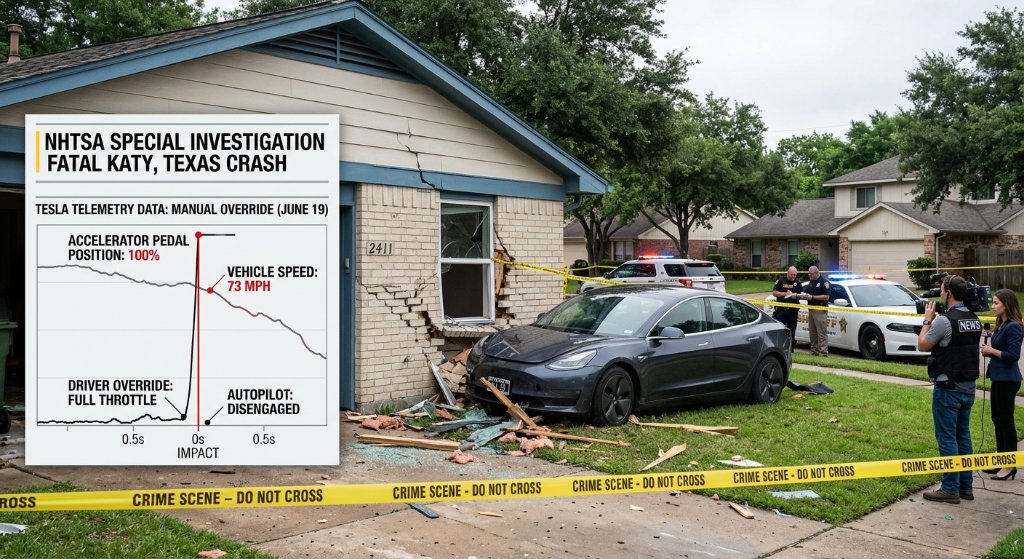
A tragic, high-speed collision in Katy, Texas, has reignited the high-stakes battle over autonomous vehicle safety and liability. On Friday evening, June 19, a Tesla Model 3 blasted through a residential street and slammed into a two-story brick home, killing 76-year-old grandmother Martha Avila inside. While the driver immediately claimed the vehicle was operating on Autopilot at the time of the crash, Tesla has fired back with concrete telemetry data that paints a vastly different picture—one of absolute driver error.
This tragic incident comes at a precarious moment for the Austin-based automaker. For years, Tesla has walked a fine line between promoting its advanced driver-assist systems (ADAS) as the future of autonomy and reminding drivers they must remain fully attentive. With the National Highway Traffic Safety Administration (NHTSA) launching a special crash investigation into the Katy tragedy, the industry is once again forced to confront a recurring, dangerous phenomenon: "mode confusion" and pedal misapplication.
What the Telemetry Tells Us
On Monday, June 22, Tesla’s executive leadership broke their silence to aggressively counter the driver’s narrative. Tesla’s Vice President of AI Software, Ashok Elluswamy, and CEO Elon Musk went public with vehicle data logs that they claim definitively exonerate the Model 3’s Autopilot system. According to Tesla's onboard black box data:
- 100% Accelerator Override: The driver manually overrode the self-driving system by depressing the accelerator pedal fully to 100%.
- Excessive Residential Speed: The Model 3 reached a terrifying speed of 73 mph in a quiet neighborhood with a 300-foot proximity to a local elementary school.
- No Post-Impact Release: The telemetry reveals the driver kept the accelerator pedal pinned to the floor even after the vehicle rammed into the home.
Musk dismissed the Autopilot claims outright, stating, "This makes no sense. FSD drives slowly through neighborhood streets, and this was a high-speed crash!"
A History of the "Autopilot Blame Game"
This is far from Tesla's first rodeo when it comes to drivers scapegoating its driver-assist software. Over the past decade, NHTSA and the National Transportation Safety Board (NTSB) have investigated numerous high-profile crashes where drivers initially blamed Autopilot or Full Self-Driving (FSD), only for telemetry to prove manual override.
- The 2021 Spring, Texas Crash: Early reports alleged a driverless Tesla Model S caused a fiery fatal crash. A thorough NTSB investigation later proved the driver was indeed in the driver's seat and had mashed the accelerator to 98.8% capacity.
- Pedal Misapplication Epidemic: Independent safety audits frequently show that when drivers panic, they occasionally experience "sudden unintended acceleration"—which is almost always a case of pressing the accelerator thinking it is the brake.
- The Regulatory Spotlight: NHTSA's newly launched special investigation joins a mounting portfolio of federal probes into Tesla’s Autopilot and FSD, which are already under intense scrutiny for how they monitor driver engagement.
Why This Matters:
This crash represents a critical inflection point for the entire electric and autonomous vehicle industry.
For Tesla, the stakes could not be higher. The company is currently pivoting its entire valuation toward AI, robotics, and the rollout of its unsupervised Robotaxi network (which debuted its pilot program right here in Texas). Any high-profile fatality that can be successfully pinned on Autopilot or FSD threatens to derail Musk’s grand vision of a driverless future. By moving instantly to release the telemetry data, Tesla is attempting to protect its brand from a potentially devastating public relations hit and pre-emptively manage regulatory fallout.
However, the "driver error" defense opens up a different, equally thorny avenue of criticism: user interface and system safety. If drivers are repeatedly suffering from "mode confusion"—wherein they are unsure whether they or the car is in control—is the system inherently unsafe? Regulators like NHTSA may increasingly pressure Tesla to implement stricter lockouts or physical barriers to override. If a driver can effortlessly override an active safety system to reach 73 mph in a residential zone, critics will argue the car's software should have intervened to prevent such catastrophic kinetic energy release, regardless of who was pushing the pedal.
Ultimately, this is a lose-lose scenario for public trust. Whether the culprit is a software glitch or a panicked driver, the optics of a multi-ton EV breaching a suburban home and taking an innocent life will fuel the fires of those pushing for tighter legislative caps on ADAS technologies.
Conclusion
As federal investigators from the NHTSA begin the painstaking process of reconstructing the Katy crash, the industry waits to see if Tesla’s telemetry holds up under federal forensic scrutiny. One thing is certain: the line between human and machine responsibility is blurrier than ever. If EV makers want to secure the autonomous future they are selling, they must find a way to solve the human element of the equation—because even the most advanced AI is only as safe as the human who can override it.