Tesla Throttles Model Y Robotaxi Growth: A High-Stakes Bet on Cybercab and FSD V15
After years of using its bestselling Model Y crossover to pilot autonomous driving, Tesla is abruptly changing gears. A newly released JPMorgan invest...
Editorial Team
World Of EV
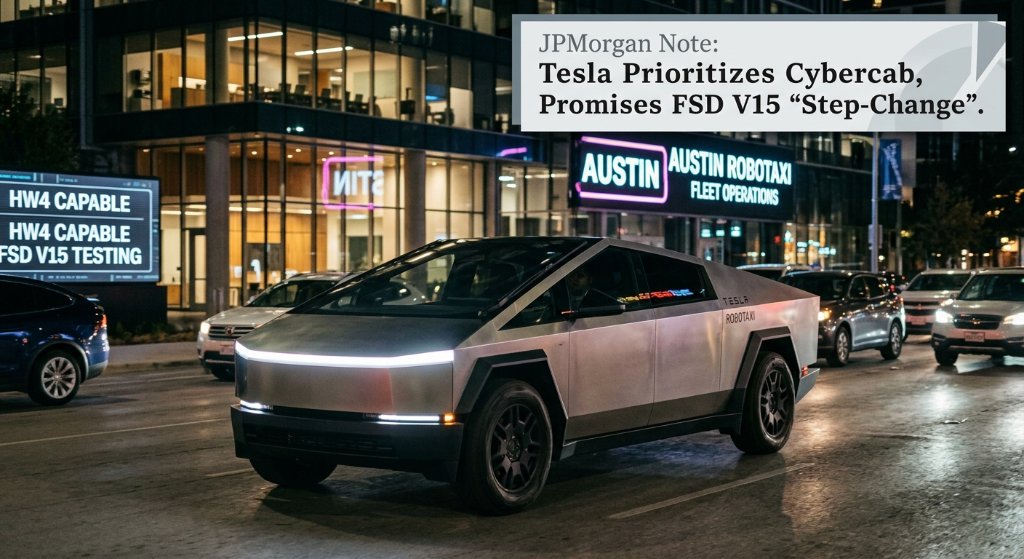
After years of using its bestselling Model Y crossover to pilot autonomous driving, Tesla is abruptly changing gears. A newly released JPMorgan investor note following a Fremont factory tour reveals that Elon Musk’s automaker is intentionally limiting the integration of Model Y vehicles into its nascent robotaxi fleet. Instead, Tesla is redirecting its massive scaling efforts toward its purpose-built, steering-wheel-free Cybercab, alongside its next-generation software, Full Self-Driving (FSD) V15.
This is a high-stakes, strategic pivot. While rivals like Alphabet’s Waymo scale rapidly by retrofitting consumer-grade electric crossovers, Tesla is betting that a purpose-built platform is the only viable path to true, high-margin, mass-market autonomy. By bottlenecking the Model Y’s deployment, Tesla is signaling that the era of adapted vehicle platforms is drawing to a close, clearing the stage for a dedicated autonomous future.
The Cybercab Shift: Why Model Y is Taking a Backseat
Historically, industry observers expected Tesla to flood markets like Austin, Texas, with thousands of modified Model Ys to build immediate coverage. However, the Fremont tour confirmed a starkly different reality: Tesla has restricted its active Austin Model Y robotaxi fleet to just 186 units.
Tesla isn't constrained by production capacity; this is a deliberate operational hold. The company is prioritizing the near-term scaling of the Cybercab, which is expected to begin public rides in Austin as early as this month. The strategic rationale behind this bottleneck includes:
- Drastically Lower Unit Economics: Tesla is targeting an ultra-low total cost of ownership (TCO) of roughly $0.30 per mile with the Cybercab, a figure virtually impossible to achieve with a heavier, more complex five-seater like the Model Y.
- Streamlined Manufacturing: Designed without a steering wheel, pedals, or traditional cabin controls, the Cybercab is built explicitly for unsupervised, low-cost assembly-line scaling.
- Hardware Optimization: Every component of the Cybercab is optimized for continuous autonomous fleet operation, reducing maintenance overhead compared to retrofitted consumer vehicles.
FSD V15: The Seven-Tech Architectural Reset
To unlock the Cybercab's potential, Tesla is relying on its upcoming FSD V15 software, which management describes as an internal 'step-change' comparable to the massive leap from V13 to V14.
V15 is not an incremental update; it is an architectural overhaul. Built on seven core technologies, approximately 40% of V15's software stack is already being actively stress-tested under the hood of Austin’s robotaxi pilot. Key developments for the next-gen system include:
- 10x Larger Neural Network: FSD V15 leverages a massive AI model boasting roughly 10 billion parameters—ten times larger than the 'small' models powering current FSD builds.
- Personalized Driving Dynamics: The system can learn from localized driving patterns and adapt to individual passenger preferences.
- HW4 (AI4) Native Architecture: V15 is built specifically to maximize the compute capabilities of Tesla's HW4 (AI4) suite, with future compatibility mapped to the upcoming AI4.5 upgrade.
The Hardware Paradox: HW4 Promises and HW3 Ghosts
Tesla continues to assert that its current HW4 (AI4) suite is fully capable of unsupervised driving. However, this claim is met with heavy skepticism from seasoned industry analysts and consumer advocates.
While Tesla promises that V15 will finally deliver on unsupervised autonomy, the reality on the ground is that customers must still supervise every move the car makes. Critics are quick to point out that Tesla is repeating a well-worn playbook. HW3 (Hardware 3) was sold to consumers for years under the explicit promise of enabling fully autonomous driving. Today, HW3 is struggling under the weight of Tesla's ever-expanding end-to-end neural networks, leaving many legacy buyers feeling left behind. Tesla’s challenge isn't just a technical one; it is a trust deficit.
Why This Matters:
This pivot represents a make-or-break moment for Tesla’s autonomous ambitions.
- The Risks of Restraint: By intentionally holding back the Model Y robotaxi fleet, Tesla is allowing Waymo and Chinese autonomous vehicle giants to entrench themselves in key urban markets. Waymo has already logged hundreds of millions of driverless miles, whereas Tesla's Austin fleet remains a drop in the bucket. If Cybercab production scaling encounters delays—a common theme in Tesla’s history—the company risks falling critically behind in the land-grab phase of the ride-hailing wars.
- The Margin Game-Changer: Conversely, if Tesla successfully scales the Cybercab, they will bypass the massive capital-expenditure trap of retrofitting expensive passenger vehicles. A fleet of $0.30-per-mile Cybercabs would utterly decimate traditional ride-hailing services like Uber and Lyft, while offering a cost structure that Waymo's expensive sensor suites simply cannot match.
- The Software Moat: This strategy proves that Tesla is transitionally morphing from an automotive manufacturer into an AI and platform-as-a-service company. FSD V15 is the true product; the Cybercab is merely its physical vessel. If V15 achieves true, unsupervised driving, Tesla's valuation logic shifts permanently. If it fails, they are left with a niche, two-seat car with no steering wheel.
Conclusion
Tesla's refusal to scale the Model Y robotaxi fleet is a bold statement of confidence in both FSD V15 and the Cybercab platform. It is a classic high-risk, high-reward play from Elon Musk. Rather than taking the safe, incremental route of using existing production assets to slowly build out a robotaxi network, Tesla is jumping straight to the end-game: a dedicated, ultra-low-cost, fully autonomous vehicle running on a massive new AI architecture. Whether this move is remembered as a stroke of strategic genius or another overhyped autonomous promise will depend entirely on how FSD V15 handles the chaotic streets of Austin without a safety driver.