Tesla Unleashes 'Atlas' Semi: High-Volume Production Signals a New Era for Electric Freight
After years of anticipation, design evolutions, and strategic delays, Tesla is finally poised to disrupt the heavy-duty trucking industry with the hig...
Editorial Team
World Of EV
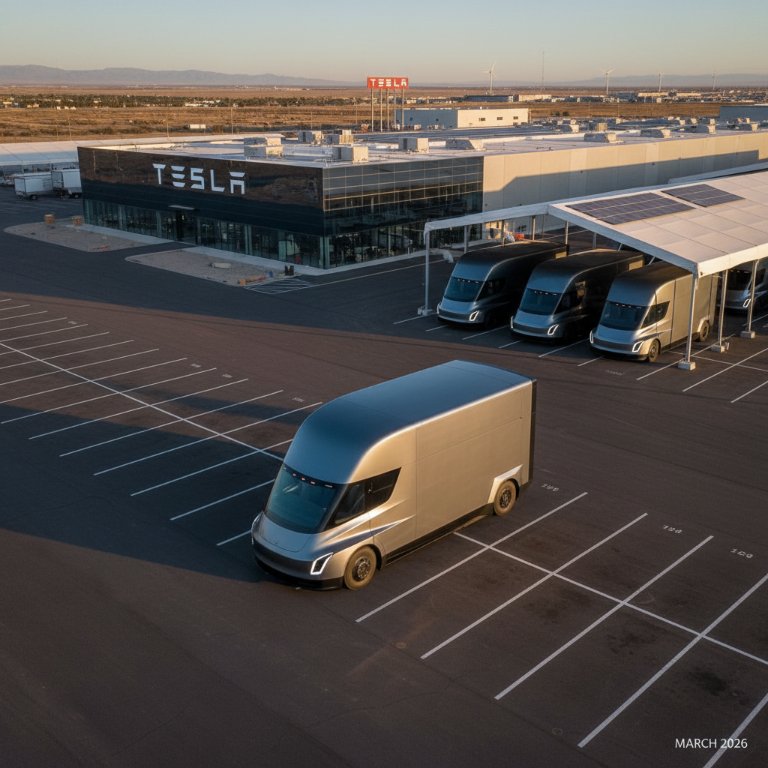
After years of anticipation, design evolutions, and strategic delays, Tesla is finally poised to disrupt the heavy-duty trucking industry with the high-volume production launch of its refreshed Semi, internally codenamed 'Atlas.' This isn't just a minor update; new aerial photography reveals significant design changes, bringing the 'Atlas' Semi firmly in line with Tesla's latest design language. Production is officially confirmed to commence at Tesla's Northern Nevada factory in March 2026, with the first customer deliveries slated for the second half of the year, marking a pivotal moment for electric freight.
Atlas Unveiled: A Design Evolution
The visible design refresh, captured through recent aerial photography, underscores Tesla's commitment to continuous improvement and its signature aesthetic. The 'Atlas' Semi now reportedly boasts design cues that mirror the sleek, minimalist, and aerodynamically optimized forms seen in the Cybertruck and the latest Model 3/Y iterations. This isn't merely cosmetic; for a Class 8 truck, enhanced aerodynamics translate directly into greater range and efficiency, critical factors for long-haul operations where every watt-hour counts. Expect a more integrated, futuristic look that likely improves driver visibility, reduces drag coefficients, and potentially simplifies exterior components for easier manufacturing and maintenance. This evolution moves beyond the initial prototype's aesthetics, indicating a production-ready design honed for efficiency and practicality.
Production Prowess: Nevada's Gigafactory Takes the Helm
Tesla's confirmation of high-volume production kicking off in March 2026 at its Northern Nevada factory is a monumental announcement. While initial, limited deliveries to companies like PepsiCo began in late 2022, these were more akin to pilot programs than true scaled manufacturing. The 'Atlas' launch signifies Tesla's intent to move beyond niche deployments and genuinely tackle the enormous demand for electric heavy-duty vehicles. This ramp-up will test Tesla's manufacturing capabilities in a new vehicle segment, requiring robust supply chains and efficient assembly processes for a vehicle far more complex than a passenger car. The shift to customer deliveries in the latter half of 2026 will be closely watched by fleets eagerly awaiting solutions to rising fuel costs and tightening emissions regulations.
European Expansion on the Horizon
Looking beyond North America, Tesla has set its sights on a European rollout for the Semi, anticipated in 2027. This strategic move highlights the global ambition for the 'Atlas' and acknowledges Europe's stringent emissions standards and growing appetite for sustainable transport solutions. Adapting the Semi for European regulations, charging infrastructure (CCS2 vs. Megacharger), and varying road conditions will be a significant undertaking, but one that could unlock immense market potential in a continent historically dominated by legacy truck manufacturers.
Why This Matters:
- Validation of Electric Long-Haul: A successful, scaled rollout of the 'Atlas' Semi will unequivocally prove the viability of battery-electric technology for heavy-duty, long-distance freight, effectively silencing skeptics who doubted its practicality and range capabilities. This will accelerate investment across the industry.
- Competitive Pressure: This move intensifies the heat on traditional trucking giants like Daimler Truck (with its eCascadia), Volvo (VNR Electric), and Traton Group, forcing them to accelerate their own EV heavy-duty offerings. It also directly challenges newer entrants like Nikola, which has focused on hydrogen fuel cell trucks, by demonstrating a viable battery-electric alternative at scale.
- Operational Cost Savings: For fleets, the promise of significantly lower operational costs due to cheaper electricity compared to diesel, reduced maintenance needs (fewer moving parts), and potential emissions credits represents a massive competitive advantage. This could fundamentally reshape logistics economics.
- Tesla's Manufacturing Credibility: Delivering the Semi at high volume will be a monumental achievement for Tesla, demonstrating its ability to master the complexities of Class 8 truck manufacturing after a history of production challenges with other models. It solidifies their position not just as a passenger EV leader, but as a full-spectrum electric vehicle powerhouse.
- Environmental Impact: The widespread adoption of electric semis will have a substantial impact on reducing greenhouse gas emissions and improving air quality, particularly in freight corridors and urban centers. This is a significant step towards global decarbonization targets.
Conclusion:
The 'Atlas' Tesla Semi, now entering high-volume production, is more than just a new truck; it's a testament to perseverance and a harbinger of change. After years of development, Tesla is finally ready to unleash its vision for sustainable freight onto highways worldwide. As customer deliveries commence in late 2026 and a European expansion looms in 2027, the 'Atlas' Semi is set to redefine efficiency, accelerate fleet electrification, and firmly establish Tesla as a dominant force in the heavy-duty commercial vehicle market. The era of silent, emission-free freight is no longer a distant dream; it's arriving on our roads.