Tesla Unleashes FSD (Supervised) in China: A Game-Changer for Global Autonomy and Market Dynamics
After years of navigating complex regulatory frameworks and fine-tuning its autonomous ambitions, Tesla has finally unleashed its Full Self-Driving (F...
Editorial Team
World Of EV
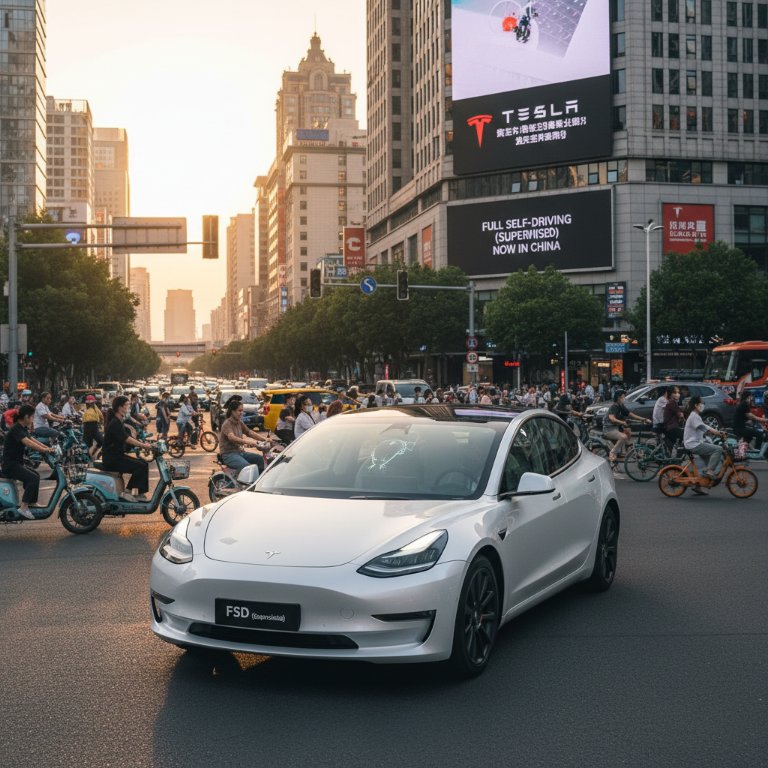
After years of navigating complex regulatory frameworks and fine-tuning its autonomous ambitions, Tesla has finally unleashed its Full Self-Driving (FSD) Supervised system on the colossal Chinese market. This monumental rollout, confirmed via the company's official social media, marks a pivotal moment for both Tesla's global strategy and the burgeoning EV landscape in China.
This strategic expansion follows closely on the heels of Elon Musk's high-profile visit to Beijing, signaling a deeply rooted commitment to the region. It's not merely a software update; it's the culmination of extensive localization efforts designed to address China's unique and demanding urban driving conditions.
FSD's Global Footprint Expands
The introduction of FSD (Supervised) in China significantly broadens its operational scope. Until now, the advanced driver-assistance system had been progressively rolled out across key Western and APAC markets, including:
- United States
- Canada
- Mexico
- Australia
- New Zealand
- South Korea
- The Netherlands
- Lithuania
China's inclusion represents the largest and arguably most challenging market yet, positioning FSD for an unprecedented real-world data collection and refinement opportunity.
Tailoring for the Dragon's Roads
Tesla's journey to Chinese FSD approval has been anything but straightforward. The company has dedicated substantial resources to adapt its AI-driven system to the specific nuances of Chinese traffic conditions. This includes navigating dense non-motorized vehicle traffic – a common sight on Chinese urban streets – and efficiently handling complex intersections often devoid of traditional traffic lights. Furthermore, compliance with China's stringent data security regulations has been paramount. Tesla proactively addressed this by establishing a dedicated local AI training center in Shanghai, ensuring all sensitive driving data remains within the country's borders.
Why This Matters:
This isn't just another software update; it’s a seismic shift for Tesla’s long-term ambitions and the broader autonomous driving sector. For years, the inability to deploy FSD in China has been a glaring gap in Tesla’s global offering, limiting its revenue potential and data advantage in the world's largest EV market. The approval unlocks a massive new revenue stream for FSD subscriptions and purchases, providing a significant boost to Tesla's profitability and valuation.
Tesla Wins Big: The immediate impact is a substantial increase in potential FSD subscribers, bolstering the company's recurring revenue model. More critically, it provides Tesla with an unparalleled data feedback loop from millions of vehicles operating in arguably the most challenging urban environments globally. This data is invaluable for accelerating FSD's development towards true unsupervised autonomy, potentially giving Tesla a decisive edge over rivals. It also solidifies Tesla's commitment and standing in China, counteracting narratives that suggest it might be losing ground to aggressive local competitors like BYD, Nio, and Xpeng in software-defined vehicles.
The Chinese Market Accelerates: For Chinese consumers, FSD (Supervised) brings a highly advanced, albeit still supervised, driver-assistance system to their fingertips, potentially enhancing safety and convenience. For local competitors, this move by Tesla serves as a powerful catalyst. Companies like Xpeng, Huawei (through partnerships), and Baidu have been aggressively developing their own advanced ADAS solutions, often tailored specifically for China. Tesla's entry with FSD will intensify competition, pushing domestic players to innovate faster and more effectively to retain market share and technological leadership. This could ultimately benefit the entire Chinese automotive industry, fostering rapid advancements in autonomous capabilities.
A Global Blueprint: Tesla's success in navigating China's regulatory and operational complexities sets a crucial precedent. It demonstrates the company's capability to localize its most advanced software, offering a blueprint for future expansions into other complex markets. This step is a 'do-or-die' moment for FSD's global viability, proving its adaptability and regulatory acceptance beyond its comfort zones.
The long-awaited arrival of Tesla's FSD (Supervised) in China is far more than a mere product launch; it's a strategic masterstroke years in the making. It promises to redefine Tesla's revenue outlook, significantly enhance its autonomous driving data advantage, and intensify the already fierce competition within China's dynamic EV market. As FSD begins to learn from the intricate tapestry of Chinese roads, the implications for the future of autonomous mobility, both locally and globally, are profound and unequivocally exciting.