Tesla Unleashes FSD v14.3.4 Second Wave: AI4 Supremacy, Cybertruck Smart Summon, and the Gamification of Safety
Tesla is accelerating its push toward true autonomy with a targeted, second-wave rollout of its latest Full Self-Driving (FSD) Supervised software. On...
Editorial Team
World Of EV
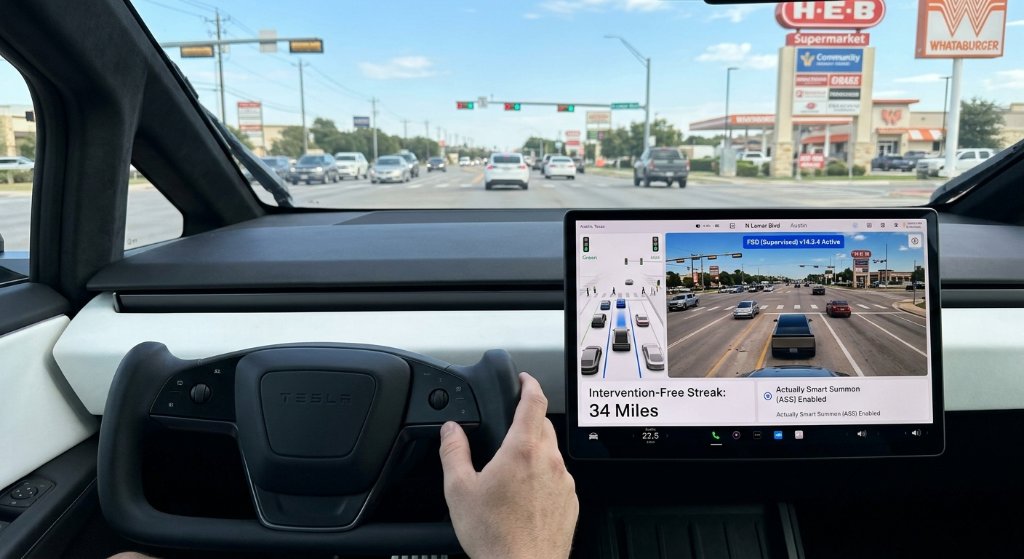
Tesla is accelerating its push toward true autonomy with a targeted, second-wave rollout of its latest Full Self-Driving (FSD) Supervised software. On June 24, 2026, the company initiated the deployment of FSD v14.3.4 (under firmware version 2026.14.6.12) to an additional 1,320 eligible AI4 (Hardware 4) vehicles. This expansion is more than a routine bug-squashing update; it represents a major stride in Tesla's hardware transition strategy, adding highly anticipated features and refining the driving experience.
However, this deployment highlights a widening divide in the Tesla community. While AI4-equipped vehicles are receiving cutting-edge neural network vision encoders and MLIR compiler rewrites, older Hardware 3 (HW3) owners are increasingly left waiting on the sidelines. Tesla’s promise of unified self-driving across its entire fleet is facing its toughest test yet as the computational requirements of FSD v14 begin to outpace older silicon.
The AI4 Advantage: Faster Minds and Sharper Vision
At the core of the v14.3.4 update is a ground-up rewrite of Tesla's AI compiler and runtime using Multi-Level Intermediate Representation (MLIR). For the end-user, this translates directly to a 20% faster reaction time—a critical metric when navigating chaotic urban environments or avoiding sudden obstacles. The update also upgrades the reinforcement learning (RL) stage of FSD’s neural network training, improving decision-making across a wide variety of scenarios.
Key features and technical updates introduced in this wave include:
- Actually Smart Summon (ASS) for Cybertruck: The angular, steer-by-wire electric pickup finally gets the ability to navigate parking lots to meet its owner autonomously.
- Enhanced Vision Encoder: Upgraded 3D geometry and traffic sign understanding, particularly in low-visibility and rare scenarios.
- Decisive Destination Parking: Improved parking location pin predictions (marked with a new "P" icon on the map) and more decisive spot selection.
- Milestone & Streak Tracking: A new user interface feature that tracks the distance traveled without a driver disengagement, alongside an option to select an intervention reason upon takeover.
The Cybertruck Finally Earns Its 'Smart' Credentials
When the Cybertruck launched, it was noticeably missing the suite of Autopilot and FSD features that standard Tesla models had enjoyed for years. Because the Cybertruck relies entirely on a vision-only system without ultrasonic sensors, and operates on a unique steer-by-wire architecture, implementing autonomous parking lot navigation was an engineering mountain to climb.
With FSD v14.3.4, Actually Smart Summon (ASS) finally lands on the Cybertruck. This is a massive milestone for the halo truck, proving that Tesla can scale its vision-based spatial computing to handle a vehicle with such massive blind spots and unconventional dimensions.
Gamifying Autonomy: The Disengagement Streak Counter
Perhaps the most intriguing—and controversial—addition to FSD v14.3.4 is the milestone tracker, which displays the mileage of an intervention-free driving "streak". While designed to showcase FSD’s growing reliability, it introduces an unexpected psychological element. By showing drivers how close they are to a milestone, Tesla is gamifying the autonomous driving experience.
Why This Matters:
The rollout of FSD v14.3.4 is a pivotal moment for Tesla, signaling both its rapid software progression and the harsh realities of its hardware roadmap.
- The Big Winner: The AI4 Ecosystem and Robotaxi Ambitions. By unifying the model structure between Actually Smart Summon, FSD, and the upcoming Robotaxi platform, Tesla is consolidating its software stack. The MLIR compiler rewrite and 20% speed boost prove that Tesla's newer AI4 hardware has plenty of headroom left to exploit.
- The Big Loser: Hardware 3 Owners. This update is strictly for AI4 vehicles. For millions of owners who purchased HW3 vehicles under the promise of full autonomy, the realization is setting in that their onboard computer is running out of memory and processing power to run the full v14 stack. While a "v14 Lite" is rumored, HW3 is rapidly becoming the legacy tier.
- The Safety Gamble of "Streaks." Gamifying safety with a "streak counter" is a double-edged sword. While it serves as excellent marketing when users post 100-mile disengagement-free runs on social media, it risks creating "streak bias." A driver might hesitate to take over during a borderline unsafe maneuver just to keep their streak alive. In a "Supervised" system where the human is legally liable, this gamification could invite regulatory scrutiny.
- The Market Signal. Tesla is showing that its vision-only, end-to-end neural network approach can handle even the most physically demanding vehicles like the Cybertruck. It keeps Tesla firmly in the lead for consumer-facing Level 2+ systems, but the pressure is mounting to prove these incremental gains can finally transition into a driverless Level 4 reality.
Conclusion
Tesla’s latest push of FSD v14.3.4 cement's the automaker's lead in OTA-delivered driver assistance, but it does so by officially establishing a multi-tiered ecosystem. The inclusion of Actually Smart Summon on the Cybertruck and the introduction of gamified safety metrics are massive talking points for enthusiasts, but the growing obsolescence of HW3 will remain a critical point of friction. As Tesla prepares for its next-generation platforms, v14.3.4 serves as a fascinating preview of a future where vision-only autonomy is faster and smarter—but only if you have the hardware to back it up.