Tesla Unleashes Mobile Power: V2L Capability Officially Expands to All Model Y Premium Trims
For years, Tesla owners watched from the sidelines as Hyundai Ioniq 5 and Kia EV6 drivers effortlessly powered campsites, coffee makers, and emergency...
Editorial Team
World Of EV
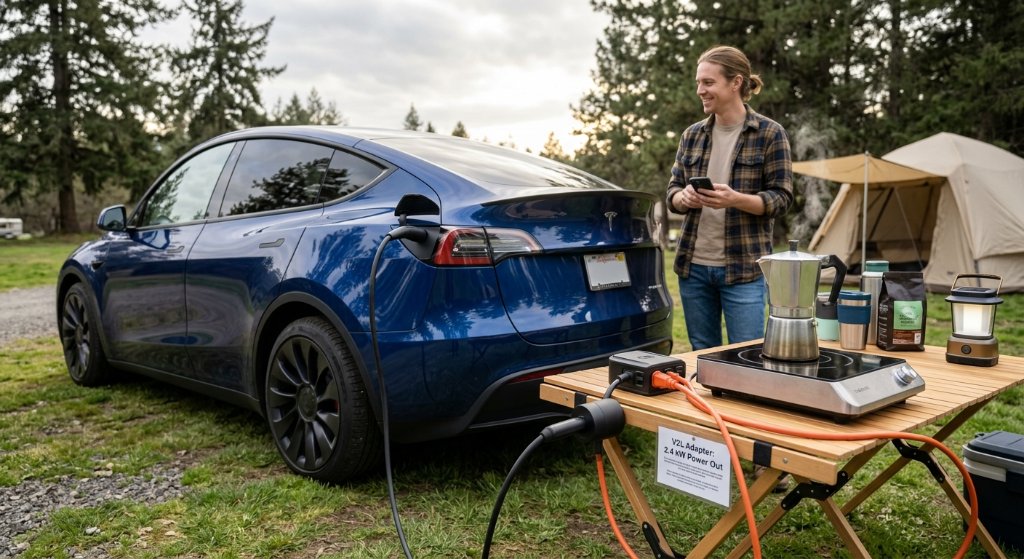
For years, Tesla owners watched from the sidelines as Hyundai Ioniq 5 and Kia EV6 drivers effortlessly powered campsites, coffee makers, and emergency home appliances straight from their vehicles. Despite having some of the largest battery packs on the road, legacy Teslas remained strictly one-way energy consumers. That era of isolation is officially over. Tesla has formally expanded native Vehicle-to-Load (V2L) capabilities to all Model Y Premium trims in the United States, transitioning bidirectional power from an expensive novelty to a mainstream standard.
This rollout marks a pivotal shift for the world’s best-selling crossover. What was once a feature reserved exclusively for the hulking Cybertruck and the top-tier 2026 Model Y Performance is now being democratized for the high-volume core of Tesla’s lineup. Coupled with a new, highly affordable accessory, Tesla is directly addressing one of the last remaining feature gaps between its vehicles and its legacy-backing competitors.
The Hardware Setup: Mobile Power on Demand
Unlike rivals that build dedicated 120V household outlets directly into the cabin or trunk, Tesla’s approach utilizes existing charging infrastructure paired with a clever, cost-effective accessory. To tap into the Model Y’s high-voltage battery, owners must combine their Gen 3 Mobile Connector with a newly launched $80 Tesla Outlet Adapter.
- Continuous Power Output: Delivers a robust 2.4 kW of continuous power, capable of handling major electrical loads.
- Voltage and Amperage: Rated at 120V and 20A, exceeding the typical 15A household circuit to confidently run high-demand electronics.
- The Hardware Combo: Requires the Gen 3 Mobile Connector (older Gen 2 units are incompatible) plugged into the vehicle's charge port, with the $80 Outlet Adapter attached to the opposite end.
- Versatile Utility: Easily powers refrigerators during residential blackouts, heavy-duty power tools on remote jobsites, or space heaters at campsites without the noise and emissions of a gas generator.
The Refresh Barrier: Who is Left in the Dark?
While this update is a massive win for prospective buyers and recent adopters, it exposes a harsh reality for legacy Tesla owners. The V2L functionality is strictly restricted to Tesla's newer "Premium" trims, which align with the recently refreshed Model Y "Juniper" generation and newer Long Range AWD models under Tesla's updated naming architecture.
First-generation Model Y owners—even those with high-end Long Range or Performance models purchased prior to late 2025—are entirely locked out of this capability. Because legacy models lack the necessary onboard bidirectional inverters and updated power distribution hardware, no software update can retroactively enable V2L. Additionally, standard-range trim models do not carry the native hardware required to run the adapter, establishing a clear hardware tier in Tesla's modern lineup.
Why This Matters:
This expansion of V2L is far more than a convenient camping upgrade; it is a calculated chess move in an increasingly cutthroat global EV market.
- The Winners: Modern Buyers and Tesla's Sales Force. Consumers looking for an all-in-one adventure or emergency vehicle now have zero reasons to cross-shop Hyundai's E-GMP platform or Ford's Pro Power-equipped offerings based on power export alone. For Tesla, this creates a massive, tangible incentive for legacy Model Y owners to trade in their older vehicles for the refreshed "Juniper" generation.
- The Losers: Legacy Owners and Third-Party Inverter Makers. Early adopters who helped build Tesla’s empire are once again left behind by rapid hardware iterations. Meanwhile, the aftermarket industry of sketchy, warranty-voiding 12V terminal-to-AC inverters has effectively been neutralized for new buyers by Tesla's affordable $80 official solution.
- The Strategic Market Signal. This move signals that bidirectional charging is no longer a premium gimmick. By standardizing V2L on its highest-volume vehicle, Tesla is laying the groundwork for broader Vehicle-to-Home (V2H) and Vehicle-to-Grid (V2G) ecosystems. It bridges the gap between individual mobility and home energy ecosystems, cementing the EV as a decentralized, mobile power station.
Conclusion
With V2L now active across the Model Y Premium lineup, Tesla has successfully eliminated one of the strongest arguments rival automakers had against its dominant crossover. By offering 2.4 kW of mobile power for a mere $80 accessory fee, Tesla is proving that it can pivot rapidly to consumer demands when pushed by competition. As the electrical grid becomes increasingly unpredictable, the ability to turn the world's most popular EV into a rolling generator is no longer just a luxury—it is a killer feature that will define the next generation of EV ownership.