Tesla Unleashes Pedal-Free Cybercab in Austin: The $30,000 Robotaxi Bet Enters the Real World
Tesla has officially unleashed its first production-spec Cybercabs onto the public roads of Austin, Texas, marking the most critical milestone yet in ...
Editorial Team
World Of EV
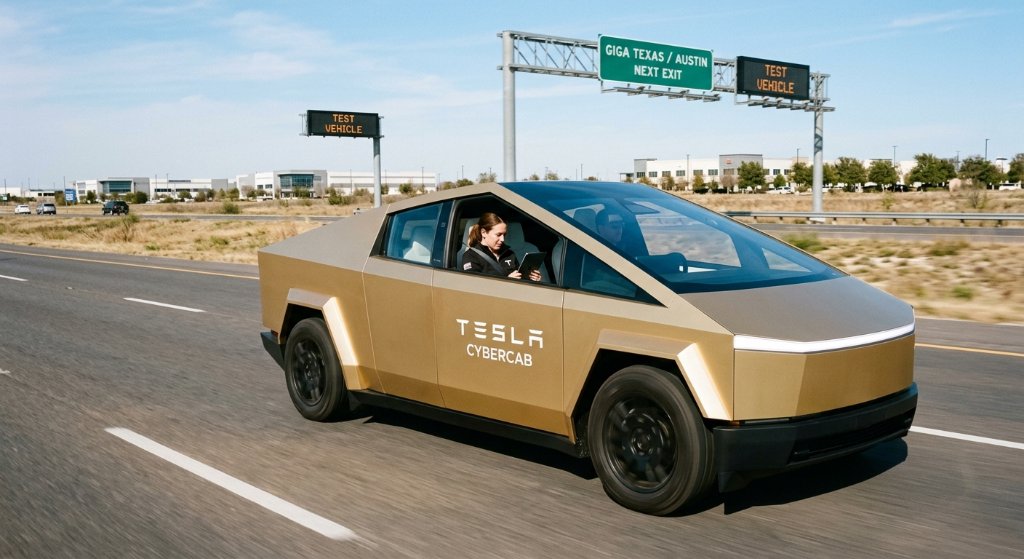
Tesla has officially unleashed its first production-spec Cybercabs onto the public roads of Austin, Texas, marking the most critical milestone yet in Elon Musk’s aggressive pivot toward a driverless future. In a video released by the automaker, the gold-colored, two-seat robotaxi is shown navigating city streets completely devoid of a steering wheel or pedals. This is not a pre-production mule; these are the actual production units rolling off the lines at Gigafactory Texas, validating a radical "unboxed" manufacturing architecture that aims to build a sub-$30,000 autonomous vehicle.
This public-road validation represents the culmination of a 20-month sprint that began when Musk first unveiled the concept in October 2024. Until now, Tesla’s nascent robotaxi service in Austin has relied on heavily adapted Model Y SUVs. By putting a purpose-built, control-free coupe into the wild, Tesla is signaling to the market that it is finally ready to move past retrofits and challenge Google-backed Waymo on its own turf.
Under the Hood of the Pedal-Free Coupe
Thanks to recent EPA regulatory filings, the mystery surrounding the Cybercab’s mechanical makeup has finally been unraveled. This is a radically lightweight, highly efficient platform engineered from the ground up for urban ride-hailing:
- The Powertrain: Departing from Tesla’s traditional rear-wheel or all-wheel-drive configurations, the Cybercab features a front-wheel-drive layout powered by a single 219-horsepower (163 kW) electric motor.
- The Battery & Weight: A compact 48 kWh lithium-ion battery pack powers the vehicle. Thanks to its lightweight design—tipping the scales at just 3,113 pounds (nearly 700 pounds lighter than a Model 3)—the Cybercab achieved a staggering 418 miles of unadjusted range in lab tests, pointing to a real-world range of roughly 300 miles.
- Radical Cabin Design: The vehicle has absolutely no steering wheel, accelerator pedals, brake pedals, or side-view mirrors. Front-seat occupants are purely passengers, and during current engineering tests, a "safety monitor" rides in the passenger seat with zero physical means to intervene dynamically.
The Regulatory Gauntlet
While the technology may be ready to roll, the legal pathway remains highly fractured. On one hand, Texas state law is notoriously friendly to autonomous vehicle testing, and recent NHTSA proposals are shifting to accommodate vehicles designed without manual controls. On the other hand, Tesla's "vision-only" autonomous philosophy remains under a dark cloud.
Unlike Waymo, Cruise, or Zoox—all of which blanket their vehicles in expensive Lidar and Radar sensors to build a 3D map of the environment—Tesla relies entirely on cameras and neural networks. This camera-only approach is currently the target of an active federal investigation by the NHTSA, focusing on the system's performance in low-visibility conditions. Until Tesla can convince federal regulators that cameras alone can safely guide a wheel-less vehicle through heavy rain, fog, and blinding dust, the Cybercab cannot transition from "engineering tests" to a fully unsupervised, commercial network.
Why This Matters:
The Existential Bet: This is a literal "burn the boats" moment for Tesla. By manufacturing a vehicle entirely without steering wheels or pedals, Tesla has eliminated any "Plan B". These vehicles cannot be sold to standard retail buyers as traditional EVs if the autonomous software fails or gets legally blocked. If Tesla's Full Self-Driving (FSD) software cannot achieve unsupervised Level 4 certification, these production units are essentially high-tech paperweights.
Who Wins: Tesla’s balance sheet and prospective fleet operators. If Tesla successfully scales the Cybercab at its target $30,000 price point, it will decimate the unit economics of legacy ride-hailing. Waymo's sensor-heavy Jaguar I-Pace vehicles cost upwards of $100,000 to put on the road. By slashing vehicle cost, battery size, and curb weight, Tesla can theoretically offer autonomous rides at a fraction of the cost per mile of any competitor.
Who Loses: Traditional ride-hailing giants like Uber and Lyft, alongside legacy automakers who are still treating autonomy as a compliance exercise. If Tesla solves the software piece of the puzzle, a $30,000 autonomous vehicle represents a terrifying threat to the entire traditional automotive business model. However, if the NHTSA blocks Tesla's vision-only system due to safety concerns, Waymo’s slow-and-steady, hardware-redundant approach will be vindicated as the only viable path forward.
Conclusion
Tesla’s move to test production Cybercabs on Austin streets is a triumphant engineering milestone, but the victory lap is premature. The hardware is here, the efficiency is stunning, and the production lines are humming. Yet, the fate of the Cybercab does not rest on its assembly quality or its 300-mile real-world range—it rests entirely on a software stack and a camera lens. Tesla has built the future, but it still has to prove that the future can see in the dark.