Tesla Unleashes 'Storm of Cybercabs' on Austin Streets, Forcing a High-Stakes Autonomy Showdown
The long-promised, oft-delayed era of the fully driverless Tesla is finally shifting from Silicon Valley hype into real-world Texas asphalt. On Thursd...
Editorial Team
World Of EV
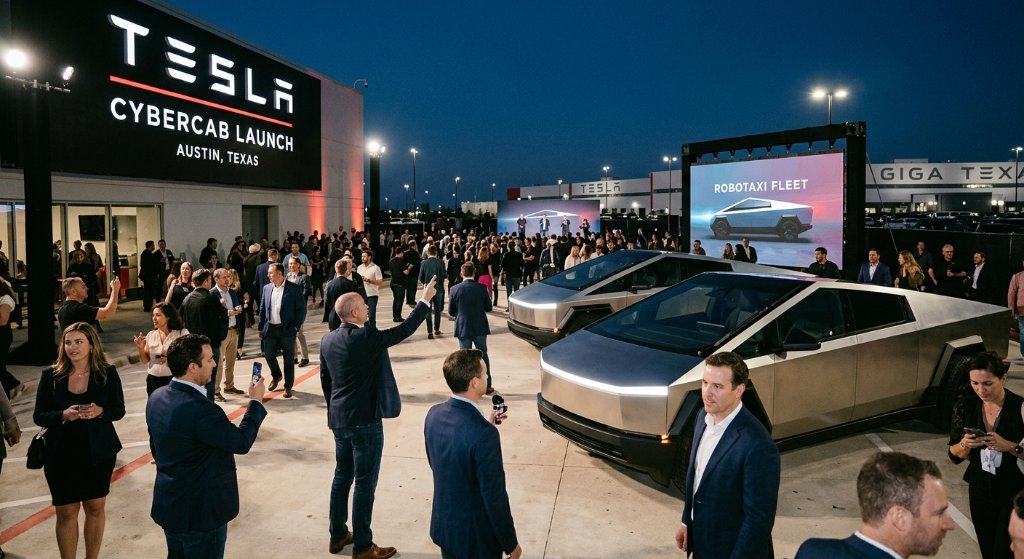
The long-promised, oft-delayed era of the fully driverless Tesla is finally shifting from Silicon Valley hype into real-world Texas asphalt. On Thursday, September 3, 2026, CEO Elon Musk officially kicked off Tesla’s highly anticipated, invite-only Cybercab launch event in downtown Austin. Dubbed a "Storm of Cybercabs," the rollout puts a fleet of gold-colored, two-seater vehicles—designed entirely without steering wheels or pedals—directly onto public streets. Wall Street responded with an immediate 7% stock rally, signaling that investors are eager to buy into Musk's high-stakes vision of an autonomous future.
Yet, this launch is more than a flashy media stunt; it is a critical pivot point for a company facing intense headwinds. For years, Tesla has leaned on promises of "Full Self-Driving" (FSD) to justify its astronomical valuation, even as core EV sales slipped globally and Chinese giant BYD snatched its crown as the world's top-selling EV maker. By unleashing purpose-built robotaxis into the wild, Tesla is trying to prove it can successfully transition from a pure-play automaker into an AI and robotics powerhouse.
Inside the Cybercab: No Drivers, No Safety Nets
Tesla’s purpose-built robotaxi completely discards conventional automotive design in favor of pure passenger autonomy. Unlike the modified Model Ys that Tesla has previously used for pilot programs, the Cybercab is built from the ground up as a dedicated hailing machine.
Key specifications and features of the initial rollout include:
- The No-Control Cabin: There is no steering wheel, no brake pedal, and no accelerator. Passengers have zero manual intervention capabilities.
- The Austin Fleet: Tesla has officially deployed 45 Cybercabs on Austin streets, operating alongside an existing registered fleet of 420 driverless-capable vehicles.
- Seamless App Integration: Version 26.8.0 of the Tesla Robotaxi app is live, allowing local Austin users to choose between a two-passenger Cybercab or a traditional four-passenger Model Y.
- Striking Design: The vehicles feature eye-catching gold paint, dramatic butterfly doors, and a simplified cabin optimized entirely for passenger comfort.
The Vision-Only Gamble Against Waymo and Zoox
By taking the Cybercab public, Tesla is drawing a hard line in the sand against the autonomous vehicle (AV) establishment. While market leader Waymo (Alphabet) and competitor Zoox (Amazon) rely on multi-million dollar sensor suites—incorporating high-definition Lidar, radar, and cameras—Tesla is placing its entire bet on a "vision-only" camera approach.
Musk's gamble centers on economics. A Lidar-equipped Waymo vehicle is estimated to cost upwards of $125,000 to build. In contrast, Musk claims the camera-reliant Cybercab can eventually be produced for under $30,000, presenting a massive operational and scaling advantage. However, the pressure is now on Tesla's neural network to prove that a camera-only system can safely navigate unpredictable urban environments, avoid pedestrians, and handle edge cases without the redundant safety layers provided by Lidar.
Why This Matters:
This is a do-or-die moment for Tesla. The company’s core business—selling consumer electric vehicles—is under immense pressure from a slowing global market and aggressive pricing wars with Chinese manufacturers. To maintain its premium valuation, Tesla must convince the world that it is a robotics company first and an automaker second.
- The Winners: If the Austin deployment succeeds and scales quickly to other cities like Miami and Dallas, Tesla stands to dominate the next era of transportation. A successful, highly profitable autonomous ride-hailing network turns Tesla into a high-margin software-as-a-service (SaaS) giant, leaving traditional automakers in the dust.
- The Losers: Legacy ride-hailing giants like Uber and Lyft face a massive existential threat. If Tesla can scale a driverless fleet at a fraction of the cost of human-driven alternatives, the economics of ride-sharing will be rewritten overnight. Furthermore, if Tesla's cheap, vision-only system achieves safety parity, Waymo's expensive, sensor-heavy strategy will look incredibly inefficient.
- The Market Signal: This launch signals to the automotive industry that the race is no longer about who builds the best electric vehicle, but who controls the autonomous platform.
Conclusion
The "Storm of Cybercabs" in Austin marks the true beginning of Tesla’s next chapter. While regulatory hurdles, safety skepticism, and public comfort remain significant bottlenecks, the physical deployment of steering-wheel-free vehicles proves that Tesla is finally willing to put its technology to the ultimate test. The transition from driver-assist to true driverless operations has officially begun, and the entire automotive landscape is about to feel the shockwaves.