Tesla Unleashes Terafab: A Bold Vertical Leap Towards AI Supremacy and Chip Autonomy
Tesla is making an unprecedented move to secure its future in artificial intelligence and robotics, quietly filing trademark applications for 'Tesla T...
Editorial Team
World Of EV
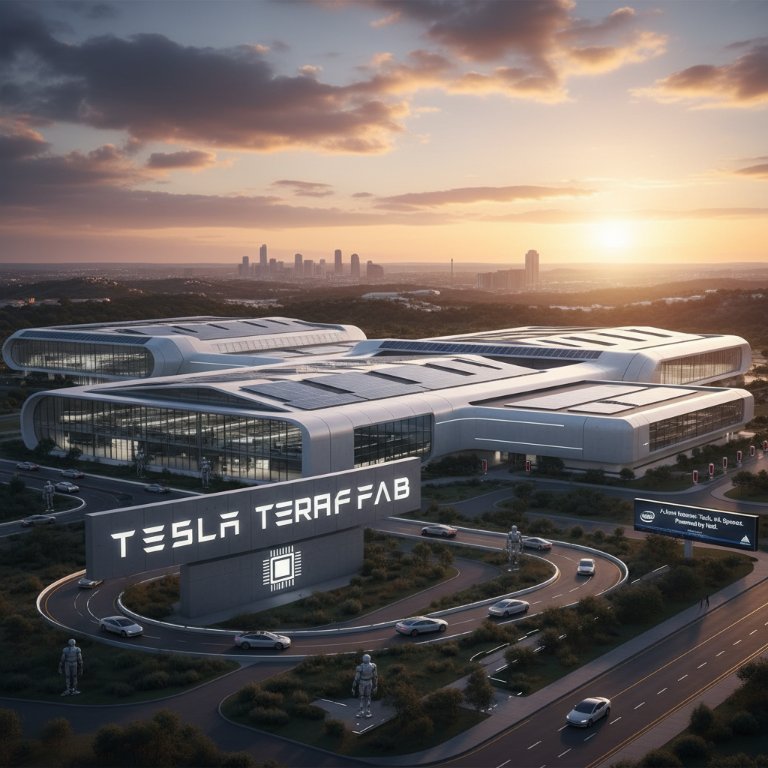
Tesla is making an unprecedented move to secure its future in artificial intelligence and robotics, quietly filing trademark applications for 'Tesla Terafab' and an accompanying logo. This isn't just another chip announcement; it signals a monumental strategic shift as the company, in a joint venture with xAI and SpaceX, prepares to establish its own semiconductor fabrication facility, significantly deepening its vertical integration and control over crucial AI hardware.
This ambitious 'Terafab' project, publicly unveiled by Elon Musk on March 21, 2026, in Austin, Texas, aims to produce custom AI and memory chips critical for Tesla's ecosystem. The initiative sees Intel, a titan in semiconductor manufacturing, contributing its invaluable expertise to the venture. This strategic partnership is poised to redefine Tesla's capabilities, moving beyond in-house chip design to full-scale, dedicated chip production.
Terafab's Ambitious Scope: Powering an AI Future
The Terafab facility will be a cornerstone for Tesla's most advanced technologies, focusing on creating specialized edge-inference processors, specifically the AI5 and AI6 chips. These custom-designed chips are essential for the robust performance of Tesla's Full Self-Driving (FSD) system, its burgeoning Robotaxi network, and the highly anticipated Optimus humanoid robots.
- Custom Chip Development: The facility will manufacture proprietary AI5 and AI6 chips, tailored for demanding AI workloads.
- Timeline to Production: Small-batch production of the AI5 chip is targeted for 2026, with volume production expected to commence in 2027.
- Strategic Alliance: The joint venture between Tesla, xAI, and SpaceX underscores a unified vision across Musk's enterprises, leveraging shared resources for unprecedented control over their technological destiny.
- Intel's Critical Contribution: Intel's role as a manufacturing expert brings decades of foundry experience to the table, providing a crucial foundation for high-volume, advanced semiconductor production.
Tesla has a history of bringing critical components in-house, dating back to 2016 when it began designing its own FSD chips to move away from reliance on external suppliers like NVIDIA. This move allowed Tesla to optimize hardware precisely for its neural networks, leading to the launch of its Hardware 3 (FSD chip) in 2019 and subsequent iterations like Hardware 4. However, until now, Tesla has operated on a 'fabless' model, designing chips but relying on external foundries like TSMC for manufacturing. Terafab represents a decisive break from this model, positioning Tesla to control the entire silicon lifecycle.
Why This Matters: The Dawn of True AI Autonomy
- Unprecedented Vertical Integration: By manufacturing its own advanced chips, Tesla gains unparalleled control over its hardware supply chain. This drastically reduces vulnerability to global semiconductor shortages, a lesson painfully learned by the auto industry in recent years. It also enables faster iteration, optimized performance, and potentially lower costs for its core AI platforms.
- Solidifying AI Dominance: Custom silicon is the bedrock of cutting-edge AI. The AI5 and AI6 chips, produced in Terafab, will be hyper-optimized for Tesla's specific edge-inference workloads in FSD, Robotaxis, and Optimus. This bespoke hardware, combined with Tesla's software and vast data, creates a formidable closed-loop system that competitors relying on off-the-shelf solutions will struggle to match. This could significantly widen the performance gap in autonomous capabilities.
- A New Era for Intel: For Intel, this partnership is a significant win for its Intel Foundry Services (IFS) strategy. After past struggles in the foundry space, securing a high-profile client like Tesla, alongside xAI and SpaceX, validates Intel's renewed commitment to manufacturing for external partners. It positions Intel as a critical enabler in the burgeoning AI hardware market.
- Winners and Losers: Tesla, xAI, and SpaceX are clear winners, gaining strategic control and competitive advantage. Intel also benefits from a major foundry customer. Traditional chip suppliers, while still critical for many, could face increased competition as more tech-forward companies consider similar vertical integration strategies. Other automakers, still largely dependent on external suppliers and less advanced in their AI hardware strategy, risk falling further behind in the race for true autonomy.
- Market Signal: Terafab sends an unmistakable signal that Tesla's ambitions extend far beyond automotive manufacturing. It is a full-stack AI, robotics, and energy company, and controlling the means of advanced silicon production is fundamental to realizing that expansive vision.
The Road Ahead: Accelerating the Autonomous Future
The establishment of 'Tesla Terafab' marks a pivotal moment in Tesla's evolution. By taking direct control of semiconductor manufacturing, Tesla is not merely building cars; it is building the foundational hardware for a future driven by pervasive AI and robotics. The rapid timeline for AI5 production underscores the urgency and strategic importance of this venture. As the AI5 and AI6 chips roll off the Terafab lines, expect to see a noticeable acceleration in the capabilities of Tesla's FSD, the deployment of Robotaxis, and the advancement of Optimus, bringing the promise of true artificial general intelligence closer to reality. This is a game-changer, and the industry will be watching closely to see if others dare to follow this ambitious, vertically integrated path.