Tesla Unleashes the Machines: Fremont Sheds Model S and X for 1 Million Humanoid Robots Annually
The iconic Tesla Model S and Model X, vehicles that once spearheaded the electric revolution and firmly established Tesla's premium market presence, h...
Editorial Team
World Of EV
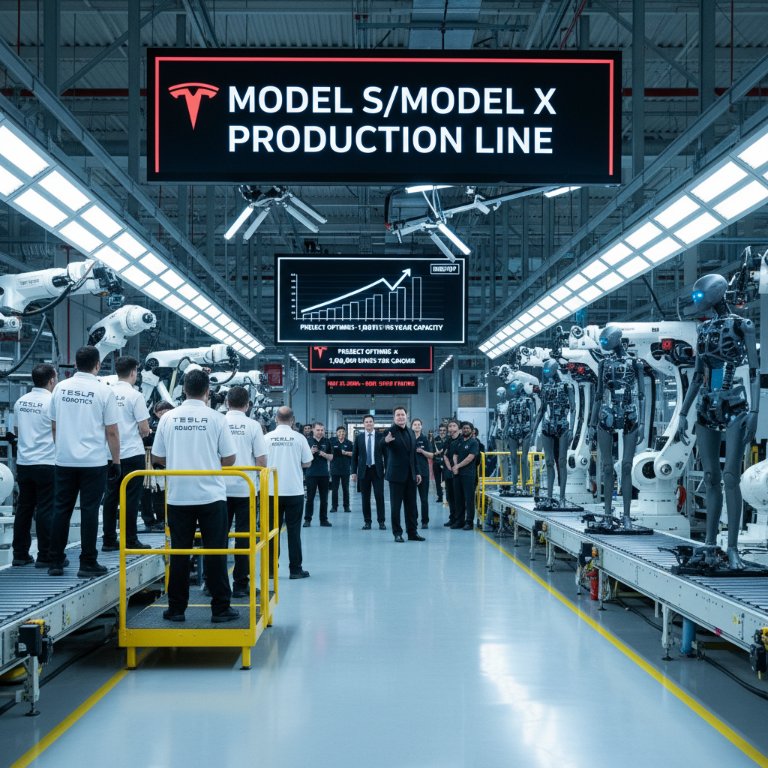
The iconic Tesla Model S and Model X, vehicles that once spearheaded the electric revolution and firmly established Tesla's premium market presence, have officially reached the end of their production run. As of May 21, 2026, the final units rolled off the Fremont factory lines, marking a seismic shift in the company’s strategic direction. This move isn't just a model refresh; it signals Tesla's audacious full-throttle pivot into the realm of AI and robotics, with the entire Fremont facility set to exclusively churn out humanoid robots, targeting an staggering annual capacity of one million units.
The End of an Era, The Dawn of Optimus
For years, the Model S and X stood as symbols of Tesla's ambition, showcasing long-range capability, cutting-edge technology, and performance that challenged established luxury automakers. The Model S, in particular, was the sedan that put Tesla on the map, proving that electric vehicles could be desirable, fast, and practical alternatives to internal combustion powerhouses. Its larger sibling, the Model X, expanded that vision into the SUV segment, complete with its distinctive falcon-wing doors. These vehicles not only defined Tesla for over a decade but also forced the entire automotive industry to accelerate its EV development. Now, the space they occupied will be entirely reconfigured.
Over the next four months, the dedicated production lines for these flagship EVs will undergo a complete dismantling and retooling. The transformation is geared towards a singular, ambitious purpose: the mass manufacturing of Tesla's humanoid robot, Optimus. Elon Musk has consistently championed AI and robotics as the next frontier, predicting a market potential that will ultimately dwarf even the booming electric vehicle sector. This unprecedented commitment of a major automotive production facility to robotics underscores the seriousness of that vision.
Why This Matters:
A Definitive Strategic Pivot: Tesla is unequivocally shifting its core manufacturing prowess and capital allocation towards AI and robotics. This moves them further away from being solely an automotive company and cements their identity as a technology giant with a diversified, albeit high-risk, portfolio. It’s a bet that the 'brains' (AI) and 'bodies' (robots) will be more valuable than the 'wheels' (EVs) in the long run.
The Premium EV Void: The departure of the Model S and X leaves a significant gap in the high-end electric sedan and SUV market that Tesla once dominated. While the Cybertruck and upcoming models will fill other niches, competitors like Lucid, Mercedes-Benz EQ, Porsche Taycan, and even Cadillac's upcoming luxury EVs will undoubtedly seek to capture this segment. Who gains from Tesla’s focus elsewhere remains to be seen.
Robotics at Scale: An Industrial Revolution? The target of one million humanoid robots annually is staggering. If achieved, it would represent a transformative moment for automation, labor markets, and the fundamental structure of global manufacturing. Such scale could drive down costs dramatically, making general-purpose robots a ubiquitous feature of industries and even homes, potentially sparking an entirely new wave of economic growth or disruption.
Investor Re-evaluation: Investors will now be forced to assess Tesla less as an automotive pure-play and more as a complex AI and robotics firm. This could attract new investment from tech-focused funds but might alienate traditional automotive investors. The success or failure of Optimus at this scale will profoundly impact Tesla's valuation and market perception.
Musk's Vision: Reality Check: While Elon Musk's ambitious pronouncements often precede groundbreaking innovation, they also come with significant execution challenges. The market will be watching closely to see if Tesla can apply its manufacturing prowess, honed over years of EV production, to a fundamentally different and arguably more complex product line. This is a "do-or-die" moment for proving the viability of large-scale, general-purpose humanoid robotics.
Tesla's decision to sacrifice its foundational EV models for the future of robotics is a bold, almost defiant move. It underscores the company's belief that true exponential growth lies beyond the automotive sector, within the limitless potential of artificial intelligence and its physical manifestations. The automotive world, and indeed the entire global economy, will be watching closely as Fremont transforms from an EV powerhouse into the world’s leading robot factory, heralding an uncertain but undeniably exciting new chapter.