Tesla Unleashes Universal Charging Blitz: New Wall Connectors Signal Broader EV Market Grab
Tesla, long the undeniable pacesetter in electric vehicle infrastructure with its proprietary Supercharger network, is now rapidly accelerating its co...
Editorial Team
World Of EV
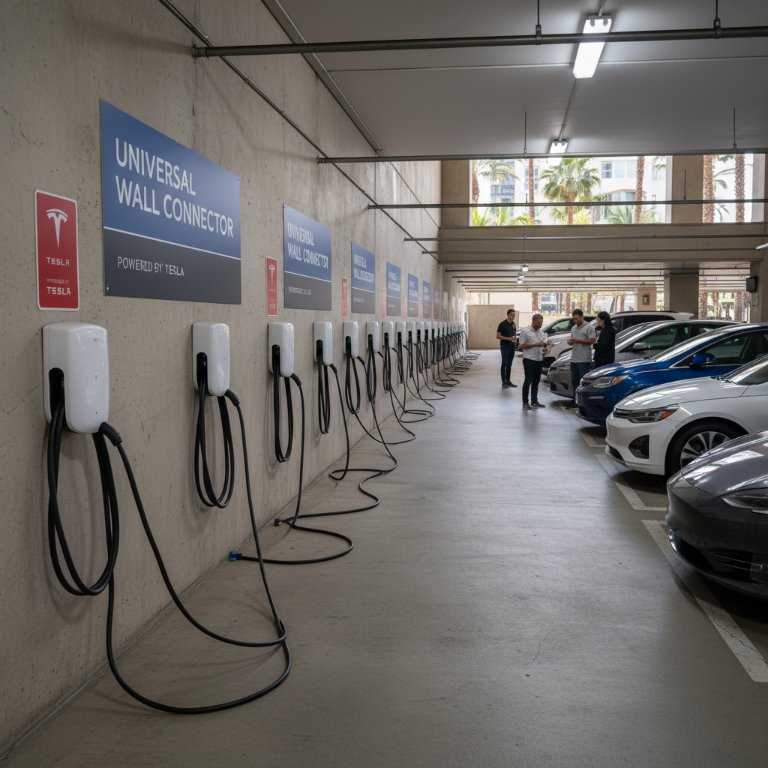
Tesla, long the undeniable pacesetter in electric vehicle infrastructure with its proprietary Supercharger network, is now rapidly accelerating its commercial charging initiative. This strategic shift, evidenced by the activation of 219 Universal Wall Connectors across 32 new North American business sites in just two weeks, marks a full-scale rollout of its “Wall Connector for Business” program. This isn't merely an expansion; it's a calculated move to embed Tesla's charging standard deeper into the everyday fabric of EV ownership, crucially, for all EV drivers.
A Rapid, Widespread Deployment
Tesla's recent push is anything but subtle. Over the past two weeks alone, the company has energized a staggering 219 Wall Connectors across 32 diverse business locations throughout North America. This swift deployment signals a determined, full-scale offensive with its Wall Connector for Business program.
- The single largest installation saw 66 Wall Connectors come online at Wilshire House in Los Angeles, California, transforming the property into a significant charging hub.
- Atlanta, Georgia's Spring Quarter also received a substantial upgrade with 20 new units.
- The expansion extends to the vital Midwest hospitality sector, ensuring EV drivers have more charging options at hotels and many other travel destinations.
The Universal Advantage: NACS and J1772 for All
Crucially, these aren't just Tesla-exclusive chargers. The newly activated units are Universal Wall Connectors, designed with the broader EV ecosystem in mind.
- Each unit delivers up to 11.5 kW of charging power, providing a substantial overnight or destination charge.
- They feature dual compatibility, supporting both Tesla's North American Charging Standard (NACS) and the widely adopted J1772 standard. This thoughtful design ensures that virtually any electric vehicle currently on the road can utilize these new charging points, a significant departure from Tesla's historical walled-garden approach.
Why This Matters:
This aggressive rollout is far more than a simple expansion; it represents a strategic masterstroke by Tesla, reshaping the foundational layer of EV charging infrastructure.
- For Tesla: This initiative significantly broadens Tesla's charging footprint beyond its high-speed Supercharger network, permeating the crucial “destination charging” segment. By making these universal, Tesla further normalizes NACS, potentially cementing its position as the de facto charging standard across North America, even at Level 2 speeds. It also establishes new revenue streams and strengthens relationships with businesses looking to attract the growing EV demographic. This isn't just about selling cars anymore; it's about owning the entire EV ecosystem.
- For Other Automakers: The prevalence of universal Tesla Wall Connectors at key destinations subtly yet powerfully pressures other automakers to fully embrace NACS, not just at DC fast chargers but across all charging touchpoints. It also means less pressure on them to build out extensive Level 2 destination charging networks, as Tesla is doing the heavy lifting, effectively becoming a utility for the entire industry.
- For EV Drivers: This is unequivocally a massive win. The proliferation of easily accessible, universal Level 2 chargers at places where drivers spend hours (offices, hotels, retail) drastically reduces range anxiety and simplifies the charging experience. Imagine pulling into a hotel, plugging in, and waking up to a full “tank” regardless of your EV's brand. This convenience is a critical accelerant for mainstream EV adoption.
- For Businesses: Participating businesses gain a significant competitive edge, attracting environmentally conscious customers and future-proofing their properties. The relatively straightforward installation and broad compatibility make it an appealing investment for commercial property owners looking to cater to the burgeoning EV market.
This move signals Tesla's ambition to be not just a car company, but the foundational infrastructure provider for the entire electric vehicle revolution, weaving its technology into the very fabric of daily life for all EV users.
Tesla's full-scale activation of its Wall Connector for Business program, featuring universal compatibility, marks a pivotal moment in the evolution of EV infrastructure. This isn't just about more chargers; it's about smarter, more pervasive, and universally accessible charging. We anticipate this strategic deployment will continue at pace, further cementing NACS as the dominant North American standard and, most importantly, making the daily reality of EV ownership easier and more convenient for every driver on the road.