Tesla Unlocks Autonomous Future: Grok Build Confirmed as Core to FSD and Cybercab Development
Tesla has publicly cemented its commitment to an AI-driven autonomous future, with a senior company engineer confirming that xAI's Grok Build is exten...
Editorial Team
World Of EV
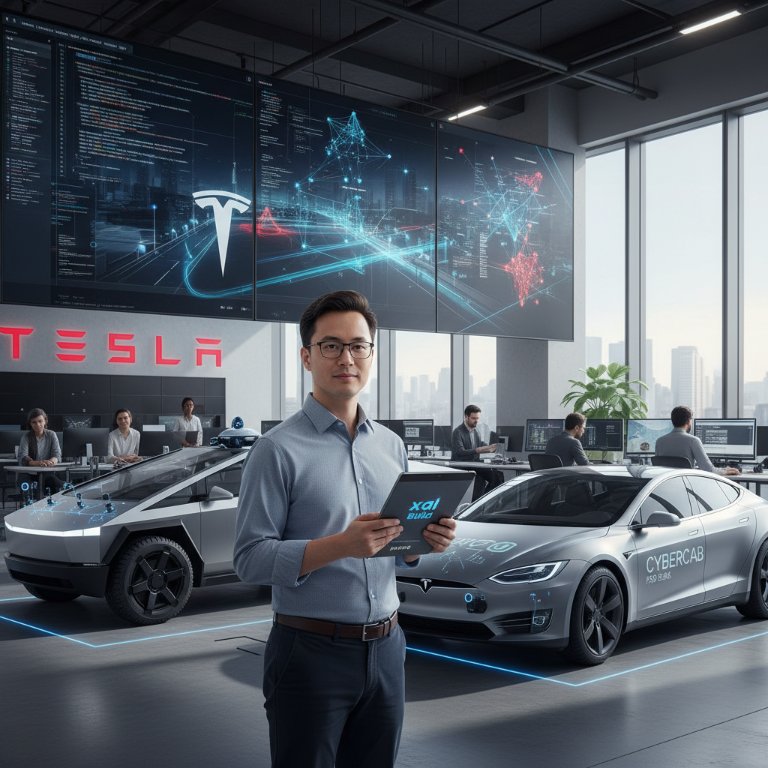
Tesla has publicly cemented its commitment to an AI-driven autonomous future, with a senior company engineer confirming that xAI's Grok Build is extensively powering the development of both Full Self-Driving (FSD) and the eagerly anticipated Cybercab. This revelation, coming directly from Tesla AI's Senior Staff Engineer Yun-Ta Tsai, marks a pivotal moment, offering the first public confirmation from a named Tesla AI engineer regarding Grok's deep involvement in active vehicle software.
This isn't just another incremental update; it’s a profound strategic alignment. For years, the industry has watched Tesla push the boundaries of AI in automotive, often amidst skepticism regarding its FSD timelines. Now, by integrating Grok – the advanced AI model from Elon Musk’s xAI venture – Tesla signals a significant acceleration and a deeper reliance on cutting-edge generative AI to overcome the complex hurdles of Level 4 and Level 5 autonomous driving.
The Grok Integration: A New Era for Tesla AI
The confirmation from Yun-Ta Tsai, a key figure within Tesla AI, is monumental. Until now, the direct, active involvement of xAI's Grok in core Tesla vehicle software development remained largely speculative or implied. This public statement changes that, underscoring a cohesive strategy across Elon Musk’s technology ecosystem.
Key aspects of this integration include:
- Grok Build: xAI’s advanced large language model (LLM) and foundational AI architecture. Its extensive use points to its capability in handling complex, real-world inference and decision-making crucial for autonomous systems.
- Dual Application: Grok's reach extends to both enhancing the existing FSD platform and laying the groundwork for the ground-up autonomous Cybercab.
- Strategic Synergy: This move deepens the technical collaboration between Tesla and xAI, potentially creating a feedback loop where real-world driving data from Tesla vehicles can further refine Grok, and Grok's advancements can, in turn, accelerate Tesla's autonomous projects.
FSD and Cybercab: Tesla's Autonomous Ambitions Intensify
Tesla’s Full Self-Driving (FSD) software has been a journey of iterative improvements, with beta testers providing invaluable data for its neural network training. Grok’s integration suggests a leap towards more sophisticated understanding and prediction capabilities, vital for navigating unpredictable urban environments. For the Cybercab, envisioned as a dedicated autonomous robotaxi platform without a steering wheel or pedals, Grok's role is even more fundamental, underpinning its entire operational intelligence.
This isn't merely about pattern recognition; it's about robust, generalizable AI that can reason, learn, and adapt in real-time. Grok’s capabilities in processing vast amounts of information and generating coherent, actionable responses could be the missing link for FSD to transcend its current limitations and for Cybercab to become a viable, mass-market reality.
Why This Matters:
- Accelerated Autonomy: For Tesla, this signals a major push to accelerate FSD development and bring Cybercab to market. Leveraging Grok could significantly reduce development cycles by providing more advanced AI for perception, prediction, and planning, potentially delivering true Level 4/5 autonomy faster than previously anticipated.
- Proprietary Edge: By deeply integrating Grok, Tesla further entrenches its proprietary AI stack. This reduces reliance on third-party general-purpose AI models and strengthens its competitive advantage against rivals like Waymo, Cruise, and Mobileye, who often rely on a mix of internal and external technologies.
- Validation for xAI: For xAI, this is a massive real-world validation. Having its Grok Build extensively deployed in safety-critical automotive applications demonstrates its robustness and advanced capabilities, potentially attracting more talent and partnerships, and accelerating its own development through access to an unparalleled dataset of driving scenarios.
- Industry Pressure Cooker: This move raises the stakes for the entire autonomous driving industry. Competitors will face increased pressure to demonstrate equally sophisticated AI integrations and to innovate at a faster pace. It signals a shift towards AI models with reasoning capabilities, rather than just advanced sensor fusion.
- Consumer Impact: While FSD has faced scrutiny, the successful integration of Grok could lead to a more reliable, safer, and ultimately more accessible autonomous driving experience for consumers, potentially reshaping urban mobility through services like Cybercab.
Tesla's strategic decision to embed xAI's Grok Build at the heart of its autonomous vehicle development is not just news; it's a blueprint for the future of mobility. This alignment promises to inject a new level of intelligence into FSD and Cybercab, potentially redefining the timeline for widespread autonomous vehicle adoption and solidifying Tesla's position at the forefront of the AI-driven automotive revolution.