Tesla Unlocks Extreme Weather Capability with New Dedicated Traction Control Modes for Model 3 and Model Y
Tesla is officially rolling out its highly anticipated 2026 Summer Update, and with it comes a massive upgrade to its two most popular vehicles. The M...
Editorial Team
World Of EV
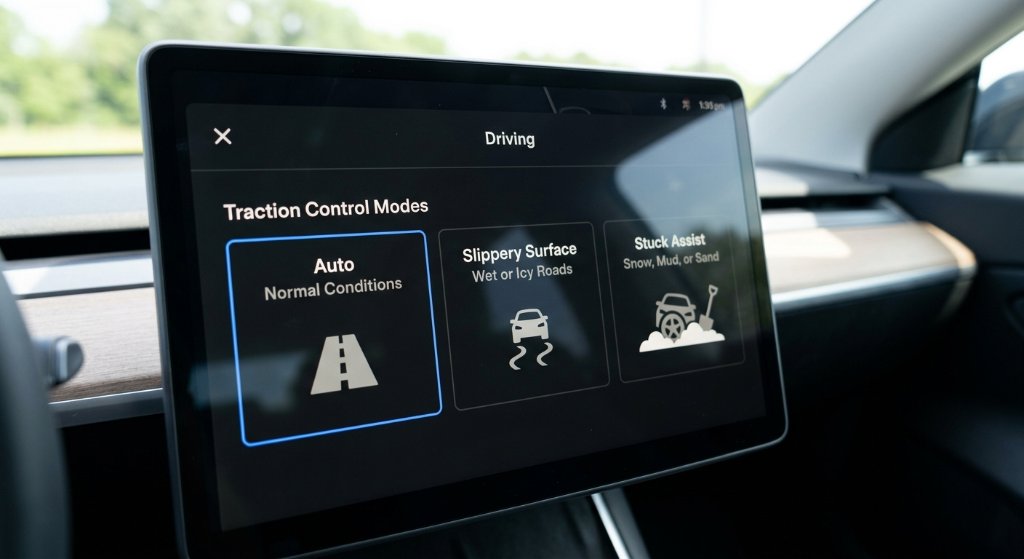
Tesla is officially rolling out its highly anticipated 2026 Summer Update, and with it comes a massive upgrade to its two most popular vehicles. The Model 3 and Model Y are receiving a new 'Traction Control Modes' feature, designed to give drivers granular, touchscreen-selectable control over how their vehicles deliver power in challenging environments.
Historically, Tesla’s approach to traction control has been famously hands-off. Unlike legacy competitors like Subaru with its renowned X-Mode, or rugged EV rivals like Rivian with its multi-terrain drive profiles, Tesla drivers facing deep snow or slick mud were left with a single, rudimentary 'Slip Start' toggle. By introducing dedicated traction profiles, Tesla is finally addressing a long-standing critique from cold-weather drivers, transforming its mass-market champions into far more capable all-weather machines.
Granular Grip: Decoding the New Traction Modes
Rather than relying on a one-size-fits-all traction algorithm, the 2026 Summer Update allows drivers to actively adapt their vehicle's dual-motor or single-motor dynamics to the environment. Accessible directly via the central touchscreen, drivers can now toggle between three distinct settings:
- Auto: The default setting optimized for everyday tarmac driving. It utilizes Tesla’s standard, lightning-fast torque vectoring to maximize efficiency, tire life, and passenger comfort.
- Slippery Surface: Specifically calibrated for wet, icy, or slushy roads. This mode softens initial throttle response and coordinates with the regenerative braking system to prevent sudden losses of traction on slick pavement.
- Stuck Assist: Engineered to tackle deep snow, mud, or loose sand. Rather than aggressively cutting power when wheel slip is detected—which often strands EVs in deep drifts—this setting allows for controlled wheel spin to help the vehicle "dig" its way out of tough spots.
Software Over Hardware: The SDV Advantage
What makes this update particularly impressive is how it highlights Tesla’s dominance in the Software-Defined Vehicle (SDV) space. While traditional automakers often require physical drive-mode dials, mechanical locking differentials, or multi-year mid-cycle hardware refreshes to introduce these capabilities, Tesla has deployed this entirely over-the-air (OTA).
By leveraging the ultra-fast processing speeds of its internal drive units, Tesla's software can adjust motor torque in milliseconds. This level of precise control means a Model Y equipped with standard street tires can now mimic some of the slip-management capabilities previously reserved for dedicated, off-road-adjacent crossovers.
Why This Matters:
- The Strategic Move: This isn't just a minor convenience feature; it is a direct play to defend Tesla's market share in harsh-winter regions like the Northeast US, Canada, and Northern Europe. By closing the "capability gap" with traditional AWD stalwarts like Subaru and Audi, Tesla removes one of the final remaining hesitation points for cold-climate buyers.
- Who Wins: Consumers who live in volatile climates or those who enjoy light trail driving and camping in their Model Y. They get a significantly safer, more predictable vehicle without paying for aftermarket modifications or trading up to more expensive, rugged EVs.
- Who Loses: Legacy OEMs who have historically marketed mechanical all-wheel-drive systems as a safety necessity. Tesla is proving that highly advanced, silicon-based torque management can replicate—and in some cases, outperform—the heavy, mechanical AWD hardware of the past.
- The Market Signal: This update signals a maturity shift in Tesla's product philosophy. Having conquered the "speed and acceleration" phase of EV adoption, the automaker is now focusing on utility, adaptability, and real-world resilience to appeal to the next wave of mainstream car buyers.
Conclusion
With the addition of dedicated Traction Control Modes, Tesla proves once again that its OTA pipeline remains its strongest competitive moat. By continuously injecting fresh, high-value utility into vehicles that are already on the road, Tesla keeps its lineup feeling remarkably modern. This update effectively redefines what Model 3 and Model Y owners can expect from their vehicles when the weather turns hostile.