Tesla Wins the Plug War: EVgo to Deploy Hundreds of 500-kW Co-Branded Superchargers in Massive NACS Victory
In a move that effectively cements Tesla's North American Charging System (NACS) as the undisputed king of electric vehicle infrastructure, major publ...
Editorial Team
World Of EV
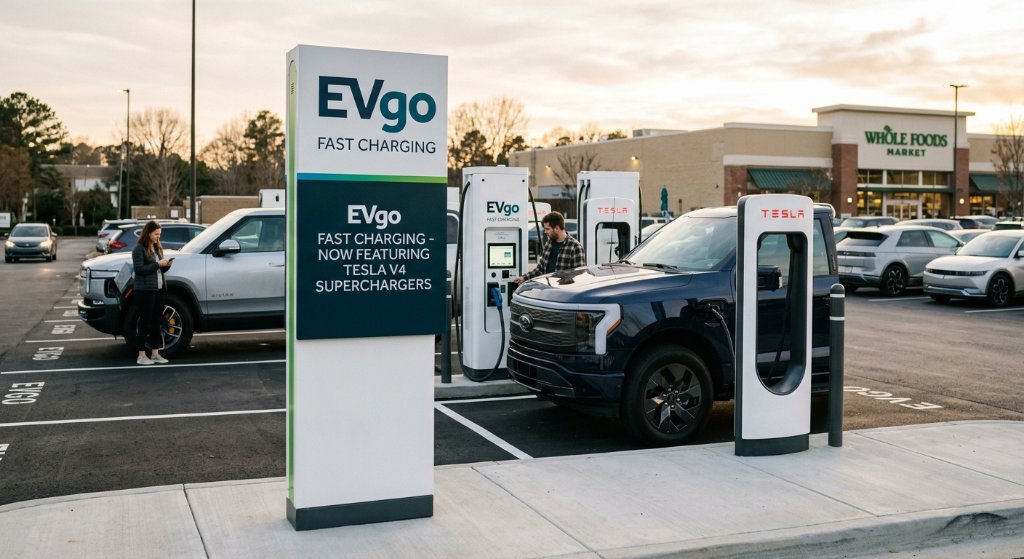
In a move that effectively cements Tesla's North American Charging System (NACS) as the undisputed king of electric vehicle infrastructure, major public charging provider EVgo has announced a massive expansion plan. Beginning this fall, EVgo will deploy hundreds of Tesla-manufactured V4 Superchargers across its US metropolitan network.
This development is a watershed moment for the industry. Just a few years ago, the EV landscape was fractured, with drivers forced to navigate a confusing maze of unreliable CCS plugs while Tesla owners enjoyed an exclusive, seamless highway network. By licensing Tesla's elite hardware, EVgo is blurring the lines between proprietary luxury and public utility—bringing massive benefits to drivers of all stripes.
The Hardware: Why Tesla's V4 is a Massive Upgrade
EVgo’s new "EVgo Superchargers" are not just rebranded legacy units; they represent the absolute cutting edge of charging technology. By utilizing Tesla’s V4 Supercharger dispensers, EVgo is solving several of the industry's most persistent headaches:
- Ultra-Fast 500-kW Speeds: Capable of operating at up to 1,000 volts, these chargers are fully future-proofed for high-voltage EV architectures—such as the Hyundai E-GMP platform (Ioniq 5 and 6), Kia EV9, and Porsche Taycan—which previously throttled on older Tesla V3 equipment.
- Integrated Magic Dock: Each dispenser features an integrated NACS-to-CCS adapter. This means both Tesla and legacy CCS vehicles can charge natively without drivers needing to carry clunky, aftermarket dongles.
- Longer Cable Reach: Tesla’s V4 design features significantly longer cables, resolving the notorious "short cable" issue that forced non-Tesla drivers to awkwardly park across multiple stalls to plug in.
- Native Tesla Navigation Integration: Because these chargers are built on Tesla’s software backbone, they will appear directly in Tesla’s in-car navigation and Trip Planner, seamlessly routing millions of Tesla drivers to EVgo locations.
Tesla's 'Supercharger for Business' Program Takes Flight
This partnership highlights a clever strategic pivot for both companies. Under Tesla’s "Supercharger for Business" program, EVgo will own and brand these stations, but Tesla will manufacture, supply, and—crucially—maintain them.
Historically, third-party networks like EVgo have struggled with uptime, relying on a patchwork of hardware suppliers like Delta Electronics. By outsourcing hardware manufacturing and maintenance to Tesla—the gold standard in charging reliability—EVgo can rapidly scale its network toward its goal of 15,000 to 17,000 ports by 2030, while boasting the near-perfect uptime that drivers demand.
Why This Matters:
- Who Wins?
- EVgo: They instantly upgrade their network reliability and tap into Tesla’s massive, loyal customer base via in-car navigation routing.
- Everyday Drivers: The psychological barrier of "charger anxiety" is crumbling. Non-Tesla owners gain access to ultra-reliable, high-speed charging without compatibility headaches.
- High-Voltage EV Owners: Drivers of 800V and 900V cars can finally utilize a Supercharger dispenser at full speed, getting up to 200 miles of range in just 15 minutes.
- Who Loses?
- Competing Hardware Manufacturers: Legacy charging hardware manufacturers (like Delta or ABB) face an existential threat. It will be incredibly difficult to compete with Tesla’s scaled manufacturing costs and unmatched reliability.
- CCS-Only Networks: Competitors who drag their feet on adopting NACS and upgrading to high-voltage, high-reliability dispensers risk immediate obsolescence.
- The Market Signal: Tesla has successfully transitioned from an exclusive automaker into the default toll-road operator of the entire EV revolution. By licensing its technology, Tesla monetizes its competitor's charging transactions while solidifying NACS as the permanent, unchallenged standard of North American transportation.
Conclusion
The partnership between EVgo and Tesla marks the end of the experimental phase of public EV charging. By combining EVgo's premium metropolitan retail locations with Tesla’s flawless charging hardware and maintenance, this deal addresses the absolute biggest pain point of EV ownership. As the first of these co-branded 500-kW sites go online in late 2026, the dream of a unified, reliable national charging grid is finally becoming a reality.