Tesla’s 2026 Summer Update Unleashes Grok-Powered Vehicle Control and FSD Stat-Sharing, Redefining the Software-Defined Car
For years, Tesla owners have put up with a software paradox. While driving the most advanced software-defined vehicles on the planet, they still had t...
Editorial Team
World Of EV
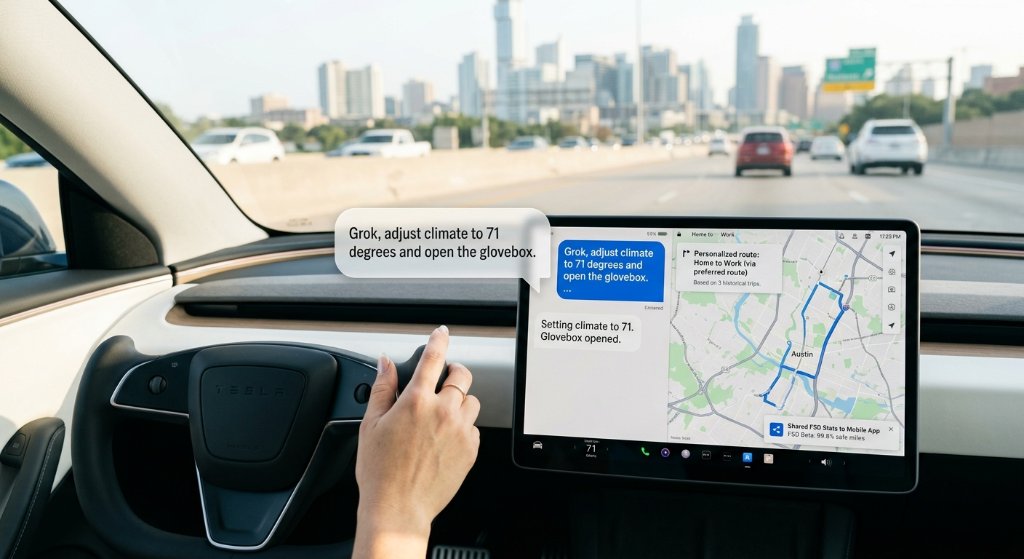
For years, Tesla owners have put up with a software paradox. While driving the most advanced software-defined vehicles on the planet, they still had to interact with a frustratingly rigid voice-control system that felt like it was plucked straight from 2012. Early integrations of Elon Musk's xAI chatbot, Grok, in 2025 and the "Hey Grok" wake-word update in early 2026 began to bridge this gap, but the AI remained locked out of the car's physical systems—acting more like a dashboard-mounted trivia assistant than an actual co-pilot.
That separation of church and state ends today. Tesla's highly anticipated 2026 Summer Software Update (build 2026.26), now hitting the global fleet, breaks down those barriers. By granting Grok direct access to the vehicle's hardware APIs and introducing deeply personalized navigation routines alongside viral-ready FSD stat-sharing, Tesla is moving beyond the gimmick phase of generative AI to deliver a highly cohesive, hyper-personalized driving ecosystem.
Grok Takes the Reins of Vehicle Control
The headline act of build 2026.26 is the physical empowerment of Grok. Instead of just answering random web-search queries or plotting basic navigation points, the xAI-powered assistant can now tap directly into the car's local hardware layer. This expansion, which is also rolling out broadly to European owners, marks a massive leap in hands-free convenience.
- Core Vehicle Control: Drivers can now ask Grok to adjust climate control zones, turn on seat heaters, make phone calls, and even pop open the glovebox—a physical action that previously required tapping through multiple touchscreen menus.
- Natural Media Control: Grok can search, queue, and play music across platforms, easily parsing complex artist names and song requests that historically choked Tesla's legacy voice-recognition engine.
- Conversational Hardware Access: By sitting directly on top of the same command APIs used by the Tesla mobile app, Grok transitions from a passive chatbot into a functional, hardware-controlling co-pilot.
Personalized Navigation That Learns Your Life
Beyond the voice assistant, Tesla’s navigation engine has received a significant brain upgrade. Historically, "Auto Navigation" was a binary affair, automatically mapping routes to "Home" or "Work" depending on the time of day, or relying strictly on calendar events. The 2026 Summer Update introduces a more nuanced, routine-learning algorithm.
- Routine Recognition: The system now automatically learns your weekly habits. Whether it’s a Tuesday morning school drop-off, a Thursday evening gym session, or a weekend coffee spot, the car proactively queues up the route.
- Historical Path Prioritization: Rather than blindly routing you via the absolute mathematically fastest freeway (which might be congested or stressful), the software now prioritizes your historically preferred driving routes while still alerting you if a massive delay makes an alternative necessary.
FSD Gamification and Mobile App Superpowers
Tesla is also looking to turn Full Self-Driving (FSD) into a social experience. The updated Tesla mobile app now allows users to access a dedicated portal displaying their FSD analytics.
- Bragging Rights: Users can now view continuous usage logs, streak milestones, and total autonomous miles driven, formatting them into shareable social media graphics directly from the app.
- Remote Control Settings: The app also adds features like setting targeted "Arrival Energy" levels remotely and seamlessly uploading custom vehicle wraps directly from your phone, bypassing the old requirement of using a physical USB drive.
Why This Matters:
This update is a strategic masterstroke that signals a major shift in how automakers will compete in the late 2020s. While legacy brands are struggling to integrate basic ChatGPT widgets that do little more than read Wikipedia articles, Tesla has successfully unified its local hardware control with a proprietary Large Language Model.
The winners here are clearly Tesla and xAI. By closing the loop between AI and vehicle hardware, Tesla is widening its moat against automakers reliant on third-party software like Apple CarPlay or Android Automotive, which still struggle to access deep vehicle APIs natively. Conversely, the losers are legacy OEMs who continue to treat software as a secondary feature rather than the core product.
Furthermore, the introduction of shareable FSD stats is a brilliant marketing play. It gamifies autonomous driving, creating a community-led marketing push. Every time an owner shares their FSD "streak" or "total self-driven miles" on social media, they are providing free, highly trusted crowd-sourced advertising for Tesla’s autonomous future. It shifts the public narrative of FSD from a controversial experimental system to an essential, daily-use badge of honor.
Conclusion:
Tesla’s 2026 Summer Update (build 2026.26) proves that the battleground of the EV market has permanently shifted from raw battery chemistry and horsepower to software intelligence. By making Grok a functional co-pilot and giving FSD users a social platform to share their autonomous journeys, Tesla is redefining what a "smart car" actually is. While competitors are still trying to figure out how to build fluid touchscreens, Tesla is already paving the way for an era where you rarely have to touch the screen at all.