Tesla's 2026.2.3 Update: Safety Enhancements, Cybertruck AI, and a Puzzling Hardware Divide
Tesla has initiated a significant global rollout of its software update version 2026.2.3, marking the official commencement of the new 2026 software b...
Editorial Team
World Of EV
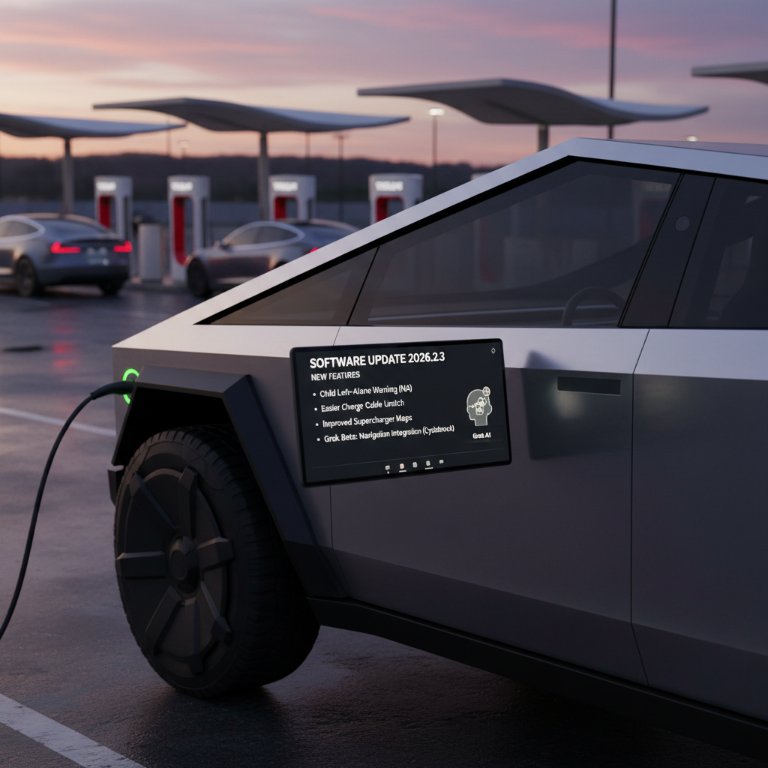
Tesla has initiated a significant global rollout of its software update version 2026.2.3, marking the official commencement of the new 2026 software branch. This wide-reaching update, touching the majority of the automaker's global fleet—including its much-discussed Cybertruck units—delivers a suite of enhancements focused on safety, user convenience, and a tantalizing glimpse into the integration of artificial intelligence within the cabin.
For an automaker that built its reputation on the power of over-the-air (OTA) updates, each new software branch signals a strategic evolution. Tesla's approach to continuous improvement via OTA has long been a differentiator, allowing for rapid feature deployment and bug fixes without requiring a visit to a service center. This 2026.2.3 release is no exception, bringing tangible improvements that directly impact daily ownership.
A Focus on Practicality and Safety
- Child Left-Alone Warning: Now available across North America, this critical safety feature alerts owners if a child is detected in the vehicle after it has been parked and locked. This addresses a serious, albeit rare, safety concern and demonstrates Tesla's commitment to leveraging its in-car sensor suite for occupant well-being.
- Easier Charge Cable Unlatching: A quality-of-life improvement that simplifies the often-fiddly process of disconnecting the charging cable. While seemingly minor, such refinements collectively improve the daily user experience, especially in adverse weather conditions or late-night charging sessions.
- Supercharger Map Improvements: Enhancements to the in-vehicle Supercharger navigation maps aim to provide more accurate information, potentially including real-time stall availability or more detailed amenity data, making long-distance travel planning more seamless for EV drivers.
Cybertruck Embraces Grok in Beta
Perhaps the most intriguing addition in this update, exclusive to Cybertruck units for now, is the beta integration of Grok for navigation commands. Grok, Tesla's proprietary generative AI, is making its automotive debut, promising a more intuitive and conversational interface for inputting destinations and controlling navigation. This move signals a deliberate push by Tesla to embed advanced AI directly into the vehicle's core functions, potentially setting a new standard for in-car voice assistants that go beyond rote commands to genuinely understand complex instructions and context.
The Curious Case of the Hardware Divide
Crucially, the 2026.2.3 update reveals a significant divergence in Tesla's software deployment strategy. The update is being pushed to Hardware 3 (HW3) vehicles running Full Self-Driving (FSD) versions 12.6.4 and 13.2.9. However, Hardware 4 (HW4) vehicles, particularly those operating with the cutting-edge FSD v14, are conspicuously not receiving this general software refresh. HW4 represents Tesla's latest and most powerful computing platform, designed to underpin the next generation of FSD capabilities.
Why This Matters:
This latest software rollout from Tesla, while bringing welcome enhancements, raises several critical questions for owners and the broader EV industry. The inclusion of the child left-alone warning is a clear win for safety and a responsible application of existing vehicle technology, bolstering confidence in Tesla's commitment to occupant protection. The easier charge cable unlatching and Supercharger map improvements, while less flashy, contribute significantly to the overall user experience, addressing common pain points that can define daily EV ownership satisfaction.
However, the selective distribution of this update – reaching HW3 vehicles but bypassing newer HW4 units on FSD v14 – is the most telling aspect. On one hand, it could indicate Tesla's strategic prioritization of its vast HW3 fleet, ensuring a consistent and stable user experience across its established customer base. It might also suggest that the advanced FSD v14 stack on HW4 is on a distinct, potentially more rigorous, development and testing path, where general software features are integrated separately or at a later stage to avoid introducing instability into the bleeding-edge autonomous driving system.
Conversely, this split could signal emerging challenges in managing a fragmented hardware and software ecosystem. For HW4 owners who have invested in Tesla's latest and greatest technology, being excluded from general feature updates, even temporarily, could lead to a perception of being in a 'beta' purgatory, waiting for their advanced hardware to fully converge with the latest user-facing features. This potential for a bifurcated experience could introduce complexity for Tesla's support infrastructure and create confusion for consumers evaluating different hardware iterations.
The integration of Grok into the Cybertruck is a forward-looking move, positioning Tesla at the forefront of in-car generative AI. If successful, this could dramatically reshape the in-vehicle human-machine interface, offering a more intuitive and powerful alternative to traditional voice commands. This development signals Tesla's ambition to go beyond basic automation and create a truly intelligent, interactive cabin environment.
Ultimately, this update paints a picture of Tesla's ongoing innovation, balancing safety and convenience with ambitious AI integration. Yet, the hardware divergence highlights the complexities inherent in rapidly evolving automotive technology, leaving a segment of its most advanced customers awaiting full feature parity. How Tesla navigates these parallel development tracks for HW3 and HW4 will be a crucial storyline to watch throughout 2026.
Tesla's 2026.2.3 update delivers practical improvements and a bold step into in-car AI with Grok for Cybertruck. While enhancing safety and user experience for many, the notable exclusion of HW4 vehicles on FSD v14 creates a distinct software divide that warrants close attention from industry observers and Tesla owners alike. The future will reveal how effectively Tesla harmonizes its diverse hardware and software ecosystems to deliver a unified and continuously improving ownership experience.