Tesla’s 2026.27.10 Update Unleashes FSD Safety Shield: How 'Automatic Collision Evasion' Takes Control When You Can't
Tesla is rewriting the rules of active vehicle safety with its latest software rollout, update 2026.27.10. At the heart of this release is a groundbre...
Editorial Team
World Of EV
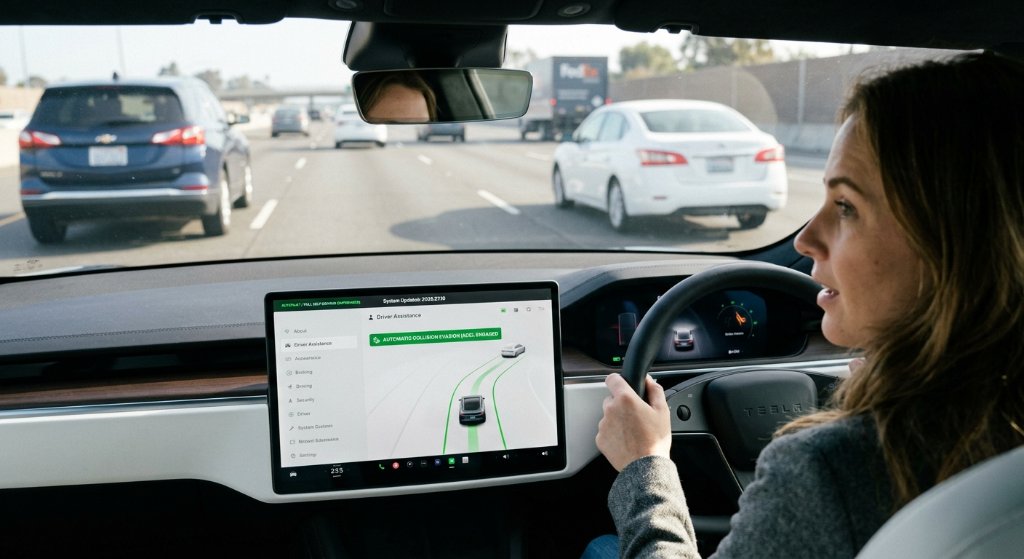
Tesla is rewriting the rules of active vehicle safety with its latest software rollout, update 2026.27.10. At the heart of this release is a groundbreaking feature called Automatic Collision Evasion (ACE), designed to act as a digital guardian angel. For years, Tesla has faced intense scrutiny from regulators and safety advocates over its "Tesla Vision" camera-only approach and the real-world performance of its driver-assist suites. With ACE, Tesla is not just defending its engineering choices; it is demonstrating how end-to-end neural networks can protect drivers even when they choose to drive manually.
Historically, active safety systems like legacy Automatic Emergency Braking (AEB) were simple, rule-based modules that could only slam on the brakes at the last second to mitigate—rather than prevent—an impact. ACE completely disrupts this paradigm. By integrating the full analytical power of Tesla's Full Self-Driving (FSD) stack into everyday manual driving, Tesla is providing an unprecedented level of real-time crash avoidance that goes far beyond anything currently offered in the passenger vehicle market.
The FSD Neural Network as a Silent Guardian
ACE operates quietly in the background, stepping in only when a catastrophic frontal collision is imminent. If the system detects a hazard that the human driver has failed to address—or is steering insufficiently to avoid—it instantly and temporarily activates the FSD neural network. What makes ACE genuinely revolutionary is its multi-modal reaction capability: rather than just applying friction brakes, it can actively steer, brake, or accelerate to dodge the obstacle.
Under the Hood: Key Specifications and Capabilities
- Speed Threshold: The ACE system operates dynamically at speeds below 85 mph, covering virtually all standard highway and urban driving scenarios.
- FSD Integration: When a frontal hazard is detected, the vehicle temporarily engages the FSD stack to execute complex evasion maneuvers, even if the driver is driving manually.
- Coexistence with Manual Steering: ACE functions seamlessly alongside human inputs. If a driver is steering manually but fails to avoid a collision, the system overrides or assists the inputs to ensure safety.
- Proactive Action Arsenal: Unlike traditional AEB, which has a single point of failure (braking only), ACE can choose to accelerate or steer around an obstacle if it determines braking will not prevent the crash.
Why This Matters:
This is a defining milestone for Tesla and a major wake-up call for the wider automotive industry. Up until now, driver-assistance features were strictly binary: you were either letting the car drive itself, or you were driving manually with basic, legacy ADAS backups. By embedding the FSD stack into manual driving mode as an invisible safety shield, Tesla has neutralized the argument that autonomous software is only useful for people who want to surrender control.
This move puts massive pressure on legacy automakers like Ford, GM, and Toyota, who rely heavily on third-party Tier-1 ADAS suppliers. While traditional OEMs are locked into static, hardware-constrained safety modules, Tesla is leveraging its vertically integrated AI compute power to upgrade millions of existing cars on the road. The clear winners here are Tesla owners, who just received a military-grade collision avoidance system via a routine over-the-air (OTA) update.
However, this feature will undoubtedly spark a fresh round of regulatory and ethical debates. If an automated evasion maneuver successfully avoids a head-on collision but results in side-swiping another vehicle, who bears the liability? Tesla’s aggressive deployment of ACE signals to the market that it is willing to navigate these murky legal waters to maintain its position as the technological vanguard of the EV transition.
Conclusion
Software update 2026.27.10 is definitive proof that the true value of a modern electric vehicle lies in its software architecture. With Automatic Collision Evasion, Tesla has transformed the FSD stack from a convenience feature into an essential life-saving utility. As the automotive industry transitions to software-defined vehicles, Tesla's ability to deploy a complex, active evasion system to its global fleet via a simple OTA update shows just how far ahead they remain in the AI race.