Tesla's Autonomous Cybercab Cleared for U.S. Roads: A Robotaxi Revolution Begins
In a seismic shift for the future of urban mobility, Tesla's highly anticipated Cybercab, its purpose-built autonomous ride-hailing vehicle, has offic...
Editorial Team
World Of EV
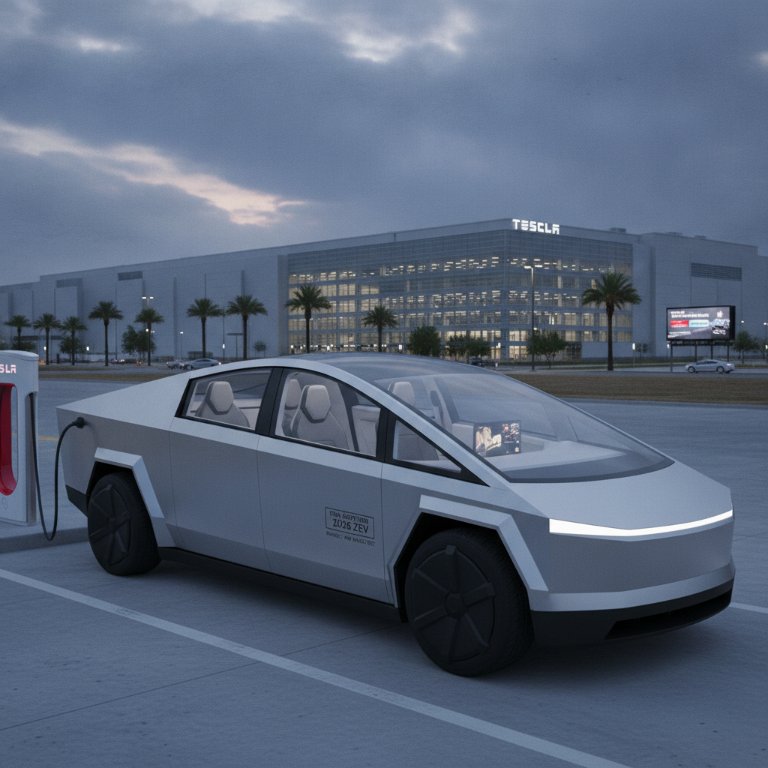
In a seismic shift for the future of urban mobility, Tesla's highly anticipated Cybercab, its purpose-built autonomous ride-hailing vehicle, has officially secured an EPA Certificate of Conformity for the 2026 model year. This critical regulatory approval, which began its journey from Giga Texas production lines earlier this year, not only paves the way for legal sales and operation across the United States but signals Tesla's concrete step towards realizing its long-promised robotaxi network.
For years, EV enthusiasts and industry analysts alike have watched as Tesla CEO Elon Musk championed the vision of a fully autonomous ride-hailing fleet, often met with a mix of excitement and skepticism. Unlike conventional vehicles adapted for autonomous driving, the Cybercab is designed from the ground up without a steering wheel or pedals, marking a radical departure and a clear declaration of Tesla's unwavering commitment to a driverless future.
Regulatory Green Light: Paving the Way for Autonomous Fleets
The EPA Certificate of Conformity is more than just a bureaucratic checkbox; it's a foundational clearance that classifies the Cybercab as a battery electric Zero Emission Vehicle (ZEV). This classification confirms the vehicle's adherence to the stringent federal Clean Air Act emission standards, effectively legalizing its presence on American roads and enabling mass deployment. For Tesla, this milestone represents a significant validation of their engineering and regulatory compliance efforts, moving the Cybercab from concept to certified reality. It sets a crucial precedent for autonomous vehicles designed specifically for a driverless service model.
Unveiling Cybercab's Core Specifications
The certification documents offered the first concrete look at the Cybercab's specifications, providing vital context for its intended urban environment and operational efficiency. The details reveal a highly optimized vehicle engineered for its unique role:
- Curb Weight: A remarkably light 3,113 lbs.
- Motor Power: A robust 219 HP.
- Battery Pack: A compact 48 kWh.
- Unadjusted City Range: Just over 418 miles.
The combination of a relatively small 48 kWh battery pack and an impressive 418+ miles of unadjusted city range highlights the Cybercab's extreme efficiency. While 'unadjusted city range' is not directly comparable to EPA's combined adjusted range figures, it suggests an incredibly aerodynamic design and optimized powertrain for low-speed urban driving – precisely what a ride-hailing vehicle demands to maximize uptime and minimize charging stops. This efficiency will be critical in a competitive robotaxi market, distinguishing it from less efficient, adapted passenger vehicles.
Giga Texas: The Birthplace of a New Era
Production of the Cybercab commenced in early 2026 at Tesla's colossal Giga Texas facility. This strategic decision underscores the company's commitment to vertical integration and scaled manufacturing, leveraging its proven expertise in high-volume EV production. The ramp-up at Giga Texas will be closely watched by the industry, as it will dictate the pace at which Tesla can truly launch its robotaxi service.
Why This Matters:
The EPA certification of Tesla's Cybercab is not merely a piece of news; it’s a tectonic shift that validates Tesla's long-term vision and sets the stage for a truly transformative era in transportation. This is far more than just another EV; it's a purpose-built platform designed to fundamentally disrupt how people move.
- Who Wins? Tesla stands to gain an enormous first-mover advantage in the purpose-built robotaxi space, potentially unlocking a massive, high-margin 'Autonomy as a Service' revenue stream that moves beyond just selling cars. Urban dwellers could see significantly cheaper, more convenient, and more accessible transportation options. Cities might benefit from reduced private vehicle ownership, congestion, and parking demands.
- Who Loses? Traditional ride-hailing giants like Uber and Lyft face an existential threat if they cannot rapidly deploy their own autonomous fleets or partner effectively. The personal car ownership model in dense urban areas could erode, impacting traditional automakers and their dealerships. Companies banking on retrofitting existing vehicles for autonomy may find themselves outmaneuvered by purpose-built designs offering superior efficiency and passenger experience.
- What This Signals: This certification is a resounding signal to the entire automotive and tech industries that Tesla is serious about its Level 5 autonomous ambitions. It signifies a clear shift from incremental FSD updates to deploying a dedicated, driverless solution. It forces competitors to accelerate their own autonomous strategies, whether through development or acquisition, or risk being left behind in a rapidly evolving mobility landscape. The efficiency figures, in particular, signal a masterclass in urban operational design.
- Is This a 'Do-or-Die' Moment? For Tesla, the Cybercab is a monumental bet, perhaps the biggest in its history since the original Roadster. Its success would cement Tesla's position not just as an EV manufacturer but as a dominant force in future mobility. Failure, however, would be a costly blow to its credibility and financial outlook. For the broader industry, it's a stark reminder that the future of transportation is coming, and it's autonomous.
With EPA clearance secured and production underway, Tesla is now on the precipice of transforming its autonomous vision into a tangible service. While significant operational and local regulatory hurdles undoubtedly remain, the Cybercab's certification marks an undeniable leap forward, promising to redefine urban transportation and solidify Tesla’s role at the forefront of the autonomous revolution. The world now watches as Tesla prepares to unleash its fleet, poised to reshape how we think about mobility forever.