Tesla's Autopilot Unbound: Slovenia Clears FSD Supervised as Momentum for EU-Wide Rollout Explodes
Tesla Europe just notched another crucial victory in its uphill battle against continental red tape, securing official regulatory clearance for Full S...
Editorial Team
World Of EV
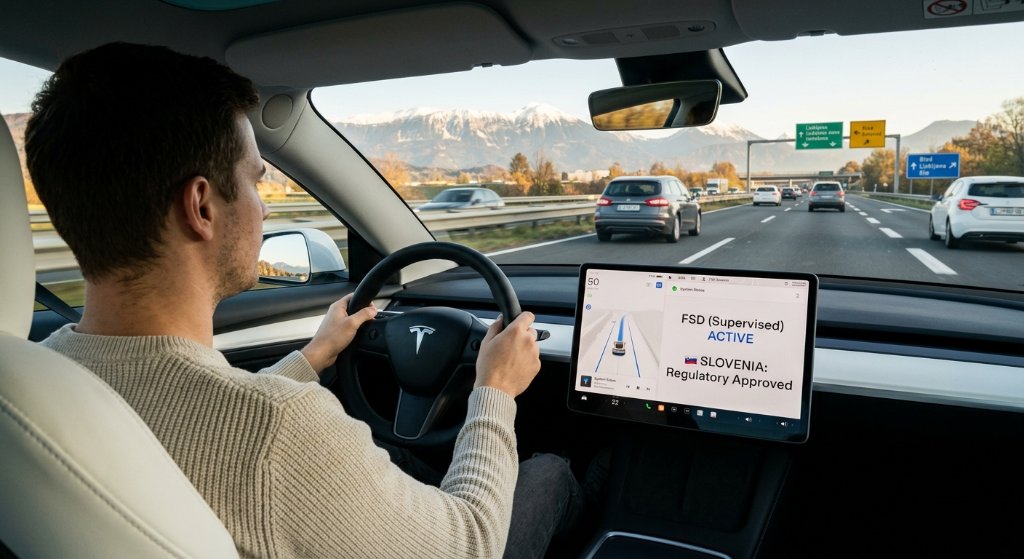
Tesla Europe just notched another crucial victory in its uphill battle against continental red tape, securing official regulatory clearance for Full Self-Driving (Supervised) in Slovenia. While the Alpine nation represents a modest automotive market, the significance of this move is massive: Slovenia is now the sixth European Union member state to greenlight the driver-assist software, signaling that Tesla's localized regulatory strategy is paying off.
This approval isn't just a flash in the pan; it marks a steady acceleration of FSD momentum across Europe ahead of a critical EU-wide vote. By utilizing a clever "anchor regulator" strategy, Tesla is successfully chipping away at Europe's notoriously strict safety frameworks, preparing to bring its flagship software to Slovenian roads via over-the-air updates in the near future.
Behind the Curtains of the RDW 'Anchor' Strategy
Tesla's expansion in Europe isn't happening by accident. It is powered by the Dutch vehicle authority (RDW), which granted an initial EU type approval under the United Nations Economic Commission for Europe (UNECE) Regulation 171 (governing Driver Control Assistance Systems, or DCAS) in April 2026.
- Mutual Recognition: The RDW's decision unlocked a legal framework allowing other EU nations to fast-track approval rather than performing testing from scratch.
- The Six-Nation Club: Slovenia now joins Belgium, the Netherlands, Denmark, Lithuania, and Estonia in bypassing general delays.
- Under-the-Hood Exemptions: The RDW used Article 39 exemptions under EU Regulation 2018/858, giving Tesla temporary permission to deploy FSD’s urban and system-initiated maneuvers which sit outside standard baseline envelopes.
Weaponizing Data Against Regulatory Inertia
To convince skittish European regulators—traditionally far more conservative than their North American counterparts—Tesla recently launched a high-stakes safety campaign. The automaker published an exhaustive safety dashboard using real-world telemetry from its European engineering test fleets.
- 4.1x Safer: Tesla’s data claims FSD (Supervised) is 4.1 times safer than manually driven Teslas on EU roads, based on 100 million kilometers of driving.
- Engineering Validation: Tesla's engineering test fleet has driven over 1 million miles across 22 European nations—including Slovenia—to train the AI for localized road layouts, signage, and roundabouts.
- Reg 171 Adjustments: To comply with UN Reg 171, European FSD builds limit lateral acceleration on curves and feature aggressive in-cabin eye-tracking and "attentiveness grading".
Why This Matters:
This approval is a clear indication that Tesla’s piecemeal regulatory lobbying is paying off, but the real prize is yet to come. On October 6, 2026, the EU’s Technical Committee on Motor Vehicles (TCMV) will vote on a historic EU-wide approval. To pass, it requires a qualified majority of at least 15 member states representing 65% of the EU population.
Who Wins: Tesla and its European customer base. Monetizing FSD (Supervised) on thousands of existing HW4/AI4 vehicles already on European roads will inject a high-margin revenue stream directly into Tesla’s bottom line. Owners will finally get a taste of the Level 2 autonomy that North American drivers have enjoyed for years, albeit with stricter speed and curve constraints.
Who Loses: Traditional European premium brands like BMW, Mercedes-Benz, and Audi. While Mercedes boasts a Level 3 "Drive Pilot" system, it is highly restricted to specific highways under 60 km/h in clear weather. Tesla's FSD operates dynamically across highways and complex urban roads. If Tesla wins the October EU-wide vote, it will leapfrog the legacy giants overnight on their own home turf. However, pushback from major auto-producing nations like France and Finland highlights that this remains a high-stakes, "do-or-die" regulatory gamble.
Slovenia’s approval of FSD (Supervised) is another brick in the wall Tesla is building to conquer the European autonomous driving landscape. As the countdown to the decisive October 6 EU vote begins, Tesla has positioned itself beautifully—backed by compelling safety data and a growing coalition of supportive member nations. The era of true hands-on, eyes-on software-defined transit in Europe is no longer a distant dream; it is rapidly becoming an over-the-air reality.