Tesla's Charging Monopoly Shattered as OEM-Backed Networks Push EV Fast-Charging Satisfaction to New Heights
For years, the narrative surrounding non-Tesla electric vehicles was plagued by a singular, nagging anxiety: the public charging "desert." While Tesla...
Editorial Team
World Of EV
For years, the narrative surrounding non-Tesla electric vehicles was plagued by a singular, nagging anxiety: the public charging "desert." While Tesla owners enjoyed the walled-garden luxury of the seamless Supercharger network, drivers of other EVs were left to battle broken screens, rejected credit cards, and sluggish speeds on third-party networks. It was a primary deterrent for prospective EV buyers and a glaring bottleneck for the industry's growth.
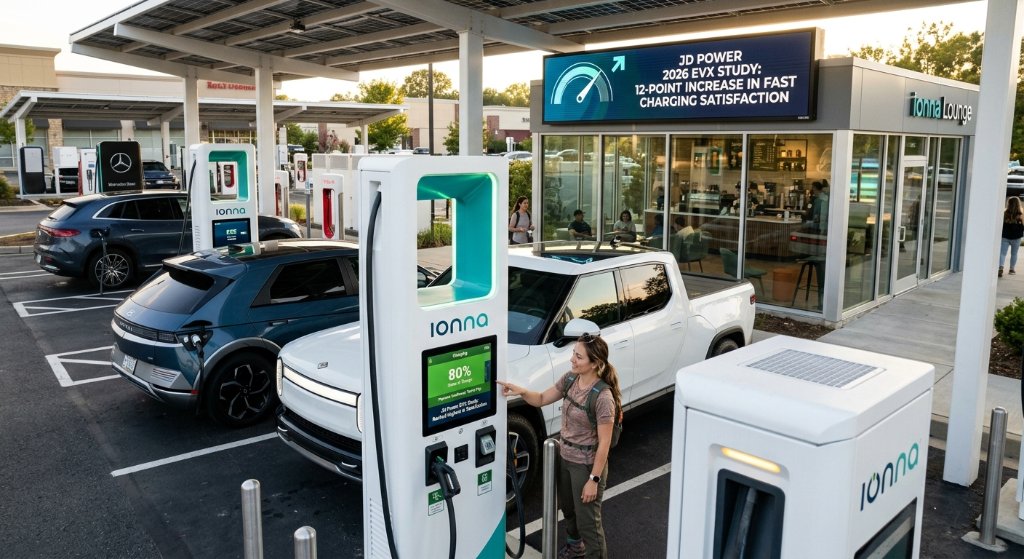
But according to the newly released J.D. Power 2026 U.S. Electric Vehicle Experience (EVX) Public Charging Study, the tide has officially turned. Overall EV owner satisfaction with DC fast chargers has climbed 12 points to 666 (on a 1,000-point scale) compared to last year. Driven by a historic drop in failed charging attempts to an all-time low of 12%, this shift is powered not by legacy charging giants, but by a new wave of automaker-backed premium networks—including IONNA, Mercedes-Benz, and Rivian—that are fundamentally rewriting the public charging playbook.
The Rise of the "Destination" Charging Experience
The dramatic rise in customer satisfaction isn't merely about getting electricity into a battery; it is about the evolution of the charging station itself. The top-performing networks in the study succeeded by shifting the paradigm from transactional utility to premium hospitality. Brands like IONNA (the joint venture backed by eight major automakers, including BMW, GM, Honda, and Hyundai) and Mercedes-Benz are deploying "destination-style" locations that offer comfortable lounges, restrooms, security, and retail options.
Key details behind the study's findings highlight what is driving this positive shift:
- The Death of the 'Dud' Charger: The industry-wide "non-charge visit rate"—the percentage of times a driver pulls up to a fast charger but leaves without successfully charging—fell to a record low of 12% (down from 14% last year).
- Automakers Take the Lead: In their first year of award eligibility, automaker-backed networks dominated the rankings. IONNA took the top spot with a stellar score of 807 out of 1,000, followed closely by the Mercedes-Benz Charging Network (797) and the Rivian Adventure Network (755).
- The Infrastructure Upgrade: Improvements were recorded across all 10 index factors, led by a 27-point surge in charger availability, and an 18-point jump in both perceived physical safety and the transparency of charging costs.
The Level 2 Divergence: A Growing Gap in the Network
While the DC fast-charging ecosystem is celebrating a major milestone, the story is far less rosy for slower, Level 2 public chargers. In a stark divergence, customer satisfaction with Level 2 public chargers actually dropped by 12 points to 595. Drivers reported growing frustration with complex payment systems and overall ease of use on these slower networks. Furthermore, fast chargers located at traditional auto dealership lots and standalone parking garages scored the lowest of any location type, highlighting that simply throwing a charger in a dark corner is no longer acceptable to modern EV buyers.
Why This Matters:
This shift marks a critical inflection point for the EV transition. Historically, Tesla’s Supercharger network was the ultimate "moat" protecting its market dominance—it was the single strongest reason to buy a Model 3 or Model Y over competitors. Now, with OEM-backed joint ventures like IONNA securing the highest marks in the industry, that moat has evaporated.
The biggest winners here are the consumers and the legacy automakers who realized they could no longer outsource their customers' charging experiences to unreliable third parties. By banding together to build IONNA, these brands have proven that a collaborative, premium-focused approach can successfully challenge Tesla's dominance.
Conversely, this is a massive wake-up call for legacy, non-OEM fast-charging networks like Electrify America, EVgo, and ChargePoint, which continue to lag behind in customer satisfaction. If these third-party operators do not rapidly upgrade their maintenance protocols and integrate better amenities, they risk becoming obsolete as automakers choose to steer their customers toward proprietary or high-performing partner networks. Ultimately, this proves that solving the charging crisis was never just about hardware—it was about reliability, convenience, and customer-first design.
The latest J.D. Power data proves that public charging in the United States is finally maturing past its Wild West phase. While Level 2 infrastructure still requires urgent intervention, the dramatic turnaround in DC fast-charging reliability demonstrates that when automakers take control of the charging pipeline, everyone benefits. As these premium networks scale up, the single largest barrier to mainstream EV adoption is starting to crumble.