Tesla's Covert Downgrade: Canadian Model 3 RWD Sees Drastic Spec Cuts, Raising Industry Eyebrows
Tesla, long lauded for its relentless pursuit of performance and innovation, appears to be taking a decidedly less transparent approach with its Canad...
Editorial Team
World Of EV
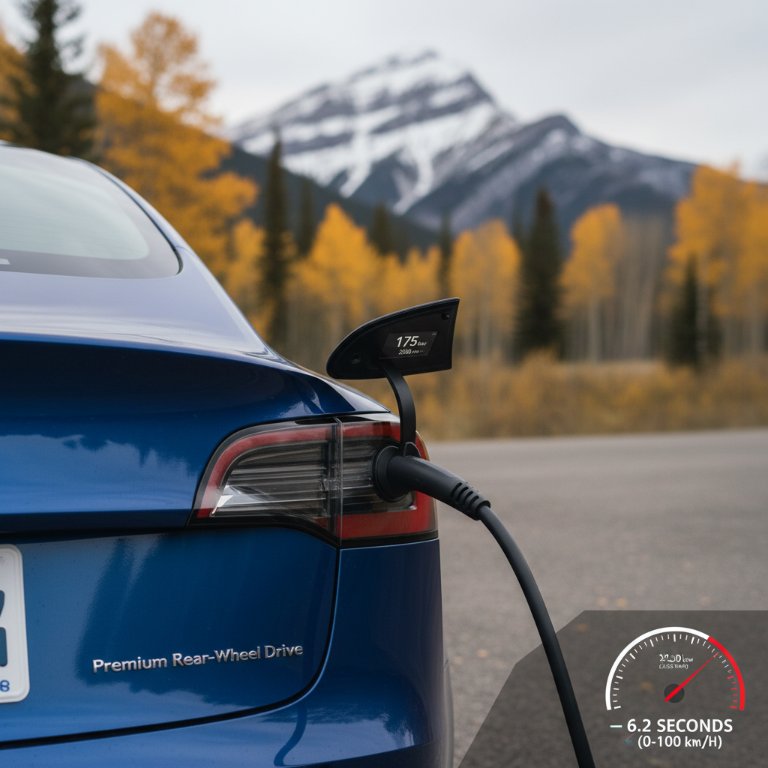
Tesla, long lauded for its relentless pursuit of performance and innovation, appears to be taking a decidedly less transparent approach with its Canadian Model 3 Premium Rear-Wheel Drive. In a move that has quietly rippled through the configurator, the automaker has drastically reduced key specifications for this particular variant, sparking concern and raising questions across the industry. This isn't just a minor tweak; these are significant downgrades to acceleration, charging speed, and warranty coverage, delivered without public announcement and rolled out rapidly over a matter of days.
Performance Hit: A Two-Second Downgrade
The most glaring alteration concerns the vehicle's straight-line performance. Initially, on May 1st, the Canadian Model 3 Premium Rear-Wheel Drive boasted a respectable 0-100 km/h (0-62 mph) acceleration time of just 4.2 seconds. This figure positioned it as a surprisingly spirited performer, particularly for a rear-wheel-drive variant. However, within a mere 12 hours, this figure was updated to 5.2 seconds. As if that weren't enough, the specification was further downgraded this week to a leisurely 6.2 seconds. This two-second increase fundamentally transforms the driving dynamics and value proposition of the vehicle.
Supercharging Speeds and Warranty Coverage Shrink
Beyond acceleration, Tesla has also scaled back the peak Supercharging rate for this Model 3. What was once a robust 250 kW, enabling rapid top-ups on Tesla's extensive network, has now been reduced to 175 kW. For prospective buyers, this translates directly to longer wait times at charging stations, eroding one of the key advantages of Tesla ownership. Furthermore, confidence in long-term ownership may be shaken by a significant reduction in battery and drive unit warranty coverage. The previous offering of 8 years or 192,000 km has been cut to 8 years or 160,000 km. This effectively shaves off 32,000 km of critical powertrain protection, a substantial difference for high-mileage drivers or those planning to keep their vehicle for the full warranty period.
Why This Matters:
This series of unannounced downgrades is more than just a spec sheet adjustment; it's a critical moment for Tesla's brand perception and market strategy. For the savvy EV enthusiast and prospective buyer, the impact is profound. A 4.2-second car and a 6.2-second car are entirely different propositions, and the expectation mismatch for customers who configured their vehicle based on initial specs is problematic. This isn't just about speed; it's about the fundamental character of the vehicle and its perceived value.
Who Loses? Clearly, the Canadian consumer who either purchased or was considering the Model 3 Premium RWD based on its initial performance metrics. They are now getting a demonstrably slower car with reduced charging capability and a shorter warranty on its most critical components. This quiet approach erodes consumer trust and can leave buyers feeling misled, potentially impacting resale values as well.
What Does This Signal? Tesla's actions could stem from several factors. It might be a cost-optimization measure in a highly competitive market, potentially signaling a move to different battery chemistries or motor configurations for this specific trim to bolster margins. Alternatively, it could be a deliberate strategy to create a wider performance gap between the base RWD model and the more expensive Long Range and Performance variants, effectively nudging customers towards higher-profit trims. Given the current climate where competitors like Hyundai's Ioniq 6 and Polestar 2 are aggressively pushing performance and value, Tesla's move, particularly its lack of transparency, appears counter-intuitive and risks alienating its loyal customer base in a crucial market like Canada.
In an increasingly competitive global EV landscape, where every kilometer of range and kilowatt of charging power is scrutinized, Tesla's decision to quietly roll back critical specifications for its Canadian Model 3 Premium RWD sends a concerning message. The incident highlights the growing need for vigilance among consumers and underscores the importance of clear, consistent communication from manufacturers. As the EV market matures, such moves, particularly when unannounced, could prove detrimental to brand loyalty and market standing.