Tesla’s Cybercab Is Officially Street Legal: EPA Approval and Giga Texas Surge Signal the Dawn of the True Robotaxi Era
Regulators have officially greenlit Tesla's highly anticipated Cybercab, clearing the zero-emission, steering-wheel-less vehicle for U.S. roads. The U...
Editorial Team
World Of EV
Regulators have officially greenlit Tesla's highly anticipated Cybercab, clearing the zero-emission, steering-wheel-less vehicle for U.S. roads. The U.S. Environmental Protection Agency (EPA) granted the 2026 Cybercab its official Certificate of Conformity, marking a monumental regulatory victory for Tesla. For years, critics dismissed Elon Musk's promises of a purpose-built autonomous ride-hailing vehicle as perpetual vaporware. But this regulatory milestone, paired with surging manufacturing activity in Texas, proves that Tesla has transitioned from the hype cycle to genuine market deployment.
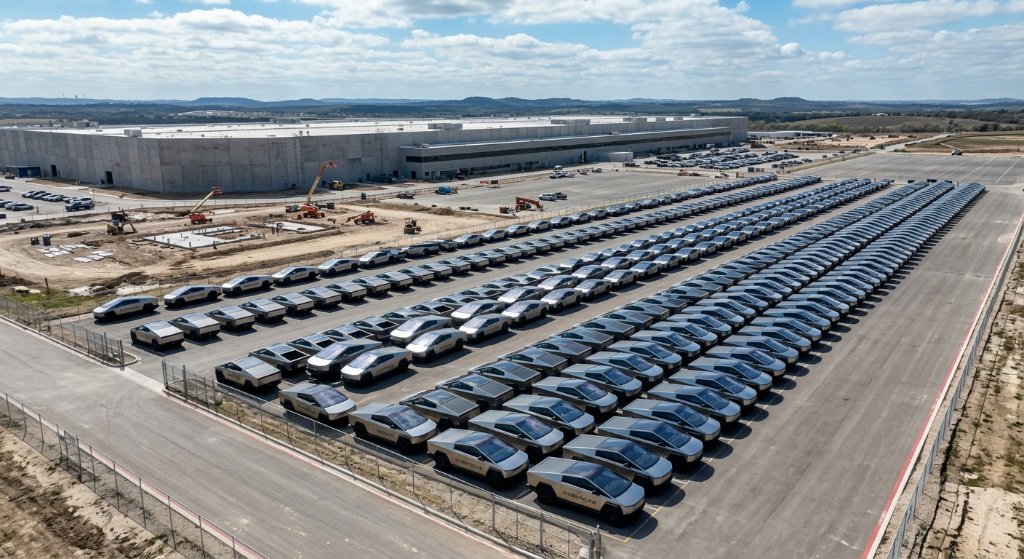
The regulatory nod coincided with explosive on-the-ground activity. Recent drone flyovers of Gigafactory Texas on June 19 revealed hundreds of Cybercabs packing the outbound lot, with fresh 'Cybercab' decals emblazoned across their doors and rear hatches. Simultaneously, construction on a specialized southwest test track at the Austin facility is nearing completion. This specialized closed loop, complete with a dedicated Cybercab testing office, will allow Tesla to run final validation cycles on its unique platform before releasing it into the wild.
Unpacking the Specs: Tesla’s Most Efficient EV Ever
The EPA certification documents lift the veil on the Cybercab’s engineering secrets, revealing a vehicle optimized strictly for high-utilization fleet efficiency rather than typical driver dynamics. Key specifications include:
- Unorthodox Drivetrain: A single, front-mounted permanent magnet motor delivering 219 horsepower in a front-wheel-drive configuration—a rare layout for Tesla, designed to maximize interior space and packaging.
- Featherweight Architecture: A curb weight of just 3,113 pounds—making it roughly 700 pounds lighter than a base Model 3 and one of the lightest EVs on modern roads.
- Pint-Sized Battery, Massive Range: A compact 48 kWh lithium-ion battery pack operating at 326V. While the raw EPA laboratory test yielded a staggering 418 miles of range, real-world range with standard EPA adjustments is expected to settle around a highly usable 293 miles.
- Unprecedented Efficiency: At an energy consumption rate of just 165 Wh per mile, the Cybercab is certified as the most energy-efficient electric vehicle the EPA has ever processed.
- No Safety Nets: The vehicle is built from the ground up completely devoid of a steering wheel, accelerator, or brake pedals. It relies entirely on Tesla’s camera-based Full Self-Driving (FSD) vision suite.
Giga Texas Transforms Into Robotaxi Central
The sudden appearance of hundreds of Cybercabs in Giga Texas's outbound lot indicates that Tesla's production lines are already humming. Rather than hand-built prototypes, these are production-ready units preparing to enter Tesla's active testing and ride-hailing fleets. The new door decals serve as visual confirmation of their intended commercial fleet status.
Meanwhile, the rapid construction of the southwest test track at the facility provides Tesla with a crucial playground. Because the Cybercab has no physical controls for a safety driver to intervene, testing on public streets remains subject to stringent state-by-state autonomous permits. Having an active, high-speed closed track allows Tesla to stress-test its software updates, wireless charging systems, and passenger interfaces in real-time, drastically compressing the validation timeline.
Why This Matters:
Tesla’s transition of the Cybercab from design concept to an EPA-certified, mass-produced reality is a massive shot across the bow for the entire transportation sector.
- The Winners: Tesla and Autonomous Scalability. By certifying a vehicle that costs less than $30,000 to produce, features an incredibly efficient 48 kWh battery, and requires zero physical controls, Tesla has cracked the code of mass-market robotaxi economics. Unlike Alphabet's Waymo, which relies on heavily modified, sensor-stuffed Jaguar I-Pace SUVs rumored to cost over $100,000 each, Tesla can build and deploy three Cybercabs for the price of one competitor.
- The Losers: Legacy Ride-Hailing and Geofenced Competitors. Uber and Lyft should be on high alert. If Tesla successfully scales this fleet, it can offer per-mile ride-hailing rates that human-driven platforms simply cannot match. Meanwhile, legacy robotaxi operators like Waymo and Cruise, which rely on expensive LiDAR suites and highly localized HD mapping, will struggle to compete with Tesla’s global, pure-vision, map-independent FSD platform.
- The Do-or-Die Moment: This is the ultimate proof-of-concept for Tesla's trillion-dollar valuation. Wall Street has increasingly priced Tesla as an AI and robotics powerhouse rather than a simple automaker. Delivering a street-legal Cybercab justifies that premium, turning speculative future cash flows from autonomous rides into tangible, imminent revenue.
Looking Ahead
The EPA Certificate of Conformity clears the federal hurdles, but Tesla’s next mountain to climb is securing individual state-level driverless operation permits to launch a commercial public service. However, with physical fleets already accumulating at Gigafactory Texas, a dedicated testing infrastructure finalized, and the regulatory green light secured, Tesla is no longer just dreaming of an autonomous future—it is actively manufacturing it.