Tesla’s Cybercab Reality Check: Why a 6% Stock Slide and NHTSA Probe Have Wall Street Shaken
Tesla’s highly anticipated Cybercab commercial deployment in Austin, Texas, was supposed to be the definitive proof of the EV giant's pivot to an AI a...
Editorial Team
World Of EV
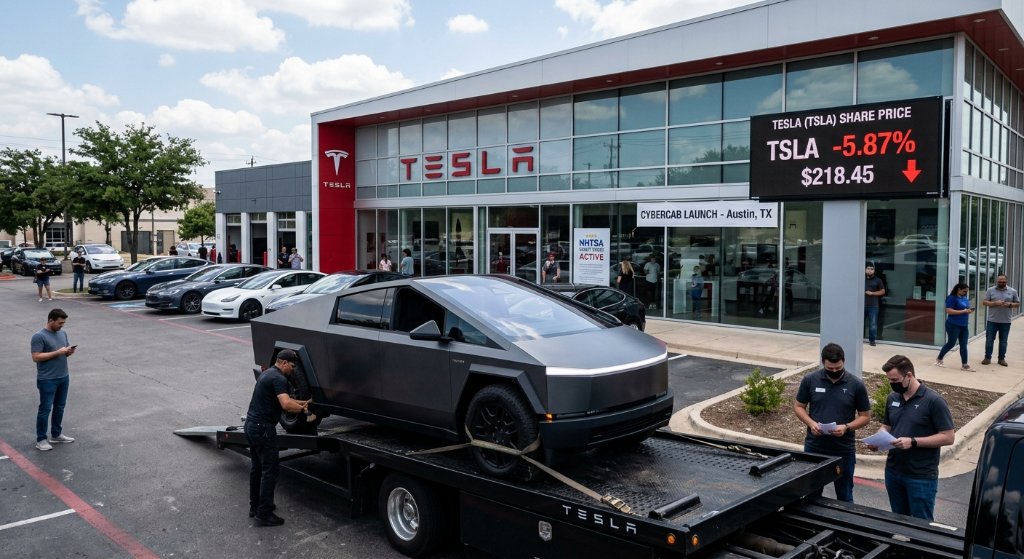
Tesla’s highly anticipated Cybercab commercial deployment in Austin, Texas, was supposed to be the definitive proof of the EV giant's pivot to an AI and autonomous-driving powerhouse. Instead, it delivered a stark reality check. Following the quiet launch, Tesla (TSLA) shares tumbled roughly 6%, wiping out previous gains and signaling that Wall Street’s patience with lofty, timeline-free promises is wearing paper-thin.
For years, Tesla has defended its premium, tech-company valuation by pointing to an autonomous future that would render human-driven cars obsolete. But as the Cybercab finally hit public streets, the vast gap between Elon Musk's grand vision and regulatory, operational reality became impossible to ignore. Compounded by cooling delivery metrics in core global EV markets, the underwhelming launch has left investors questioning the company's near-term growth narrative.
A Launch Light on Scale, Heavy on Questions
The commercial debut of the gold-colored, two-seat Cybercab in Austin lacked the typical fanfare of a massive global livestream, leaving retail investors to piece together details from scattered social media posts. When the dust settled, the actual metrics of the deployment were underwhelmingly small:
- Tiny Initial Fleet: Of the roughly 420 automated vehicles Tesla has registered in Texas, only 45 were actual steering-wheel-free Cybercabs.
- Vague Production Timelines: Beyond vague assertions that the vehicle would eventually scale, Tesla executives failed to provide concrete long-term manufacturing ramp targets or clear pricing structures for public riders.
- Geofenced Limitations: While the service began offering limited public rides, it remains restricted to a small section of Austin during off-peak hours, with full 24/7 operations not expected for "the next month or so".
By comparison, Alphabet's Waymo is already operating a mature commercial network, delivering over 500,000 autonomous rides a week across multiple major U.S. cities with a fleet of nearly 1,000 vehicles. Wall Street expected Tesla to showcase a strategy to leapfrog this competition; instead, they got a hyper-localized pilot program.
Feds on the Scene: NHTSA Launches Cybercab Audit
Adding severe downward pressure to the stock was the immediate intervention of federal regulators. Just hours after the first Cybercabs rolled out, the National Highway Traffic Safety Administration (NHTSA) opened a formal Audit Query (AQ26002) into approximately 1,000 of the vehicles.
Because the Cybercab is built without a steering wheel, accelerator, brake pedal, or side mirrors, it lacks the physical, human-centric controls standard under Federal Motor Vehicle Safety Standards (FMVSS). Tesla chose to "self-certify" that these vehicles meet federal safety requirements rather than wait for standard regulatory exemptions. NHTSA is now auditing the exact process and technical data Tesla relied on to make this claim.
Historically, this aggressive "self-certification" playbook has been a legal minefield. When Amazon-owned Zoox self-certified its own steering-wheel-less driverless shuttles, it triggered a grueling multi-year NHTSA investigation before the agency ultimately granted exemptions for testing. Tesla’s bid to bypass this tedious regulatory queue has immediately landed them in the same federal crosshairs.
Why This Matters:
This is a critical, high-stakes inflection point for Tesla. The company is attempting an incredibly difficult double-transition: keeping its cooling core EV business afloat while simultaneously convincing the market it is an AI and robotics utility.
- Who Wins: Alphabet's Waymo and established robotaxi operators. By taking a measured, regulator-approved approach with traditional vehicles adapted for autonomy, they have established deep trust with federal bodies and actual commercial scale. Tesla’s regulatory troubles only widen Waymo's first-mover advantage.
- Who Loses: Tesla's retail and institutional investors who expected a rapid, nationwide monetization of Full Self-Driving (FSD) and Cybercabs. Instead of explosive revenue, they face a prolonged, multi-year legal and regulatory battle with federal safety watchdogs.
- The Market Signal: Building a car without a steering wheel is a great marketing gimmick, but actually deploying it commercially is a regulatory minefield. Tesla's aggressive "build first, ask for permission later" playbook has met an immovable regulatory wall. For prospective EV and AV buyers, this signal suggests that the day you can buy a fully autonomous, driverless vehicle to park in your own garage is still years away.
The Road Ahead
Tesla’s Cybercab launch was meant to silence the skeptics and prove that the future of transport had arrived. Instead, by delivering a tiny fleet, dodging concrete production metrics, and immediately drawing a federal audit, Tesla has raised more questions than it answered. If Tesla cannot quickly satisfy NHTSA's safety queries and outline a viable path to mass production, its premium tech valuation may continue to erode, forcing the company to rely on a cooling consumer EV market it has lately neglected.